


To scrape Amazon reviews and ratings for sentiment analysis, use a review-focused workflow: enter an ASIN, run the Amazon Reviews Scraper (US) template, then export review text, star rating, title, date, and verification fields for analysis. If you are an eligible seller or vendor and only need first-party topics and trends, use Amazon’s Customer Feedback API instead. Choose Octoparse Desktop only when you need custom fields or page logic.
For products you do not sell, the template is usually the practical route because Amazon’s official API is not a general full-text feed for arbitrary ASINs. Our September 20, 2026 test found 392 ratings but only 13 visible reviews before “See more reviews” led to sign-in, so the guide records both visible-page limits and the rows returned by the scraper.
https://www.octoparse.com/template/amazon-reviews-scraper-for-amazon-us
One fact worth knowing before you start: Amazon caps every review page at 100 reviews per search query, even when a listing has thousands of ratings, according to the Amazon Reviews Scraper (US) template documentation, updated September 17, 2026 (shown below). In our own testing on a mainstream Amazon listing with 392 ratings, done on September 20, 2026, the product page itself showed just 13 reviews, 8 from the US plus 5 from other marketplaces, before “See more reviews” redirected straight to Amazon’s sign-in page. Both limits are why a purpose-built scraper, not a browser extension or manual copy-paste, is the practical way to get review text at scale.
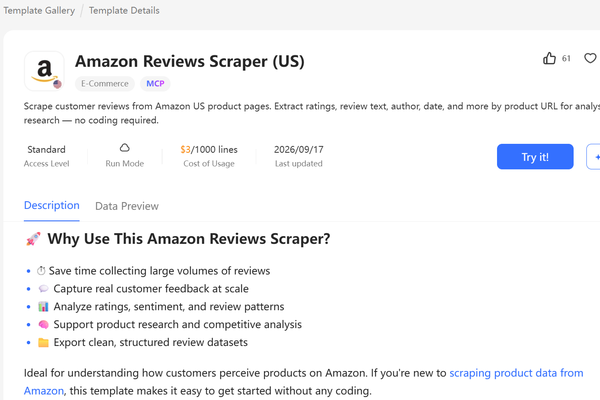
For sentiment analysis specifically, this Amazon Reviews Scraper (US) is the closest match on Octoparse: it extracts 17 structured fields per review, rating, review text, reviewer name, date, verified-purchase status, helpful-vote count, and country, by ASIN, and it’s MCP-enabled if you’d rather call it from an AI agent than click through the UI.
Why Scraping Amazon Reviews Is Essential for Modern Businesses
Sentiment analysis uses natural language processing, text analysis, and computational linguistics to identify the emotional tone of written content. In e-commerce, it is widely applied to customer feedback (such as reviews, ratings, and surveys) for purposes ranging from marketing and customer support to product development.
As one of the biggest players in the e-commerce industry, Amazon is a gold mine for sentiment analysis.
Related Reading: 10 Useful Tips for Amazon Marketing
Instant Access to Rich Source of Consumer Intelligence
The volume of product reviews on Amazon is immense, and shoppers actually rely on it: per PowerReviews’ June 2025 survey of over 21,000 consumers, 95% said they regularly read product reviews before buying, and only 43% would purchase a listing with zero ratings or reviews at all. Each review contains structured data points including:
- Rating scores (1-5 stars) for immediate sentiment classification
- Review text with detailed customer experiences
- Verified purchase indicators for authenticity validation
- Helpful votes showing community agreement levels
- Date stamps for temporal analysis trends
Skip Complex Data Labeling with Ready-Made Sentiment Labels
Amazon’s 5-star system gives you instant sentiment labels:
- 4-5 stars = Positive sentiment
- 3 stars = Neutral sentiment
- 1-2 stars = Negative sentiment
This pre-labeled data eliminates the need for complex natural language processing setup.
The actionable insights from Amazon review scraping include identifying product weaknesses, understanding competitor advantages, spotting emerging trends, and discovering unmet customer needs that could drive product innovation.
Scrape Amazon Product Reviews Without Coding
As mentioned above, there are innumerable products along with countless reviews on Amazon. Collecting such data by hand is impractical. Web scraping, to some extent, is born to solve this problem. By selecting certain elements on the web and then parsing the information, you are able to get the data.
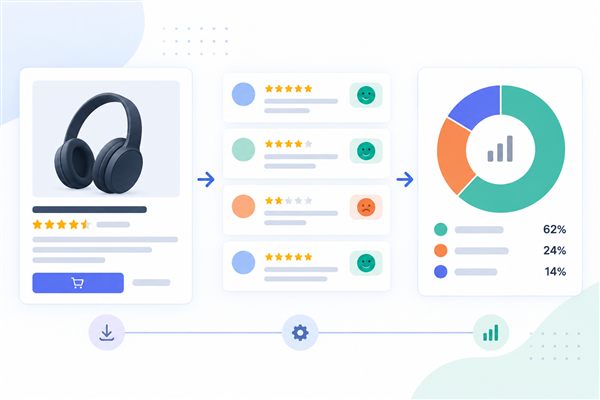
Review text, ratings, and dates can be collected as structured rows for analysis.
Octoparse is a web data platform that turns Amazon pages into clean, structured data, no code required. For reviews specifically, you can run a ready-made template from its Templates Gallery (like the ones further down this page) or build a custom scraper in Octoparse Desktop to pull review text, pricing, stocks, and descriptions into Excel, no coding required. It also supports various data extraction modes (headless browse mode included), scheduled Cloud runs, IP rotation, and CAPTCHA solving to keep collection running.
That approach holds up elsewhere on Amazon too: a Chilean Amazon reseller runs 20 Octoparse crawlers to pull 200,000+ fresh price points daily without tripping Amazon’s CAPTCHA, the same anti-blocking layer this review template relies on.
To show this isn’t hypothetical, we ran Octoparse’s Amazon Reviews Scraper (US) template against the same earbuds listing referenced earlier in this guide, for real, on September 20, 2026 (task 8a61ad02, lot 639254886562653931). It returned 40 rows in a single cloud run, no manual page-clicking, each one already structured with reviewer name, star rating, review text, verified-purchase flag, and date. Three, quoted verbatim:
- Michael Alfredo, September 15, 2026, Verified Purchase, 5 stars: “I like these earbuds. They connected quickly to my phone and the sound is clear. They’re comfortable, don’t feel heavy, and the charging case is convenient for storing and charging them.”
- Katherine Parraga, September 13, 2026, Verified Purchase, 5 stars: “I really liked these headphones. They have a beautiful and modern design, are comfortable to use and easily connect to the phone. The sound is quite clear and they have good volume.”
- Seyer-Odnavo U.S.A., September 17, 2026, Verified Purchase, 5 stars: “I can’t believe this jewel cost 19.99 dollars and easily rivals the Apple brand if not are even better, they are very light and charge super fast and the sound it’s amazing.”
None of that required opening a single product page by hand: the template took the ASIN, ran on Octoparse’s Cloud, and handed back clean rows ready for the sentiment workflow covered later in this guide.
Turn Amazon reviews data into Excel, CSV, Google Sheets, or any other formats.
Scrape data easily with auto-detecting functions, no coding skills are required.
Preset scraping templates for hot websites to get data in clicks.
Never get blocked with IP proxies and advanced API.
Cloud service to schedule data scraping at any time you want.
Step-by-Step: How to Scrape Amazon Reviews with Octoparse
Step 1. Enter Amazon Page URL to Create a Task
Copy the URL of a product detail page, and paste it to the search bar on Octoparse. Then click “Start” to create a new scraping task. Wait until Octoparse’s built-in browser finishes loading the page before moving on.
Step 2. Auto-detecting and Customize Data Field
Click “Auto-detect web page data” in the Tips panel. Octoparse will scan the entire page and highlight all extractable review elements including:
- Reviewer names and profiles
- Star ratings and review titles
- Full review text and descriptions
- Review dates and verification status
- Helpful vote counts and reviewer rankings
You can check if the data is to your needs or not. You can also preview all data fields in the Data Preview panel and remove any unwanted fields.
Step 3. Export Scraped Amazon Product Reviews
Now we will begin to extract the overall reviews of your Amazon product. Just click on the “Run” button after you have previewed all data fields. You can download the scraped review data in Excel or any other format.
Octoparse also has preset scraping templates for Amazon product reviews. You can search Amazon to find the templates and preview the data samples. If you still have any questions about the above steps, you can move to Octoparse Amazon Review Scraping Guide for more details.
Ready-to-Use Amazon Review Scraper Templates
What’s more, Octoparse also provides data scraping templates for Amazon and other popular sites. With these preset templates, you can extract data by entering a few keywords only, and without downloading any software. Try the Amazon review scraper below according to your needs after you have previewed the data sample.
If you want to extract review content, ratings, dates, etc from Amazon by product URLs, you can try this Amazon Reviews Scraper (Lite):
https://www.octoparse.com/template/amazon-reviews-scraper
If you want to scrape Amazon product titles, prices, inventories, images, and more by ASINs, you can try the Amazon Product Scraper below:
If you want to scrape Amazon product review content, ratings, dates, reviewers, etc., by ASIN, you can try Amazon Reviews Scraper below:
Does Amazon Have an Official Reviews API?
Sort of, but it’s not what most people searching for an “Amazon reviews API” actually need. Amazon’s Customer Feedback API, part of the Selling Partner API (SP-API), returns review topics, mention counts, star-rating impact, and month-over-month trends, along with review snippets at the ASIN level. But it’s restricted to sellers and vendors with a Brand Analytics or Selling Partner Insights role, covers only seven marketplaces (US, UK, France, Italy, Germany, Spain, and Japan), refreshes weekly, and only works on your own listings, not a competitor’s ASIN.
Some older guides point people to the Product Advertising API instead. That option is gone: PA-API 5.0 has been deprecated and now returns a 403 Forbidden error, with Amazon steering affiliate and publisher use cases toward a new Creators API built around catalog data, not customer reviews (more on the exact deprecation notice in the FAQ below).
Bottom line: there’s no Amazon-sanctioned way to pull full review text for an arbitrary product as a general developer. That gap is exactly what third-party “Amazon Reviews API” products (from vendors like Apify, ScraperAPI, or Bright Data) fill, they’re scraping services packaged behind an API endpoint, not a feed Amazon itself provides. If you need review text and ratings for products you do not sell, a properly authorized scraper such as the templates above is a practical route, subject to the target site’s access controls and terms.
| Method | What it returns | Best for | Key limitation |
|---|---|---|---|
| Amazon Reviews Scraper (US) | Review text, ratings, dates, and ASIN-level fields | Public review text and sentiment datasets | Page access and marketplace visibility can vary |
| Amazon Customer Feedback API | Topics, mention counts, rating impact, trends, and snippets | Eligible sellers or vendors analyzing their own listings | Weekly refresh; seven stores; no full arbitrary-product review text |
| Octoparse Desktop custom task | Custom fields and navigation logic | Non-standard pages and controlled workflows | Requires setup and maintenance |
| Third-party Amazon Reviews API | API-formatted review responses | Developer pipelines with vendor coverage | Coverage, authorization, and vendor terms vary |
How to choose: start with the prepared template for review text, use Amazon’s official API only when your seller or vendor role qualifies, and move to a custom task when the page or fields need special handling.
Template vs Customer Feedback API vs Third-Party Reviews API
Use this short matrix to choose the right data-access route.
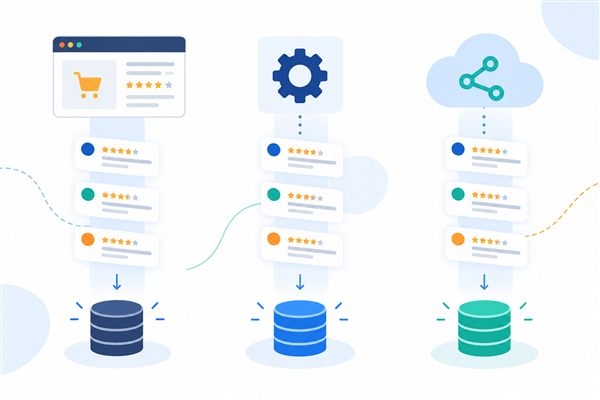
Choose between a prepared template, Amazon’s first-party insights API, or a provider-managed API endpoint.
| Metric | Octoparse template | Customer Feedback API | Third-party Reviews API |
|---|---|---|---|
| Data scope | Review text, rating, date, ASIN | Topics, trends, snippets | Provider-defined review fields |
| Competitor ASINs | Possible if page is accessible | Not a general feed | Provider-dependent |
| Refresh | On demand or scheduled | Weekly | On demand or cached |
| Full review text | Yes, when rendered | No; snippets only | Often, but verify coverage |
| Best for | No-code exports | Eligible sellers/vendors | Developer pipelines |
| Access limits | Login, CAPTCHA, marketplace rules | SP-API roles and stores | API key, cost, quota, terms |
| Check first | Test one ASIN | Confirm role and region | Test schema and row count |
Source note: Amazon’s Customer Feedback API documentation specifies weekly refreshes, seven stores, and seller/vendor access. Third-party coverage and limits vary by provider.
Amazon Review Policy and Industry Updates
What changed recently: As of September 20, 2026, the latest public policy signals point in the same direction: review data is becoming more useful for analysis, but provenance and compliance matter more. Amazon’s 2025 Trustworthy Shopping Experience Report says Amazon blocked hundreds of millions of suspected fake reviews in 2025 and uses AI, behavioral signals, and human investigation before reviews are shown. That means sentiment datasets should preserve the ASIN, source URL, collection date, marketplace, and any visible verification label instead of treating every row as equally reliable.
The compliance baseline is also clearer. Amazon’s customer-review policy guidance prohibits misleading or incentivized reviews, while the FTC Consumer Reviews and Testimonials Rule addresses fake reviews, sentiment-conditioned incentives, undisclosed insider reviews, and review suppression. For analysis, collect only data you are authorized to access, do not manufacture or alter review sentiment, and keep the raw text separate from your model’s label. This is practical compliance guidance, not legal advice.
Sentiment Analysis for Amazon Product Reviews
Now that you’ve got the data, what can you do with it? You could read through every review yourself, but that doesn’t scale past a handful of products. That’s why sentiment analysis, scoring each review as positive, neutral, or negative, matters once you’re working with hundreds or thousands of rows.
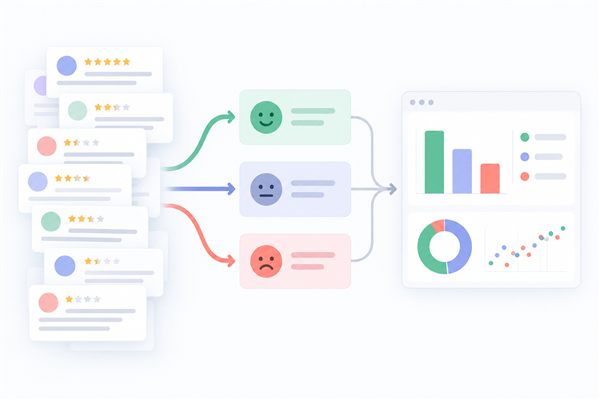
Structured review rows can be grouped into positive, neutral, and negative signals before modeling.
Star ratings look like a shortcut, but they’re not always consistent with what the review text actually says, which is why the text itself, not just the average rating, is worth scraping and scoring.
Here’s a real example, run on September 20, 2026. On the same wireless-earbuds listing referenced earlier in this guide (392 ratings), Amazon’s own rating breakdown looked like this:
| Star Rating | Share of 392 Ratings | Rough Sentiment |
|---|---|---|
| 5 stars | 87% | Positive |
| 4 stars | 7% | Positive |
| 3 stars | 2% | Neutral |
| 2 stars | 0% | Negative |
| 1 star | 4% | Negative |
That distribution is a rough sentiment histogram before you’ve read a single review, roughly 94% positive-leaning, 2% neutral, 4% negative. But the star rating alone can hide real signal. One of the 4-star reviews on that same listing read:
“For $20 I can’t really complain much. They look expensive, but the plastic is cheap and lightweight. It could crack if dropped, it’s definitely not the highest quality material I ever owned. But for $20 they work and are convenient.”
4-star Verified Purchase review, September 7, 2026
Scored on stars alone, that review counts as positive. Run through a text-based sentiment model, the durability complaint (“the plastic is cheap,” “it could crack if dropped”) would likely pull the sentiment score down toward neutral, a real mismatch a star-only analysis would miss entirely.
To replicate this on your own product: export review text, star rating, and date with a review-focused template like the ones on this page, then run the text through a sentiment classifier, an open-source option like VADER or NLTK, or a hosted NLP API, and cross-tabulate the output against the star rating. Reviews where the two disagree, a high star rating with a complaint buried in the text, or a low star rating that’s mostly praise with one dealbreaker, are usually the most useful ones to read manually.
Is It Legal to Scrape Amazon?
Scraping publicly accessible Amazon data like reviews, prices, and product listings is typically legal when you’re accessing information that’s freely available to any visitor. The key distinction lies in what and how you scrape.
Where you can run into legal trouble: accessing data behind login requirements, scraping personal customer information, or violating Amazon’s Terms of Service can result in legal consequences including lawsuits or permanent account suspension.
Amazon’s ToS clearly states that automated data collection is prohibited, and they actively use technical countermeasures like IP blocking to enforce this policy.
Best Practices for Compliant Amazon Review Scraping:
- Use reasonable request intervals (1-2 seconds between requests)
- Respect robots.txt directives where applicable
- Don’t overload Amazon’s servers with simultaneous requests
- Focus on data analysis rather than republishing content
The clearest precedent here is hiQ Labs v. LinkedIn, where the Ninth Circuit ruled in September 2019 that scraping publicly accessible profile data does not violate the Computer Fraud and Abuse Act. The case didn’t end there: LinkedIn and hiQ ultimately settled in December 2022, with a $500,000 judgment against hiQ on separate state-law claims (breach of contract and trespass to chattels) tied to LinkedIn’s user agreement. The lesson carries over to Amazon directly: clearing the CFAA bar for scraping public pages doesn’t clear a site’s own Terms of Service, which is a separate, contract-based risk.
Final Thoughts
Amazon product reviews are one of the richest data sources for sentiment analysis, and with tools like Octoparse, collecting them at scale no longer requires coding skills or building a scraper from scratch. Use the templates above, or build a custom one in Octoparse Desktop, to get review text, ratings, and dates flowing into your own analysis pipeline.
FAQs about Amazon Review Scraper
How Many Pages Can You Scrape at Once on Amazon?
The limit depends on the template and task settings. The Amazon Reviews Scraper (US) template handles pagination for supported review pages, but Amazon can require sign-in or show different marketplace views. Test one ASIN first, then scale only after checking the returned rows and fields.
What All Can You Scrape From Amazon?
Beyond reviews, you can scrape fields with the Amazon Product Details Scraper and review-specific fields with the Amazon Reviews Scraper (Lite), including:
- Product prices, descriptions, and images
- Seller information and ratings
- Best seller rankings
- Review text, ratings, and verification status
- Reviewer profiles and helpful votes
How Do You Avoid Getting Blocked While Scraping Amazon?
Use these strategies:
- Rotate IP addresses with residential proxies
- Add random delays (1-3 seconds) between requests
- Randomize browser headers and User-Agent strings
- Use professional tools like Octoparse that handle anti-bot measures automatically
Which Tools Work Best for Scraping All Reviews Without Coding?
Top picks:
- Octoparse – Best overall with Amazon templates and cloud scraping
- ParseHub – Good visual interface
- WebHarvy – Simple for basic extraction
- Chat4Data – AI-powered solution
Choose based on template availability, anti-bot features, and export options.
Does Amazon Prohibit Scraping?
Amazon’s Conditions of Use and the target page’s access controls still matter. Public visibility does not remove contractual, privacy, or jurisdiction-specific obligations, so review the terms and collect only what you are authorized to use.
Can Amazon Detect Fake Reviews?
Amazon says it uses automated systems and human investigation to protect review integrity. For context, see its Community Guidelines for Customer Reviews. Signals commonly discussed include:
- Reviewer behavior patterns
- Purchase verification checks
- Language pattern analysis
- Review timing clusters
When scraping, look for red flags like generic positive language, unverified purchases, and similar phrasing across products.
Is There an Official Amazon Reviews API?
Only a limited one. Amazon’s Customer Feedback API gives eligible sellers and vendors review topic summaries and rating trends for their own ASINs, not full review text for any product. The API some older guides mention, PA-API 5.0, is no longer an option: Amazon’s own documentation confirms it has been deprecated in favor of a new Creators API built for catalog data, not reviews. For review text on products you do not own, a properly authorized review scraper is a practical route, since no Amazon API provides that full arbitrary-product text to general developers.