

Goodreads stopped issuing new API keys on December 8, 2020. If you need Goodreads’ own book pages, ratings, or reviews, use a permitted page-level workflow; if you only need general book metadata, consider a documented alternative such as Hardcover’s GraphQL API.
There are three real routes around that. If you specifically need Goodreads’ own ratings, reviews, and book pages, a scraper is the only way in now, either Apify’s Goodreads Scraper, which pulled 45 books and 33,656 reviews in one mystery-genre run, or Octoparse’s own free Goodreads templates (below), which need no code and no scraping knowledge. If you just need book metadata and don’t care whether it’s Goodreads-sourced, developer Emma Goto recommends Hardcover’s free GraphQL API as a well-documented alternative, built on Hardcover’s own catalog rather than Goodreads’ data.
This guide focuses on the first route: getting Goodreads’ actual book reviews and ratings, plus book list data, without code, using Octoparse, including a real template test run further down.
What You Can Scrape from Goodreads
Goodreads shows the very details of every single book on its page. Along with fundamental information like the book’s title, subtitle, genres, author, and language, it also offers more specific details like the book’s first publication information, literary awards it has won, its format, and its ISBN. We can also check the rating, number of ratings, reviews, and number of reviews on the book page. All of these types of data are available for data extraction on Goodreads.
Besides collecting data on a specific book, you can also scrape a variety of book lists from the new updates, on a certain category, and even the best books of the year. These rankings also reflect information about book qualities, the global reading trend, and reader interests.
How You Can Benefit from Goodreads Data
If you only use Goodreads as a reader, the most obvious advantage must be you’re more likely to find the right books with Goodreads. But when we talk about data, we need to think about it on a larger scale. Goodreads’ own site puts a real number on how much reader activity is in play: its recommendation engine analyzes 20 billion data points to generate suggestions, which is exactly why the API shutdown left so many publishers, marketers, and researchers looking for another way to tap into that data themselves.
Understand the Market
Data from Goodreads is a valuable resource for studying the entire market. You can quickly determine which genre is the most popular and which theme is well accepted among readers using information like ratings, reviews, the number of people who wish to read, etc. It’ll help you in various aspects. For example, if you’re an editor, you’ll get an idea about what kind of books are more potential; if you’re a writer, it’ll tell you how to create a popular work to some extent. This isn’t just a marketing exercise, either: UC San Diego researcher Mengting Wan built a public research dataset from more than 15 million Goodreads reviews covering about 2 million books, scraped from public shelves and cited in peer-reviewed papers at RecSys and ACL.
Develop an Insight into the Audience
Goodreads members are passionate about books and reading. They’re the bullseye customers of content. Their behaviors on Goodreads are worthy to be observed, and will let you build a truthful and extensive comprehension of what they prefer to read, how they evaluate a book, and their reading habits and attitudes. You can use it for optimizing marketing strategy and targeting the right customers, especially when you’re a book publicist.
Find the Next Best-selling
Only a small share of the 4,172,222 ISBN-registered titles Bowker counted in the US for 2025 become best sellers. Goodreads has a page to present monthly new releases. This page lists the books that Goodreads members most regularly add to their shelves, along with the average rating and the total number of ratings for each new title. Collecting data from such pages, you can use it to understand what’s trending and what type of books are more likely to be the next hit. Even for the entertainment industry, when some companies seek novels to adapt as movies, Goodreads data is essential for reference.
4 Steps to Scrape Goodreads Data
This section will lead you through using Octoparse to scrape ratings and reviews from Goodreads. Octoparse is a web data platform that turns Goodreads pages into clean, structured data, no code required. Whether you have expertise in coding or not, ready-made templates or point-and-click authoring in Octoparse Desktop will get you extracting data from Goodreads.
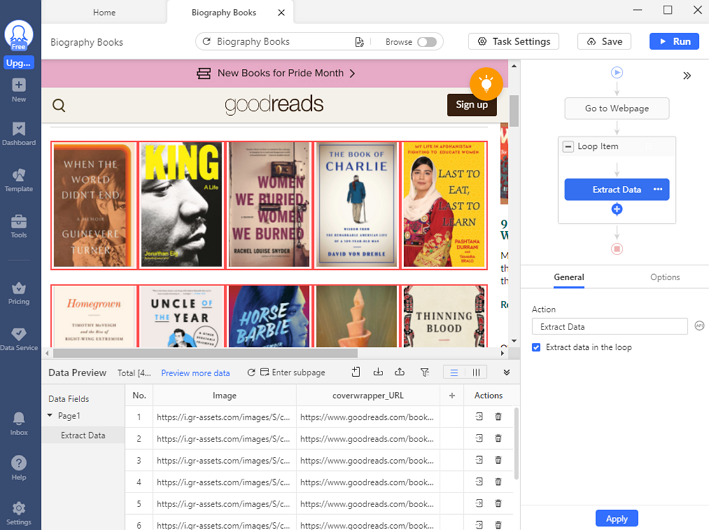
Step 1: Create a Goodreads scraper
Take any Goodreads book page as an example: copy the target URL and paste it into the search bar on Octoparse. Create a task by clicking “Start” after that. The target page will be loaded in Octoparse’s built-in browser in seconds. Please wait until it finishes loading before going forward.
Step 2: Select the wanted data
Click “Auto-detect webpage data” in the Tips panel. It’ll let Octoparse scan the page to “guess” what data you want. Then Octoparse will highlight extractable data on the page so you can confirm it is what you’re looking for. So far, Octoparse has selected reviewers, reviewers’ homepages, review dates, review content, etc., automatically.
However, the detected data fields might be unwanted sometimes. You can also delete these undesirable fields on the bottom and rename data fields there to make the data a structured and clean format.
Step 3: Create and modify the workflow
Once you’ve selected all the data fields you need, click “Create workflow” to build a scraper. Then a workflow will show up on the right-hand side. You can grasp how this scraper operates by reading it from top to bottom and inside to outside (for nested actions only). You can also click on each step to see a preview of it in the built-in browser to see if it works as intended.
Step 4: Run the task and export data
Once you’ve double checked that all the data fields you wanted were selected and the workflow worked as expected, click “Run”. Then a box will show up and provide two options for running your task. You can run it on your local device or hand it over to Octoparse’s cloud servers, which is worth it once a book has thousands of reviews rather than a couple dozen.
After you pick an option, Octoparse will take care of the rest for you. Once the scraping process is done, you can download Goodreads data as an Excel, CSV, or JSON file, or export it straight to a database like Google Sheets.
Bonus: You can also use Octoparse to scrape movie reviews from IMDb or other similar sites (more on that below).
Ready-to-Use Goodreads Templates (Tested With 18 Real Rows)
Octoparse maintains two free Goodreads templates in its Templates Gallery, so you don’t have to build a workflow from scratch. To show they actually work, and that the MCP claim below isn’t just a spec sheet, we called Octoparse’s MCP server directly (the same interface an AI agent uses) to search for the template and run it on September 21, 2026 (task a7baa49d, lot 639255764500097064), searching the keyword “mystery.” It returned 18 rows in a single run, no manual clicking through search pages and no human touching the Octoparse UI. Three, quoted verbatim:
- “The Tainted Cup (Ana and Din Mysteries, #1)” by Robert Jackson Bennett, 4.29 stars, 111,185 ratings, published 2024
- “The Mystery Guest (Molly the Maid, #2)” by Nita Prose, 3.79 stars, 170,593 ratings, published 2023
- “The Mystery of the Blue Train (Hercule Poirot, #6)” by Agatha Christie, 3.88 stars, 89,483 ratings, published 1928
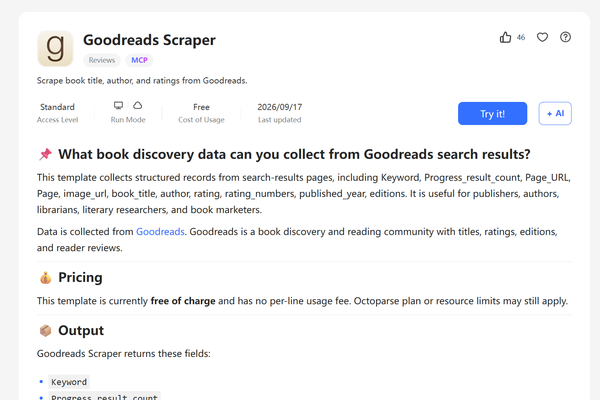
If you want book titles, authors, and ratings by keyword or genre, use Goodreads Scraper below. Both templates are free, MCP-enabled (so an AI agent can call them directly instead of a human clicking through the UI), and were last updated September 17, 2026.
https://www.octoparse.com/template/goodreads-scraper
If you want reviewer names, ratings, dates, and full review text instead, use Goodreads Comments Scraper below.
https://www.octoparse.com/template/goodreads-comments-scraper
Is It Legal to Scrape Goodreads?
Scraping publicly visible Goodreads pages, book details, ratings, and reviews anyone can read without logging in, sits on solid legal ground in the US. The clearest precedent is hiQ Labs v. LinkedIn, where the Ninth Circuit ruled in September 2019 that scraping publicly accessible pages does not violate the Computer Fraud and Abuse Act. That case still ended in a loss for the scraper on separate contract grounds, so respect Goodreads’ own Terms of Service, scrape at a reasonable rate, and stick to data that’s public without an account.
This isn’t a hypothetical worry: a thread titled “Is it legal to scrape goodreads?” has run in Goodreads’ own Librarians Group forum for years, which is exactly why staying within public-page, no-login scraping matters more than the CFAA question alone.
For a repeatable no-code workflow across book and media pages, start with the Octoparse Templates Gallery and validate one permitted input before scaling.
FAQs About Scraping Goodreads
- Does Goodreads still have a public API in 2026?
No. Goodreads stopped issuing new developer keys on December 8, 2020, and has been winding the program down for existing keys since. There’s no indication it’s coming back, so scraping or a third-party alternative is the practical route for new projects.
- What are the best Goodreads API alternatives?
If you need Goodreads’ own data specifically, use a scraper: Octoparse’s free templates above need no code, while Apify’s Goodreads Scraper is a code-friendly option for developers. If you just need general book metadata and don’t need it to come from Goodreads, Hardcover’s free GraphQL API is a documented, actively supported alternative.
- Can I scrape book reviews and star ratings, not just book details?
Yes. Octoparse’s Goodreads Comments Scraper template is built specifically for that: it returns reviewer name, rating, review date, review content, and like count per review, in addition to the book title and author.
- Is it legal to scrape Goodreads?
Scraping public pages is generally treated as legal under US law, per the CFAA precedent set in hiQ Labs v. LinkedIn (see above). Stay on the safe side by only collecting data visible without logging in, respecting reasonable request rates, and reviewing Goodreads’ Terms of Service before large-scale or commercial use.
- Can an AI agent pull Goodreads data directly?
Yes. Both Goodreads templates covered in this guide are MCP-enabled, so an AI agent (Claude Desktop, for example) can search for them and run them through Octoparse’s MCP server without a human clicking through the UI, in fact, the 18-row test above was run exactly this way, an AI agent calling the MCP server, not a person clicking through the UI.
- What’s the best web scraper for extracting data from Goodreads?
It depends on whether you’d rather click or code. For no-code use, Octoparse’s free Goodreads Scraper and Goodreads Comments Scraper templates (tested above) cover book details and reviews without writing a line of code. For a code-first workflow, Apify’s Goodreads Scraper actor is built for developers who want to script the extraction themselves.
Wrap-up
Goodreads’ own API is gone, but the data isn’t out of reach. Octoparse’s free Templates Gallery entries get you book lists, ratings, and full reviews without code, whether you need a one-off export for a research project or a scheduled Cloud run that keeps a dataset fresh. The same approach works for other book and media sites, including IMDb and Amazon’s own Kindle store.