
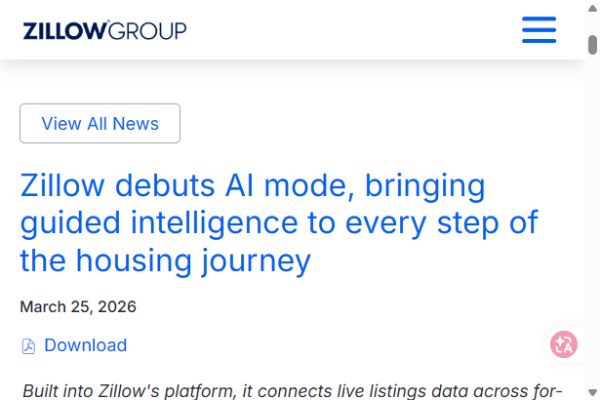
Zillow’s API story is no longer a simple yes-or-no answer. Zillow Group’s current developer portal lists close to 20 APIs and datasets across MLS listings, mortgages, public records, rentals, transactions, and Zestimates. However, the MLS Listings API is currently invite-only, and each MLS partner controls access. Zillow also launched Zillow AI Mode on March 25, 2026, using live for-sale and rental listings in a limited beta. The company is expanding data-powered products, but it still does not offer an open, self-serve property-search API.
Our own test provides a concrete benchmark: on September 10, 2026, the Octoparse Zillow Listing Scraper exported 574 listings for one metro, with zpid and house_url present on every row. The comparison below separates official Zillow routes from third-party APIs, no-code templates, Python, and MCP.
Open the tested template: https://www.octoparse.com/template/zillow-scraper-by-keywords
If you need repeatable price and status changes rather than one-time rows, see Zillow Listing Monitor Sending Duplicate or Missed Price-Drop Alerts? Causes and Fixes.
Quick Answer
- No open property-search API. The ZWSID developer program was retired on September 30, 2021 and never replaced with a self-serve equivalent.
- Official listing-data route: Bridge Interactive. Zillow Group’s MLS Listings API is currently invite-only, and each MLS partner decides access.
- Third-party Zillow APIs resell scraped Zillow data as JSON. Some have a free tier; paid plans run from per-call cents to a few hundred dollars a month. The provider table is in Method 3.
- No-code scraping. The Octoparse Zillow Listing Scraper template takes a city plus “buy” or “rent” and runs on Octoparse Cloud past Zillow’s bot check. In our test it returned 574 rows for one metro.
Does Zillow have an API?
Zillow has APIs, but not an open, self-serve property-search API. Zillow’s old developer program, the Zillow Web Services ID (ZWSID), gave developers a key for Zestimates, property details, and listing data.
The MLS Listings API uses Bridge technology and returns normalized data through REST and JSON. The platform is currently invite-only, and data access is at the discretion of individual MLS partners in the United States and Canada.
For everyone else there are two practical routes, covered below: a third-party Zillow API that scrapes Zillow for you and returns JSON, or your own scraper, no-code or Python. Both collect publicly displayed data and neither is an official Zillow feed. If you are new to the topic, start with what web scraping is and how it works. For a step-by-step no-code walkthrough, see our Zillow scraper guide.
What data can you extract from Zillow?
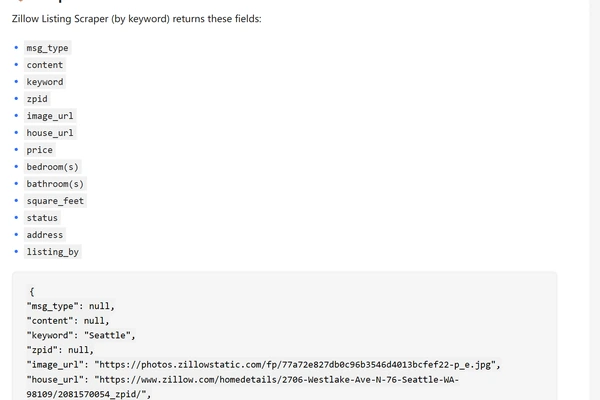
A Zillow listing scraper pulls the fields shown on a search results card and the top of each listing page. The Octoparse template returns the columns below.
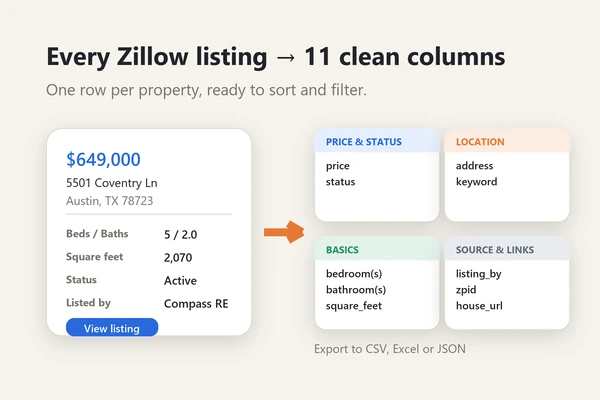
| Field group | Columns |
|---|---|
| Price and status | price, status (Active, Pending, House for sale, and so on) |
| Location | address, keyword (the search location you entered) |
| Property basics | bedroom(s), bathroom(s), square_feet |
| Listing source | listing_by (the brokerage or agent), zpid (Zillow’s property ID) |
| Links | house_url (the listing page), image_url (the primary photo) |
For deeper per-property detail, a separate Zillow Details Scraper template returns 59 fields, including lot size, year built, garage capacity, price per square foot, and the originating MLS.
3 ways to get Zillow data, compared
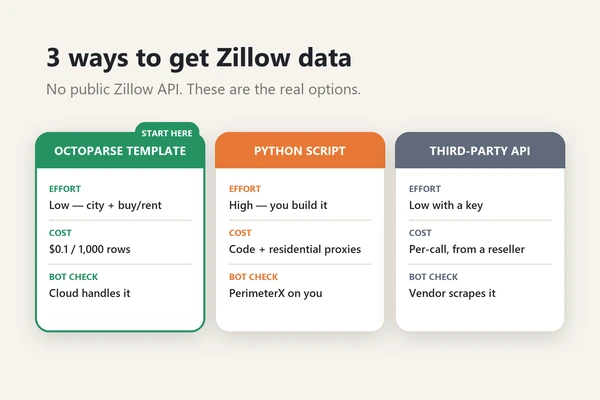
| Method | Best for | Setup effort | Cost | Blocks handled for you |
|---|---|---|---|---|
| Third-party Zillow API | Teams that want a REST call and will pay per request | Low once you have a key | Free tier to about $299/mo, or per-call | Yes, the vendor runs the scrapers |
| Octoparse Zillow template | Analysts, investors, and agents who want listing pulls without code | Low, a city plus buy or rent | $0.1 per 1,000 rows on a Standard plan | Yes, Octoparse Cloud runs past the bot check |
| Custom Python script | Engineers feeding Zillow data into an existing pipeline | High, you build and maintain the anti-bot layer | Free code plus residential proxy costs | No, PerimeterX and proxies are on you |
Is it legal to scrape Zillow?
Scraping publicly visible listings sits on firmer ground than scraping data behind a login or a license. Two US rulings drew that line:
- Van Buren v. United States (Supreme Court, June 2021, 6-3). The Court narrowed the Computer Fraud and Abuse Act: using access you already have for a purpose the site dislikes is not “exceeding authorized access.”
- hiQ Labs v. LinkedIn (Ninth Circuit). After the Supreme Court sent it back in light of Van Buren, the Ninth Circuit reaffirmed in April 2022 that scraping public profile data does not violate the CFAA. A separate 2022 ruling still found hiQ had breached LinkedIn’s user agreement, which is a contract question, not a criminal one.
Zillow adds two wrinkles. Its Terms of Use prohibit automated access, so heavy scraping can be a contract breach even when it is not a crime. And some fields on a listing come from an MLS feed with its own licensing rules, while agent contact details are personal data covered by GDPR and CCPA. Public listing facts like price, address, and bed count carry less risk than agent PII or MLS-licensed fields. Read Zillow’s current terms, collect only what you need, and see our overview of whether web crawling is legal. This is not legal advice.
Method 1: Get Zillow data with Octoparse (no code)
Octoparse is a web data platform, no code required. Its Templates Gallery holds 680+ ready-made scrapers built and maintained by the Octoparse team, and two of them target Zillow: one takes a location (“Austin, TX”) plus buy or rent, the other takes a filtered Zillow URL. Both run on Octoparse Cloud with in-house anti-blocking scraping browsers, so PerimeterX, IP rotation, and pagination are handled for you.
The scraper is a fixed rule set that replays the same way every run, with no model re-reading the page and no per-run token cost. When Zillow shifts its markup, Octoparse’s automatic selector self-repair keeps the template working instead of returning empty rows.
When you want listings for a city, not a URL
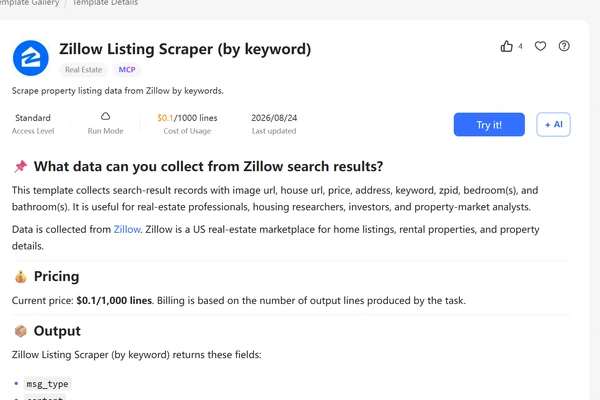
https://www.octoparse.com/template/zillow-scraper-by-keywords
The by-keyword template takes two inputs:
- Locations (required): one or more places, up to 1,000 per run, one per line, for example
Austin, TX. - Buy or rent (required):
buyorrent.
Then:
- Open the template and click Try it.
- Sign in.
- Enter your locations and choose buy or rent.
- Run it in the Octoparse cloud so the job uses the anti-blocking scraping browsers.
- When the run finishes, export the rows as CSV, JSON, or straight to Excel.
What the test run actually returned
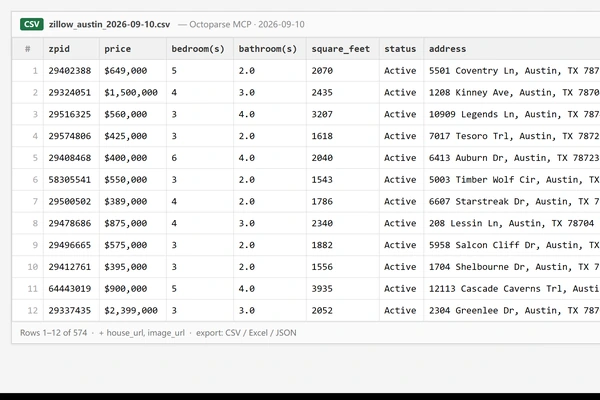
We ran the by-keyword template on 2026-09-10 through the Octoparse MCP server. Input: Locations Austin, TX, buy or rent buy. The cloud run returned 574 rows before we stopped it, each with the eleven fields above populated.
Three real rows from that batch:
| Address | Price | Beds / Baths | Sqft | Listed by |
|---|---|---|---|---|
| 5501 Coventry Ln, Austin, TX 78723 | $649,000 | 5 / 2.0 | 2,070 | Compass RE Texas, LLC |
| 1208 Kinney Ave, Austin, TX 78704 | $1,500,000 | 4 / 3.0 | 2,435 | eXp Realty, LLC |
| 10503 Foundation Rd, Austin, TX 78726 | $2,950,000 | 4 / 6.0 | 5,250 | Intege Realty LLC |
Prices in the batch ran from $275,000 to $9,900,000, and every row carried a zpid and a house_url back to the Zillow listing page.
When you want the pull inside Claude or ChatGPT
Octoparse’s Open Platform includes a live MCP server. That is how we ran the test above. An AI client such as Claude, ChatGPT, or Cursor can search the Templates Gallery, run a cloud template extraction, and pull the rows back into the conversation. The MCP server runs templates and tasks rather than authoring new ones, and its capability set expands release by release, so confirm specifics against the current docs.
What it costs
Both Zillow templates bill $0.1 per 1,000 rows and sit on a Standard plan (the screenshot above shows the live price). Octoparse has a free plan with no credit card for testing the workflow first; paid plans start from $69/mo Standard and $249/mo Professional, billed annually. Pricing is moving toward usage-based billing, so confirm the current figures before you commit.
Method 2: Get Zillow data with Python
A custom script makes sense when Zillow data feeds a pipeline you already run, or when you need parsing the templates do not offer.
Zillow is one of the harder consumer sites to scrape. Three things make it hard:
- PerimeterX (HUMAN Security). Zillow runs a bot check that reads browser fingerprint, mouse movement, and timing. The same script from the same residential IP can pass one day and get a “press and hold” challenge the next.
- Data hidden in JSON. Zillow is a Next.js app. Listing data lives in a
__NEXT_DATA__script tag and agdpClientCacheobject, not in readable HTML, so a plainrequestscall returns an empty shell even after it clears the bot layer. - An 820-result cap. A search returns at most about 20 pages of roughly 41 listings. Dense metros need a map-bounded tiling strategy, splitting the area into boxes and querying each one.
A working script needs a headless browser, rotating residential or mobile proxies (datacenter IPs are blocked in milliseconds), randomized timing, a CAPTCHA fallback, and code to parse __NEXT_DATA__. See our list of web scraping proxy providers. Budget for ongoing maintenance, not a one-time build.
Method 3: Third-party Zillow APIs
A third-party Zillow API is a REST service that scrapes Zillow for you and returns JSON: listings, Zestimates, comparables, and tax and price history. You get an API key, not a scraper to run. The figures below are current as of September 2026 and change often, so check each provider before you build.
| Provider type | Free tier | Paid entry | What it returns |
|---|---|---|---|
| Self-serve wrappers (Zillapi, APIllow, OpenWeb Ninja) | No card, roughly 50 to 100 requests a month | Pay-as-you-go near $0.003 per call | Listings, Zestimate, comps, price history, tax data |
| Property-data platforms (ATTOM, Estated) | Trial or limited free calls | Roughly $99 to $299 a month for small workloads | Broader property records beyond a listings scrape |
| RapidAPI marketplace listings | Varies by provider | Varies by provider | Zillow scrapers for quick testing, reliability varies |
Pick an API when you need Zestimates or history a listings scrape does not give you, you do not want to run scraping infrastructure, and your volume is low enough that per-call pricing beats a subscription. Run your own scraper when you need full control of the fields, higher volume without per-call fees, or a workflow the vendor does not support.
What to do with Zillow property data
\nFor rental pricing, see our repeatable method for finding rental comps from real Zillow data.
Once the export lands, the structured fields open up work that is slow to do by hand. For more patterns, see our guide to web scraping for real estate.
For a business workflow that sends collected Zillow rows to an AI assistant, see How to Build a No-Code Real Estate AI Business with Zillow Data.
- Comp analysis. Pull every active listing in a ZIP code, then filter by beds and square footage to build a comparable set before making or pricing an offer.
- Market monitoring. Scrape the same city weekly and track median price, inventory count, and days-to-status change over time.
- Investment screening. Filter a metro-wide pull for price-per-square-foot below a threshold, then pass the
house_urllist to a details scrape for lot size and year built. - Agent and brokerage intel. Group by the
listing_bycolumn to see which brokerages hold the most inventory in a market. - Lead lists for services. Recently listed or price-cut homes are a signal for movers, lenders, and home-service businesses.
FAQ
Does Zillow have an API?
Zillow no longer offers a general-purpose public developer API. The former ZWSID developer program was retired on September 30, 2021. For licensed real estate data, Zillow Group provides Bridge Interactive developer services, with access subject to the relevant data provider’s licensing and approval. Independent projects commonly use a third-party API or an authorized scraping workflow.
Is a Zillow scraper API the same as the Zillow API?
No. An official Zillow data route and a Zillow scraper API are different products. A scraper API is an independent service that collects publicly displayed pages and returns structured data through its own REST endpoint. For example, Zillapi describes itself as an independent third-party REST API and states that it is not affiliated with Zillow Group.
Is there a free Zillow API?
There is no free, general-purpose official Zillow API. Some independent providers offer limited test access; for example, Zillapi currently advertises 100 signup credits with no credit card. Free quotas and conditions can change, so verify the provider’s live page before building around them.
How much does a Zillow API cost?
There is no single Zillow API price. Bridge Interactive access depends on data licensing and the approved use case, while third-party services publish their own usage plans. As one current example, Zillapi lists 100 signup credits and a paid plan starting at $5 per month. Check the live provider page before budgeting because quotas and prices change.
Is there a Zestimate API?
There is no general-purpose public Zillow endpoint for Zestimate data. Independent providers may expose Zestimate values collected from publicly displayed Zillow pages; APIllow documents one third-party Zestimate API implementation. Review the provider’s source, permitted use, freshness, and coverage before relying on the value.
Can you scrape Zillow with Python?
It can be technically possible, but Zillow is a difficult and policy-sensitive target. Browser rendering, bot protection, and structured-data parsing make a production workflow more complex than a simple requests call. More importantly, Zillow’s Terms of Use prohibit automated queries, including scraping, robots, spiders, and crawlers. Review the terms and proceed only when you have a valid legal basis and authorization.
How many listings can one Zillow search return?
A commonly reported practical ceiling is about 820 listings, or roughly 20 pages of 41 results. This is not a stable official limit and can change by query or page layout. For a dense metro, split the map into smaller bounds and de-duplicate records by zpid.
What fields does a Zillow scraper return?
https://www.octoparse.com/template/zillow-scraper-by-keywords
The published Octoparse Zillow Listing Scraper (by keyword) currently lists fields including keyword, zpid, image URL, house URL, price, bedrooms, bathrooms, square feet, status, address, and listing agent.
https://www.octoparse.com/template/zillow-details-scraper
The Octoparse Zillow Details Scraper adds deeper property attributes such as lot size, year built, price per square foot, and MLS details. Actual field availability depends on what the source page displays for each record.
Ready to pull Zillow data?
The fastest path for most people is the no-code template: open the Zillow Listing Scraper, enter a city, and export the file. The Templates Gallery also has scrapers for realtor.com, Redfin, and other property sources.