

A SERP API returns Google’s search results, organic listings, ads, People Also Ask, and AI Overviews, as structured JSON, so you skip building and maintaining a scraper. Picking one in 2026 is trickier than it used to be. Google’s own official search API is closing, prices swing from about $0.30 to $25 per 1,000 searches, the biggest vendor just had a Google lawsuit against it dismissed (though Google may refile), and half the “free” tiers vanish after a few hundred queries. We compared eight of the most used Google search APIs on real monthly pricing, features, and user reviews.
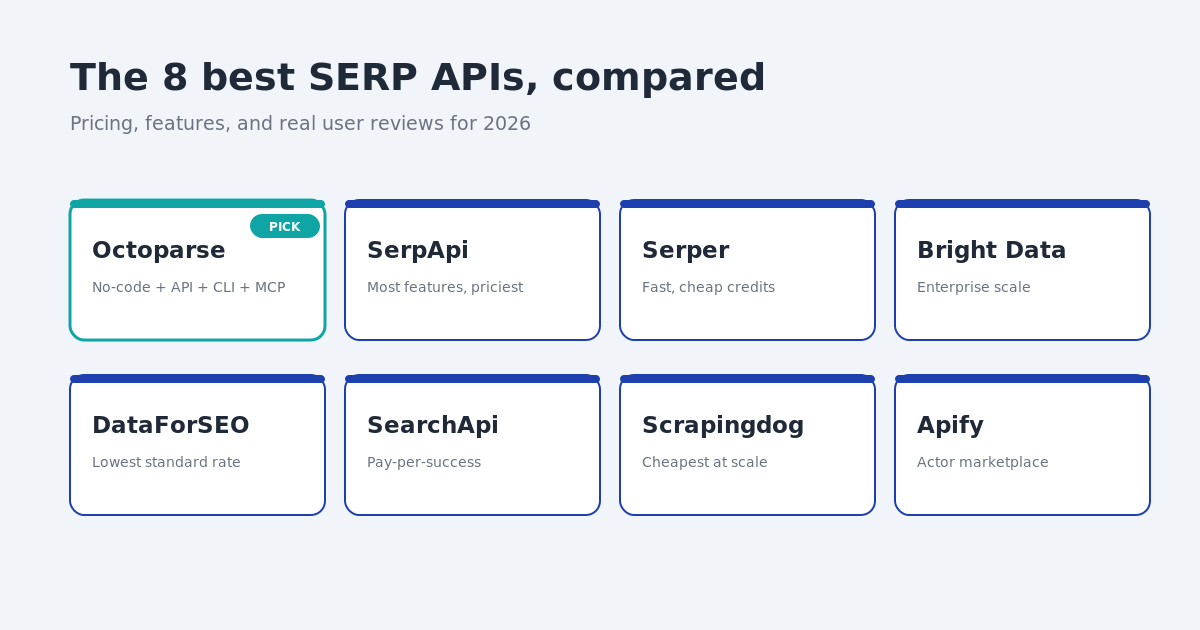
Top picks at a glance
- Best all-in-one data platform: Octoparse. The only pick that serves non-coders (visual templates), developers (a Google SERP API and CLI), and AI agents (MCP) from one platform, so no one on the team is locked out.
- Best all-round developer API: SerpApi. The most complete feature set and support, if you can accept the price and a Google lawsuit that was dismissed in July 2026 but could return.
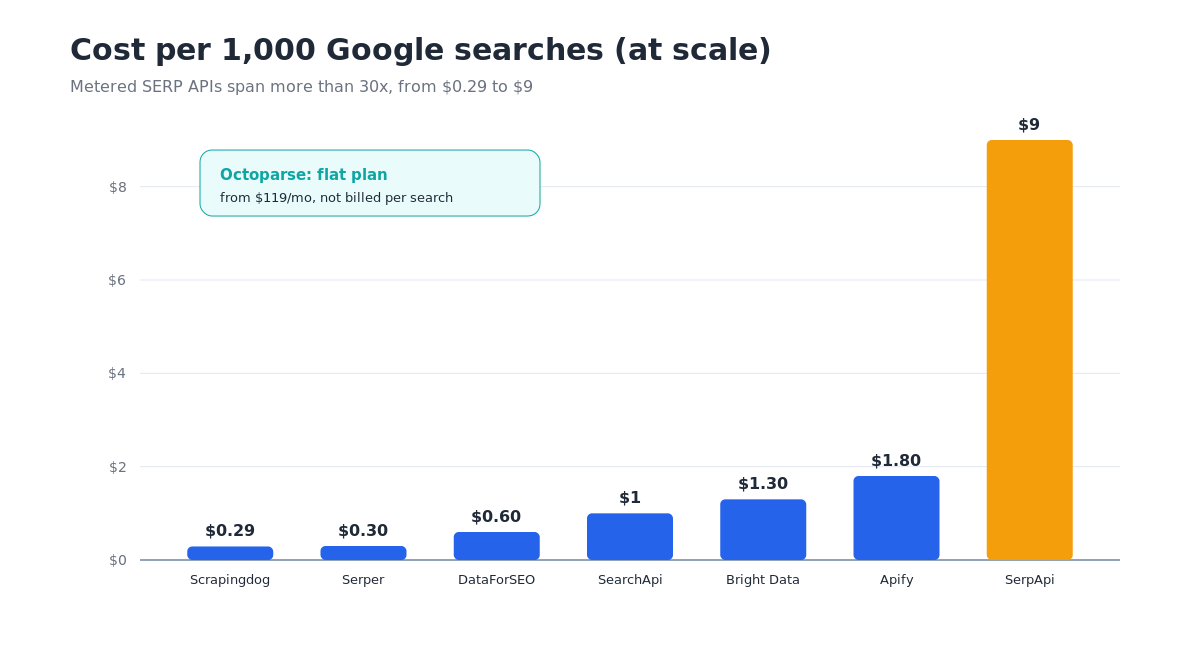
- Cheapest at scale: Scrapingdog, Serper, and DataForSEO, all from about $0.30 to $0.60 per 1,000 searches.
- Best free tier: Octoparse. Its free plan gives 2,000 records per week (about 8,000 a month) through the API and MCP, more than Bright Data’s 5,000 a month.
- Best for AI agents: Octoparse, Bright Data, Apify, and DataForSEO all ship MCP servers that let Claude or ChatGPT pull results directly. Octoparse stands out for a free weekly MCP quota and a no-code path for the non-coders on the team.
New to the category? Start with our pillar guide on how to get Google search data, then come back here to choose a tool.
The 8 best SERP APIs compared (2026 monthly pricing)
| SERP API | Type | Free tier (approx) | Entry paid (monthly) | Cost at scale (unit varies, see note) | AI Overview / PAA |
| Octoparse | No-code + API + CLI + MCP | ~8,000 / mo (2,000 / week) | $119/mo Standard | Flat $119/mo (Google Search template free) | Yes |
| SerpApi | Developer API | 250 / mo | $25/mo (1,000 searches) | ~$9 / 1k (Big Data plan) | Yes |
| Serper | Developer API | 2,500 (one-time) | $50 (50k credits, ~$1/1k) | ~$0.30 / 1k | Partial |
| Bright Data | API + MCP | 5,000 / mo | Pay-as-you-go $1.50 / 1k | $1.30 / 1k ($499/mo Scale plan) | Yes |
| DataForSEO | API + MCP | $1 credit (one-time) | Pay-as-you-go ($50 min deposit) | $0.60 / 1k standard | Yes ($1.20/1k) |
| SearchApi | Developer API | 100 (one-time) | $40/mo (10,000 searches) | to $1 / 1k | Yes |
| Scrapingdog | Developer API | Free trial | $40/mo (40k requests) | to $0.29 / 1k | Yes |
| Apify | Actor (via API or MCP) | ~1,000 / mo ($5 credit) | $29/mo Starter + $2.50 / 1k pages | $1.80 / 1k pages (Business, $999/mo) + add-ons | Yes |
The prices above are monthly billing, not annual, and reflect each vendor’s public pricing as of August 2026. Always re-check the vendor page before buying.
A caveat on units: these vendors do not all price in the same unit. SerpApi, SearchApi, DataForSEO, Scrapingdog, and Apify’s official actor charge per search (one SERP page); Serper charges per credit, which is roughly one search. Some community Apify actors price per result instead. Since one search returns about 10 results, a per-result price is only about a tenth of a per-search price, but you pay it for roughly 10x as many units, so the same data ends up costing about the same. The small headline number just looks cheaper. Normalize everything to one unit before comparing (see “watch the pricing unit” below). Octoparse is the outlier: it bills by flat plan rather than per search, so its cost does not climb with volume. Free-tier figures are approximate monthly volume; entries marked “one-time” are sign-up credits, not recurring.
The 8 SERP APIs at a glance (with G2, Capterra, and Trustpilot ratings)
- Octoparse: a data platform, not just a no-code tool, serving developers (a Google SERP API and CLI), non-coders (visual templates), and AI agents (MCP) from one place. Rated 4.8 on G2 (52 reviews) and 4.7 on Capterra (106), with responsive support and the most generous free tier here (2,000 records a week, usable through the API and MCP).
- SerpApi: the most feature-complete developer API, with the best docs and support. 4.8 on G2 (28 reviews) and 4.9 on Trustpilot (96). Downsides: the highest price, rigid subscriptions, and a Google lawsuit that a court dismissed in July 2026 but Google may refile.
- Serper: a fast, cheap, credit-based API, strong for high-volume rank checks. Developer-favored on price and speed; lighter on SERP-feature coverage and formal support.
- Bright Data: enterprise reliability, with a free tier of 5,000 results a month. 4.6 on G2 from 280 reviews, the largest base here, with users citing a low error rate. It also ships an MCP server; the trade-off is a heavier, proxy-centric setup.
- DataForSEO: pay-as-you-go with the lowest standard rate ($0.60 per 1,000 searches), a full SEO data suite beyond SERP (backlink, keyword, and site-audit APIs), and an MCP server. Reviewers praise its “top notch” support but rate the developer experience below dedicated SERP tools.
- SearchApi: a real-time, pay-per-success API; simple and mid-priced, with no no-code path.
- Scrapingdog: the cheapest at scale, down to about $0.29 per 1,000 searches; good value, with lighter support and docs.
- Apify: a marketplace of “Actors” (cloud scrapers) you run from the UI, through Apify’s API, or via its MCP server, rated 4.8 on the Apify Store (130 reviews). The official Google Search Results Scraper is priced per SERP page, $1.80 to $4.50 per 1,000 pages depending on plan, with premium features like Google AI Mode and ads extraction billed as extra add-ons. Cheaper community actors exist, but you have to vet them yourself.
What the pricing pages will not tell you
Three traps hide inside SERP API pricing.
First, watch the pricing unit. Some vendors charge per search (one query returns one SERP page), others per 1,000 results. Because one Google SERP page holds about 10 results, the two units are roughly 10x apart. A “$0.50 per 1,000 results” plan sounds cheaper than “$2 per 1,000 searches,” but $2 per 1,000 searches works out to about $0.20 per 1,000 results, so it is actually the cheaper of the two. Convert everything to one unit before you compare.
Second, credit-based plans get more expensive on deep queries. Serper, for example, bills one credit for up to 10 results but two credits for 11 to 100, quietly doubling your rate on long result sets.
Third, AI Overview and AI Mode data is often priced separately. DataForSEO charges about $1.20 per 1,000 searches for its AI Overview endpoint, well above its $0.60 standard rate, and Apify’s official actor bills Google AI Mode as an add-on, from $2 to $5 per 1,000 searches on paid plans. If AI answers matter to you, price that line on its own.
AI Overview and AI Mode pricing by tool
| Tool | AI Overview / AI Mode pricing |
| Octoparse | Included in the free Google Search template, no surcharge |
| DataForSEO | ~$1.20 / 1,000 searches (AI Overview endpoint), vs $0.60 standard |
| Apify (official actor) | Google AI Mode add-on: $2–$5 / 1,000 searches on paid plans |
| Most others | Usually returned in the standard response (verify on the vendor page) |
Which SERP API is fastest and most accurate?
Speed and accuracy separate these tools as much as price does. A few patterns hold up across vendor data and reviews.
- Reliability: Bright Data has the largest review base here, 4.6 on G2 from 280 users, with reviewers citing a low error rate. That is why it tends to win enterprise work where missed results are costly.
- Speed tiers: DataForSEO lets you trade speed for cost across three queues, Standard (about 5 minutes), Priority, and Live (real-time), so you pay the premium only when you need instant data.
- Rank tracking: if you track positions on a schedule rather than doing one-off lookups, several vendors sell a dedicated SERP tracking API. Serper’s fast, credit-based API and Octoparse’s scheduled cloud tasks both fit that job.
- Accuracy: accuracy claims are hard to verify from marketing, so run a test batch. Independent head-to-head tests of SerpApi, Serper, and Scrapingdog are a useful starting point, but your own keywords are the real benchmark.
Opinionated picks (not balanced reviews)
- Top pick for no-code teams: Octoparse. If you do not want to write or maintain code, a visual template that exports to Excel beats any API, and you still get an API later if you need it.
- Top pick for developers who want the most features: SerpApi, not Serper. SerpApi parses more SERP elements and has better docs and support. Serper wins only on raw price.
- Cheapest at real scale: Scrapingdog, Serper, or DataForSEO, all around $0.30 to $0.60 per 1,000 searches. Expect thinner support in exchange.
- Best free tier: Octoparse. Its free plan gives 2,000 records per week (about 8,000 a month), usable through the API and MCP. That beats Bright Data’s 5,000 a month, which is the most generous of the remaining tools, and far above SerpApi’s 250.
- Skip a heavy integration if: you just need the data once or weekly. A template or a single MCP call is faster than wiring up and maintaining an API.
For the free-tier limits in detail, see our breakdown of free SERP APIs.
Where Octoparse fits: a data platform for developers, no-code users, and agents
Octoparse is a data platform used by more than 3 million people, built to serve three kinds of users from one place: developers, non-coders, and AI agents. That range, not any single feature, is what sets it apart from the developer-only APIs in this list.
For non-coders: a template that exports to a spreadsheet
Most SERP APIs assume you will write a script. The Google Search Scraper template runs your keywords in the cloud and exports organic results, People Also Ask, AI Overview text, ads, and rankings to Excel or Google Sheets, with no code. There is a full walkthrough in how to scrape Google search results.
https://www.octoparse.com/template/google-search-scraper
For AI agents: an MCP server
Octoparse ships an MCP server. MCP, the Model Context Protocol, lets an AI assistant like Claude or ChatGPT call an external tool directly, so the assistant can pull live SERP data itself during a task. Free and Basic accounts get 2,000 records per week at no upgrade, shared across MCP and the API. Bright Data, Apify, and DataForSEO also offer MCP servers; what is rarer is Octoparse’s mix of MCP with a no-code template, so the marketer and the AI agent draw from the same tool.
For developers: a Google SERP API and a CLI
Octoparse exposes a Google SERP API and a CLI, so developers get structured JSON and scriptable runs without forcing the rest of the team onto code. Its Google Search template is currently free, so the API is not metered per search: a high-volume Google job stays at the flat plan price, from $119 a month on the Standard tier, no matter how many results you pull, instead of climbing with every request the way a metered API does. There is a free plan to start.
Beyond Google search, the same platform covers templates for hundreds of sites and a library of ready data sources, so one subscription can feed a whole team. Put simply, Octoparse fits best when a mix of people, or an AI agent, needs data from the same tool.
How to choose the right SERP API
Match the tool to the person, not the other way around.
Choose an all-in-one platform like Octoparse if a mix of marketers, developers, and AI agents need the same data, or if you want a flat, predictable bill rather than per-search metering. Choose a cheap developer API like Scrapingdog or DataForSEO if you have engineers and steady mid-volume needs; Octoparse’s flat plan also fits here, and gets cheaper the higher and more predictable that volume is. Choose SerpApi if you want the richest parsing and best support and can absorb the cost. Choose Bright Data for enterprise reliability and compliance guarantees. Choose an MCP-capable tool, such as Octoparse, Bright Data, Apify, or DataForSEO, if an AI agent, not a person, is the one making the request.
One last filter: most of these vendors offer a free tier or trial, so shortlist two, run the same 100 keywords through each, and compare the output fields and the bill before you commit. The right SERP API is the one that fits your team and your volume, not the one with the loudest benchmark.
Frequently asked questions
- What is a SERP API?
A SERP API is a service that returns Google search results, organic listings, ads, People Also Ask, and AI Overviews, as structured JSON, so you do not have to build or maintain a scraper. You send a keyword and get back parsed fields ready to drop into a sheet, database, or app.
- What is the best SERP API in 2026?
There is no single best SERP API; it depends on who needs the data. Octoparse is best for mixed teams that need one platform for non-coders, developers, and AI agents; SerpApi for developers wanting the richest features; and Scrapingdog or DataForSEO for the lowest cost at scale. Bright Data leads on enterprise reliability with its 4.6 G2 rating across 280 reviews.
- How much does a SERP API cost?
SERP API pricing in 2026 ranges from about $0.30 to $25 per 1,000 searches, with SerpApi at the high end and Scrapingdog, Serper, and DataForSEO at the low end. Entry monthly plans include SerpApi from $25 for 1,000 searches, SearchApi and Scrapingdog at $40, and Octoparse at $119 for its Standard plan. Pay-as-you-go options like DataForSEO start near $0.60 per 1,000 searches.
- Is there a free SERP API?
Several offer free tiers. Octoparse is the most generous: 2,000 records per week (about 8,000 a month) usable through its API and MCP. Of the remaining tools, Bright Data includes 5,000 results per month, Serper gives 2,500 free credits on signup, and SerpApi allows 250 searches per month. Free tiers often exclude premium data like AI Overviews. See our full free SERP API comparison for the limits.
- Is SerpApi legal to use?
SerpApi’s legality is contested but trending in its favor. Google sued SerpApi in December 2025 under the DMCA, and in July 2026 a court dismissed that claim, finding the DMCA does not protect non-copyrighted search results, though Google was given leave to amend. It is not clearly illegal, but many teams still prefer hosted tools that let them control collection rate and volume. We explain the case in is SerpApi legal.
- What is the best SerpApi alternative?
The best SerpApi alternative depends on your reason for switching. For lower cost, Serper, Scrapingdog, and DataForSEO all run cheaper per 1,000 searches. If you want one platform that serves non-coders, developers, and AI agents rather than an API alone, Octoparse is the closest fit, with a template, a Google SERP API, a CLI, and MCP. For enterprise scale and reliability, Bright Data is the common replacement. Many teams also weighed the Google lawsuit when considering a move, though a court dismissed it in July 2026.
- Which SERP API returns Google AI Overviews?
Most modern SERP APIs now return AI Overview data, including SerpApi, Bright Data, DataForSEO, and Octoparse, though several charge extra for it. DataForSEO prices its AI Overview endpoint around $1.20 per 1,000 searches, above its standard SERP rate. To extract AI Overviews specifically, see how to scrape Google AI Overviews.
Pricing and ratings verified in August 2026 from each vendor’s public pages (linked inline above); check them before buying, as pricing changes. Product and brand names are the property of their respective owners.