

Pulling data out of Google search used to be simple. In 2026 it is not. Google’s official Custom Search JSON API is now closed to new customers and shuts down completely on January 1, 2027. At the same time, Google took the biggest third-party SERP API vendor, SerpApi, to court over how it scrapes results, a case a federal court dismissed in July 2026 but that Google may still amend.
So if you need Google search data, ads, rankings, People Also Ask, or AI Overviews, which door do you actually walk through? This guide maps every route, who each one is for, and how to get the data without betting your project on a tool that might disappear or get blocked.
Quick answer: the fastest way to get Google search data
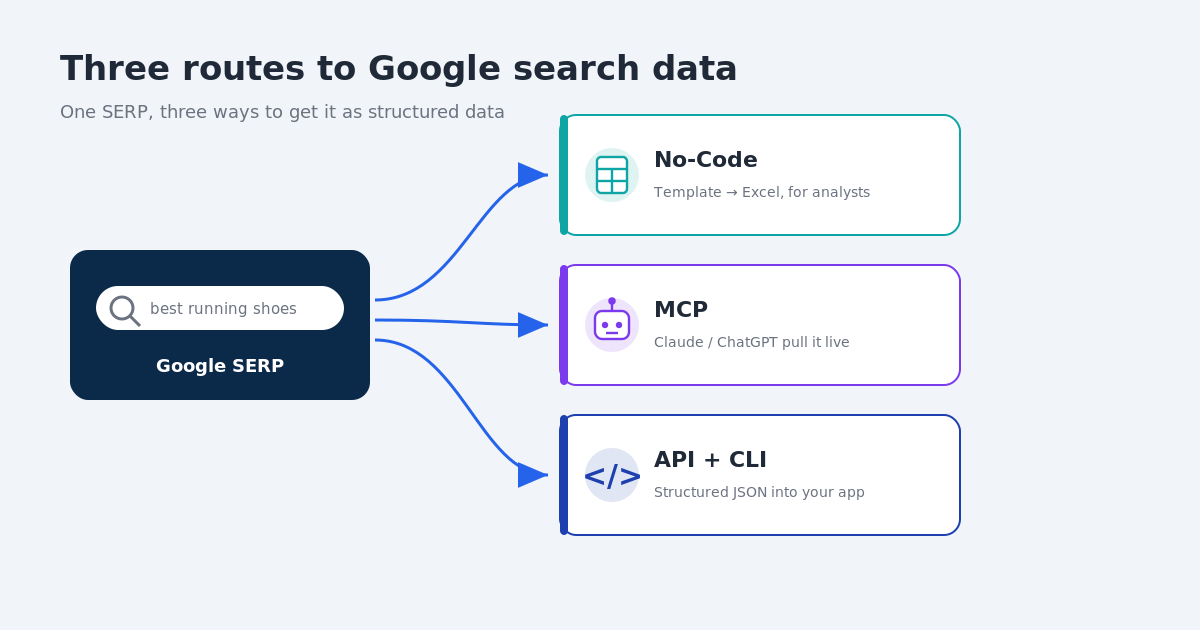
You have three routes to Google search data, and one tool covers all three:
- No-code: run keywords through a visual template and export organic results, PAA, and AI Overviews to Excel or Google Sheets. Best for SEOs, marketers, and analysts.
- MCP: the Model Context Protocol lets an AI assistant such as Claude or ChatGPT pull live results itself, mid-conversation. Best for AI builders.
- API: wire structured JSON into your own app. Octoparse ships a Google SERP API for this, alongside SerpApi, Serper, Bright Data, and SearchApi.
Octoparse is a data platform that covers all three routes from one place: a no-code Google Search Scraper template for non-coders, a Google SERP API and a CLI for developers, and an MCP server for AI agents. Several competitors now offer an MCP server too, but few pair it with a no-code template.
https://www.octoparse.com/template/google-search-scraper
How the main Google search data tools compare
This table is an orientation map, not a pricing sheet. For a full ranked comparison with live prices, see the Best SERP APIs guide.
| Tool | Routes offered | Best for | AI Overview / PAA | Honest catch |
| Octoparse | No-code + API + CLI + MCP | Marketers, analysts, AI builders, and devs | Yes: organic, ads, PAA, AI Overview, related, sitelinks | Newer as a standalone SERP API name than SerpApi or Bright Data. |
| SerpApi | API only | Developers | Yes | Google’s DMCA lawsuit was dismissed in July 2026 (may be refiled); API-only. |
| Serper | API only | Devs wanting fast, cheap calls | Partial | Credit-based, thinner feature coverage. |
| Apify Google Search Scraper | Actor (via API or MCP) | Developers | Yes | Priced per SERP page; you run an Actor and fetch an async dataset, not one native SERP endpoint. |
| Bright Data SERP API | API + MCP | Enterprise, high scale | Yes | Pay-as-you-go or a monthly plan; proxy-centric onboarding built for scale. |
| SearchApi | API only | Developers | Yes | No visual or no-code path. |
| DataForSEO | API + MCP | Developers and agencies at scale | Yes | Task-based async API, pay-as-you-go, steeper setup. |
SerpApi, Serper, and Bright Data are better known specifically as SERP APIs, so a developer who wants nothing but an API may reach for an incumbent first. Octoparse covers that route too, with its own Google SERP API, and pairs it with a no-code template that the code-first vendors do not offer.
What is a SERP API, and how is it different from the Google Search API?
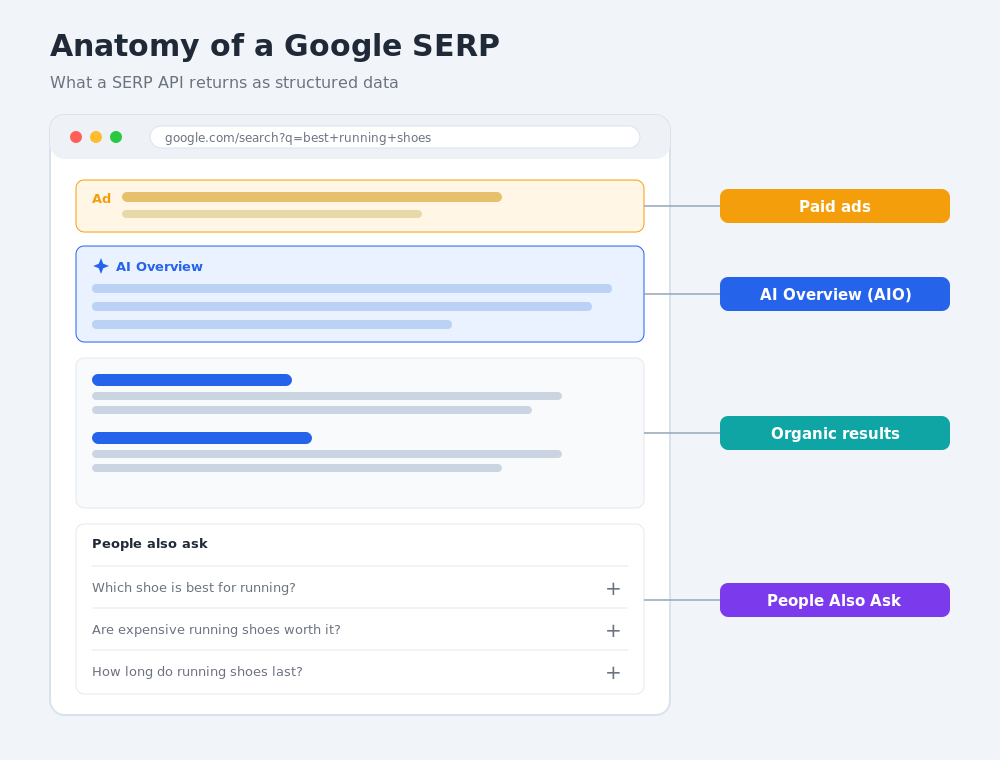
A SERP API is a service that returns structured Google search results as JSON without you building a scraper. You send a keyword, it returns organic links, ads, People Also Ask, and often AI Overviews, already parsed into fields. People Also Ask is the expandable block of related questions on the results page, and an AI Overview is Google’s AI-generated answer that sits at the top of many SERPs with its own cited sources.
The “Google Search API” is a fuzzier term. People use it to mean any API that returns Google results, but Google’s own official product, the Custom Search JSON API, is built for searching your own site or a defined set of sites through a Programmable Search Engine. It is not designed to return the full public Google SERP at scale, and it is now closing. That gap between what people want (“give me Google’s results”) and what Google officially offers is exactly why third-party SERP APIs exist.
What does a SERP API request look like?
Most SERP APIs work the same way: send a keyword and an API key to an endpoint, get parsed JSON back. A few lines are enough to pull the organic results:
Octoparse exposes a similar Google SERP API, and the same query can run through its no-code template with no code at all.
https://www.octoparse.com/template/google-search-scraper
Does Google have an official search API in 2026?
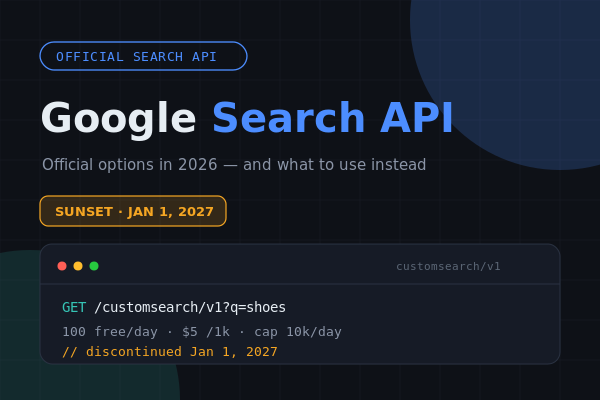
Technically yes, but it is going away. Google’s Custom Search JSON API is closed to new customers and will shut down on January 1, 2027, with the notice issued in January 2026. Existing users are pointed toward Vertex AI Search, which needs a full Google Cloud setup, OAuth, and enterprise pricing.
There is also the Google Search Console API, but that only returns your own site’s search analytics, not general search results. For anyone who wants live public SERP data, the official path is narrowing fast. That is the practical reason most teams end up on a third-party route. We break down Google’s official options and what to use instead in Google’s official search API guide.
The three ways to get Google search data in 2026
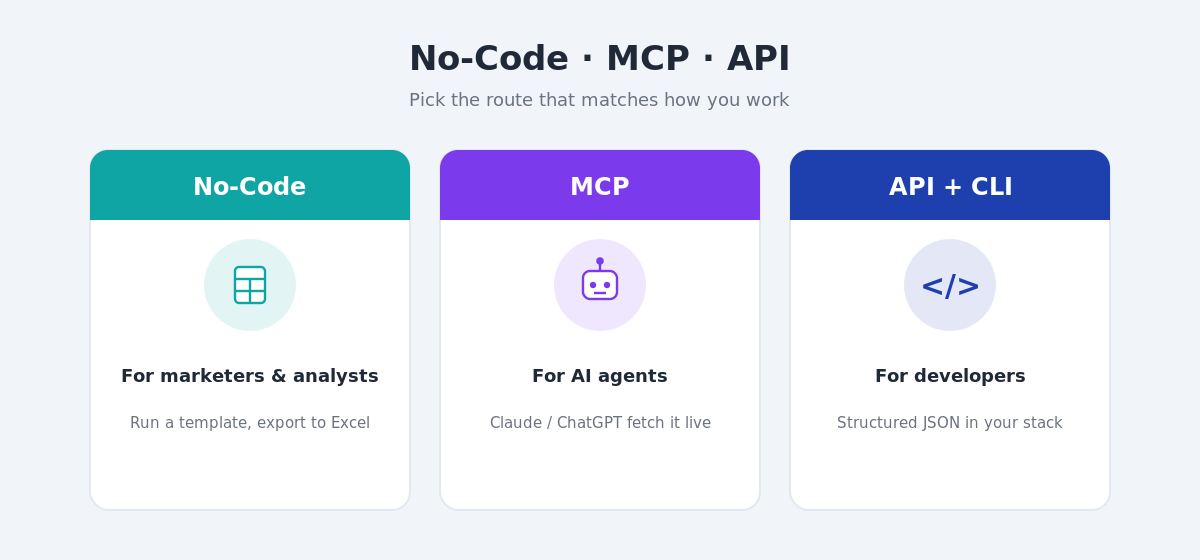
There is no single “best” way to get Google search data. There are three routes, and the right one depends on who you are and what you are building. Pick the route first, then the tool.
Route 1: No-code scraper. You want the data, not a codebase. A visual template or hosted task runs your keywords and exports organic results, PAA, and AI Overviews straight to Excel, CSV, or Google Sheets. Best for SEOs, marketers, analysts, and anyone who would rather not manage proxies and parsers.
Route 2: MCP. You want Google results inside an AI workflow. With an MCP server, an assistant like Claude, ChatGPT, or Cursor can pull live SERP data itself, mid-conversation, and reason over it. Best for people building AI agents or automations.
Route 3: SERP API. You want to wire SERP data into your own application. A developer-first API gives you endpoints, parameters, and JSON at volume. Best for engineering teams comfortable maintaining an integration.
Many teams use more than one. An analyst might start with a no-code template, then hand the same job to an API once it needs to run nightly at scale.
Mapped to tools: Octoparse covers all three routes, while SerpApi, Serper, Apify, Bright Data, and SearchApi focus on the API route. For hands-on method steps, see how to scrape Google search results.
Is scraping Google search results legal?
This is the question the whole category wrestled with in 2026. In December 2025, Google sued SerpApi, alleging it circumvented technical protections to scrape copyrighted results at scale, a claim under the DMCA. In July 2026 a federal court dismissed that claim, finding the DMCA does not protect search results that contain no copyrighted content, though it gave Google leave to amend.
Even so, treat blanket “it’s totally legal” claims with caution. Scraping public data is broadly permitted in many contexts, but how you collect it, whether you bypass protections, and what you do with copyrighted content all matter. We break down the SerpApi case in is SerpApi legal, explained, and cover the broader question in is scraping Google legal. The practical takeaway: prefer hosted, no-code tools like Octoparse that collect responsibly and give you control over rate and volume.
Is a SERP API free to use?
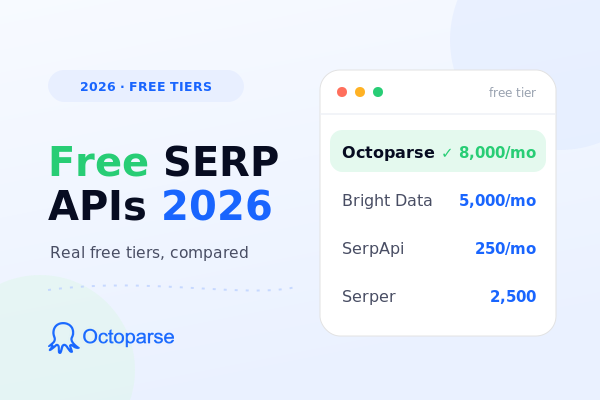
Most SERP APIs offer a limited free tier, then charge by request or credit. SerpApi’s free plan, for example, includes 250 searches per month, and Serper gives 2,500 free credits on signup. Free tiers often exclude premium features. Google’s own Custom Search JSON API allowed 100 free queries per day, but it is closing to new users. If your need is small or occasional, a no-code tool with a free plan is usually the cheapest way to start, because you skip both the code and the per-request billing. Octoparse, for example, is free to start: Free and Basic accounts get 2,000 records per week (about 8,000 a month) at no upgrade, usable through its MCP server and its API. That is more free volume than Bright Data’s 5,000 results a month. For a plan-by-plan look at the free tiers, see free SERP APIs compared.
Getting Google search data with Octoparse
Octoparse is a data platform used by more than 3 million people. It is built to serve three kinds of users from one place: non-coders (a no-code template), developers (a Google SERP API and a CLI), and AI agents (an MCP server). For Google search, that is why the same tool fits a marketer, a developer, and an AI builder. Here is how that plays out by real task.
When you need Google results in a spreadsheet by this afternoon
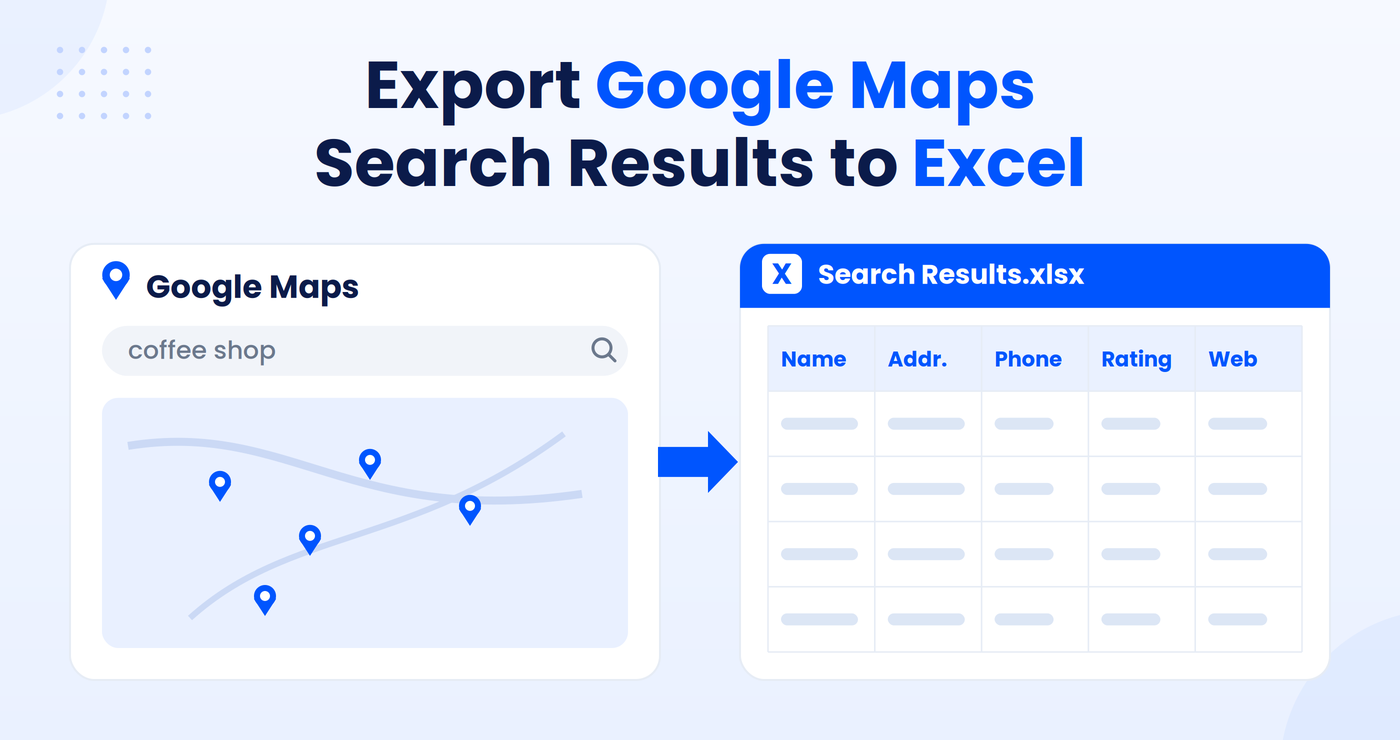
You do not want to write a parser. The Google Search Scraper template takes your keywords, runs them in the cloud, and returns organic results, People Also Ask, AI Overview text, related searches, ads, and rankings, ready to export to Excel, CSV, or Google Sheets. It is a point-and-run job, and there is a walkthrough in how to scrape Google search results.
https://www.octoparse.com/template/google-search-scraper
When you want SERP data inside Claude or ChatGPT
You are building an AI workflow and want your assistant to fetch live results itself. Per Octoparse’s MCP documentation, the MCP server connects to clients including Claude, ChatGPT, Cursor, and VS Code, so an agent can trigger a Google search scrape and reason over the returned organic results, PAA, and AI Overview sources in one conversation. Free and Basic accounts get 2,000 records per week at no upgrade, shared across MCP and the API.
When you need to wire it into your own stack
You want scheduled, repeatable extraction feeding a database or dashboard. Octoparse offers a Google SERP API and a CLI for exactly this, so a developer gets structured JSON and scriptable runs without giving up the no-code and MCP routes the rest of the team uses. The same job can also run as a scheduled cloud task, delivering fields including position, pagination, sitelinks, and AI Overview content into your pipeline, with location targeting and site: filtering to narrow the query.
Octoparse is not the first name people think of for a SERP API, but it is the only option here that gives you the no-code template, the MCP server, and a Google SERP API from one hosted tool, without you managing proxies or getting blocked. You can start on the free plan and browse related scrapers in the template library.
Beyond Google: other search data
The same routes apply to other engines and verticals. If Bing is your target, see how to scrape Bing search results. For Google’s AI answers specifically, scraping Google AI Overviews breaks down four methods and the exact fields you can pull.
The bottom line
The story of Google search data in 2026 is not “which API wins.” It is that the official API is closing, the biggest scraper just won a court dismissal Google may still amend, and the smart move is to pick the route that matches how you work: no-code if you want the data, MCP if you want it in an AI agent, an API if you want it in your codebase. Choose the route, and the tool follows.
Frequently asked questions
- What is a SERP API?
A SERP API is a service that returns structured Google search results as JSON, including organic links, ads, People Also Ask, and AI Overviews, without you building or maintaining a scraper. You send a keyword and get back parsed fields you can drop into a sheet, database, or app.
- Is SerpApi legal?
It is contested. In December 2025 Google sued SerpApi under the DMCA, alleging it circumvented technical protections to scrape copyrighted results. In July 2026 a federal court dismissed that claim, finding the DMCA does not protect non-copyrighted search results, though it left Google room to amend. So it is not clearly illegal, but avoid treating the question as fully settled, and favor hosted tools that let you control collection rate and volume, such as platforms like Octoparse.
- Is a SERP API free to use?
Most offer a limited free tier, then bill by request or credit. SerpApi’s free plan includes 250 searches per month, and Serper gives 2,500 free credits on signup, though free tiers may exclude premium features like AI Overviews. For small or occasional needs, a no-code scraper with a free plan is often cheaper because you skip both coding and per-request charges. Octoparse, for example, is free to start and includes 2,000 records per week (about 8,000 a month) via its API and MCP, more than Bright Data’s 5,000 a month.
- Does Google have an official search API?
Google’s official Custom Search JSON API exists but is closed to new customers and shuts down on January 1, 2027. It was built for searching specific sites through a Programmable Search Engine, not for returning the full public SERP at scale. Google Search Console has an API too, but only for your own site’s analytics.
- What does “serp google” mean?
“serp google” refers to a Google SERP (Search Engine Results Page) — the page of results Google returns for a query, including organic listings, paid ads, and features like the local pack, People Also Ask, and AI Overviews. To capture that page as structured data, teams use a SERP API such as Octoparse, which exports the organic, ad, PAA, and AI Overview fields to a spreadsheet.
- What is the difference between the Google Search API and a SERP API?
The Google Search API usually means Google’s own Custom Search JSON API, which is narrow and closing. A SERP API is a third-party service built to return the full public Google SERP, including ads, PAA, and AI Overviews, as structured JSON. Most teams that want general Google results use a third-party SERP API or a scraper, not Google’s official API. Octoparse, for example, offers a Google SERP API alongside a no-code template and an MCP server for the same data.
- Can I scrape Google search results without coding?
Yes. No-code tools use a visual template or hosted task to run your keywords and export organic results, PAA, and AI Overviews to Excel, CSV, or Google Sheets. Octoparse’s Google Search Results Scraper template is one example, aimed at SEOs and analysts who want the data without managing parsers or proxies.
- Can an AI assistant pull Google search data directly?
Yes, through MCP. An MCP server lets assistants such as Claude, ChatGPT, or Cursor call a Google search scraper themselves during a conversation and reason over the returned results. This is the practical way to give an AI agent live SERP data instead of stale training knowledge.