

Short answer: using SerpApi is not illegal on its face, and in July 2026 a US federal court dismissed the core of Google’s lawsuit against it. But the case is not fully closed, and “legal” still depends on how you collect and use the data. Here is what actually happened and what it means for you.
What happened: the Google v. SerpApi timeline
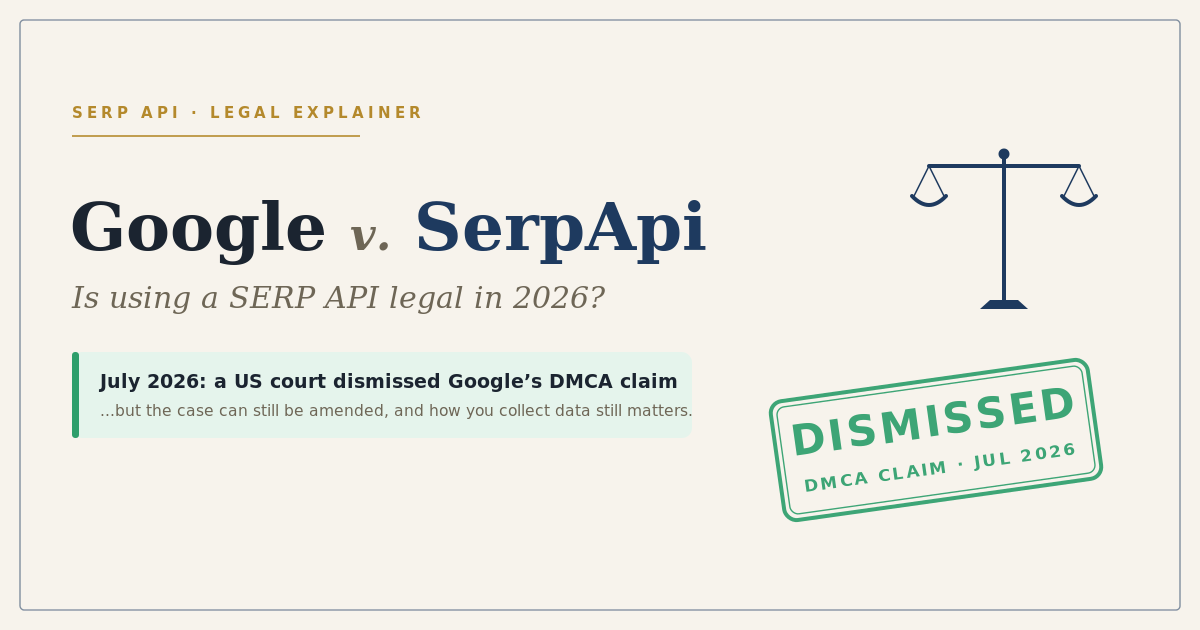
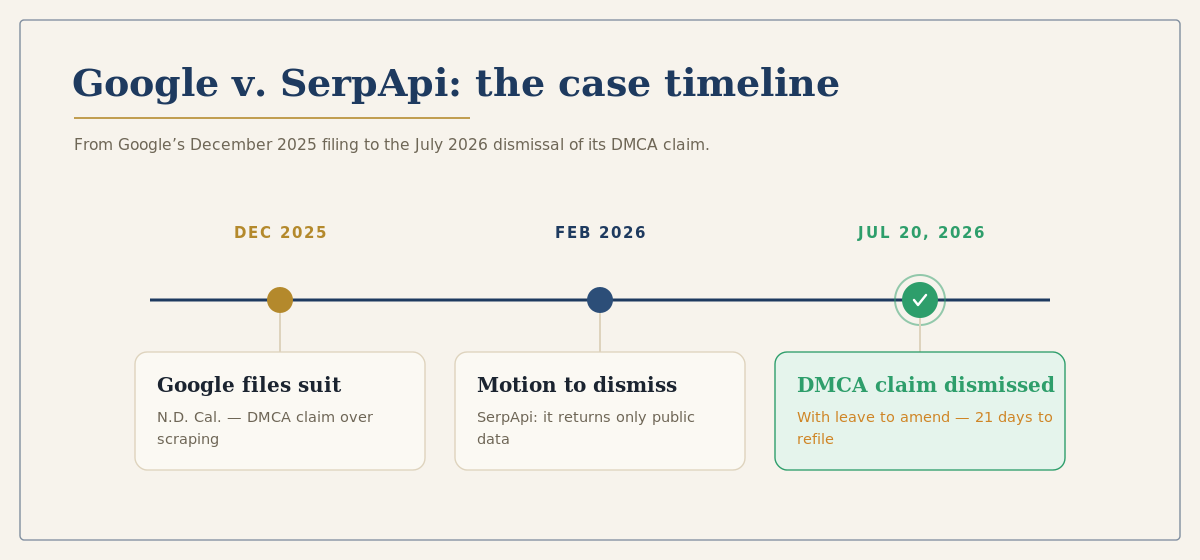
Google sued SerpApi in December 2025 in the US District Court for the Northern District of California. Google’s complaint argued that SerpApi circumvented Google’s anti-scraping protections to extract and resell copyrighted search results at scale, a claim brought mainly under the Digital Millennium Copyright Act (DMCA).
SerpApi filed a motion to dismiss in February 2026, arguing it only returns the same public data any person can see in a browser.
On July 20, 2026, Judge Yvonne Gonzalez Rogers granted that motion, dismissing Google’s DMCA claims. You can read the court’s dismissal order directly.
What the July 2026 ruling actually said
The court found that Google had not stated a valid DMCA claim for search results that contain no copyrighted content, reasoning that the DMCA protects copyrighted works, not public data on its own. Those claims were dismissed.
Two nuances matter, though.
First, the dismissal came with leave to amend. Google was given 21 days to refile if it can show it had authorization from the actual copyright owners of specific results. So the case can still continue in a narrower form.
Second, the ruling was about the DMCA claim, not a blanket declaration that scraping Google is always legal. Circumventing technical protections, breaching terms of service, or reusing genuinely copyrighted content can still create legal exposure under other theories.
So is it legal to use SerpApi?
For most users, using SerpApi to retrieve public search data is not illegal, and the July 2026 ruling is a point in favor of that view. The suit targeted SerpApi’s own collection methods, not its customers, and the DMCA claim did not survive.
That said, treat any absolute “it’s totally legal” claim with caution. The case may be amended, laws differ by country, and what you do with the data (republishing copyrighted snippets, for example) carries its own rules. Legality depends less on the vendor’s name and more on how the data is collected and used.
Is scraping Google search results legal in general?
Scraping publicly available data is broadly permitted in many jurisdictions, and courts have often sided with scrapers of public information. But the method and the use matter: bypassing login walls or technical protections, ignoring a site’s terms, or copying copyrighted material can each change the answer. We cover the general picture in is web scraping legal, and how the routes to Google data compare in our guide to getting Google search data.
How to collect Google search data responsibly
Whatever tool you pick, a few habits keep you on safer ground:
- Collect public data only. Do not scrape behind logins or paywalls.
- Control your rate and volume. Aggressive, high-frequency scraping is what draws attention and blocks.
- Respect robots and terms where they apply, and do not republish copyrighted content wholesale.
- Prefer hosted, managed tools over home-grown bots, so rate limiting and compliance are handled for you rather than left to a script.
This is where a managed platform helps. Octoparse is a data platform for non-coders, developers, and AI agents, with a no-code Google Search template, a Google SERP API, a CLI, and an MCP server. Because runs are hosted and rate-controlled, you decide how much you pull and how often, rather than pointing an unmanaged bot at Google. It does not make any scraping automatically “legal,” but it gives you the controls that responsible collection requires. There is a free plan to start, with 2,000 records a week at no cost.
https://www.octoparse.com/template/google-search-scraper
Once you have picked an approach, our Best SERP APIs comparison weighs the main tools on price, features, and reviews.
Frequently asked questions
- Is SerpApi legal to use in 2026?
Using SerpApi to fetch public Google results is not illegal on its face, and in July 2026 a US federal court dismissed Google’s DMCA lawsuit against it, finding no valid claim over search results that contain no copyrighted content. The case can still be amended, and legality depends on how you collect and use data, so it is not a blanket “always legal.” Whichever tool you use, stick to public data and a rate-controlled, hosted platform such as Octoparse for more responsible collection.
- Did Google win its lawsuit against SerpApi?
No. On July 20, 2026, the US District Court for the Northern District of California granted SerpApi’s motion to dismiss Google’s DMCA claims. The dismissal came with leave to amend, giving Google 21 days to refile a narrower complaint if it can show authorization from the copyright owners of specific results.
- Is scraping Google search results legal?
Scraping publicly available search data is broadly permitted in many places, but it is not unconditional. Bypassing technical protections or logins, violating a site’s terms, or reusing copyrighted content can create legal risk. The safest approach is to collect only public data, control your request rate, and avoid republishing copyrighted material.
- Is it safer to use a SERP API than to build my own scraper?
Often, yes, on the operational side. A hosted SERP API or platform handles rate limiting, proxies, and blocking, which reduces the aggressive behavior that triggers problems. It does not change the underlying law, but managed collection is easier to keep within responsible limits than an unmanaged bot.
- Will the SerpApi ruling change how SERP APIs work?
Possibly. A dismissal of Google’s DMCA theory is broadly favorable to services that return public search data. But because the case may be amended and other legal theories exist, most vendors are unlikely to change their core model overnight. Watch for an amended complaint within the court’s deadline.
This article is general information, not legal advice. Laws vary by jurisdiction and the case described may change. Consult a qualified lawyer for your specific situation. Details reflect public reporting as of August 2026.