

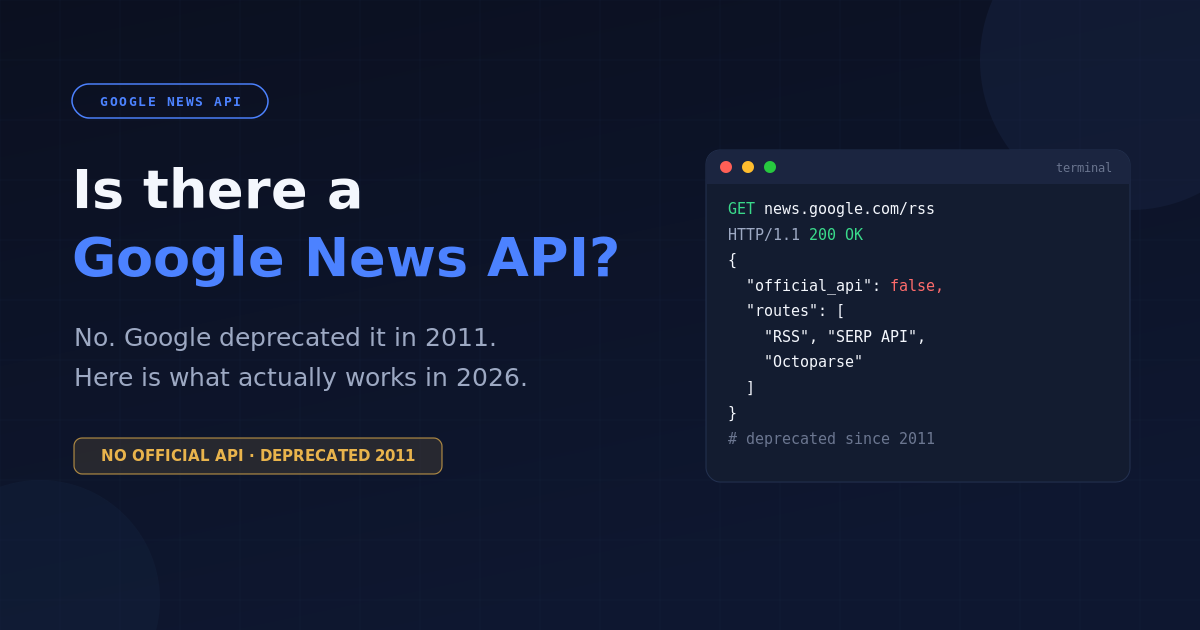
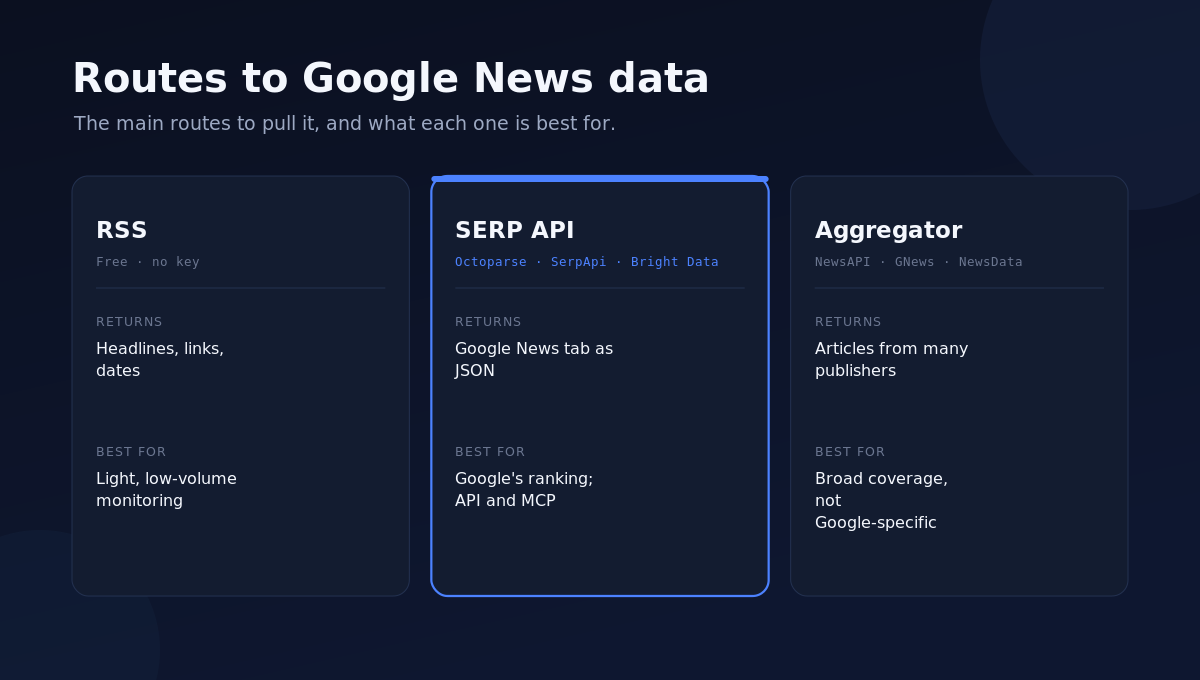
Short answer: no. Google does not offer an official Google News API. It deprecated the original one in 2011 and never replaced it. To get Google News data today you use one of three routes: Google News RSS, a third-party SERP API, or a news aggregator API. Octoparse sits in the SERP-API camp, returning Google News results through a no-code template, an API, or an MCP server.
Does Google News have an API?
No, not a public, developer-facing one. The original Google News API was shut down in 2011 and has no official successor. The only first-party option that touches news is the Google Search Console API. But it only returns performance data for a site you own and have verified: your clicks, impressions, and positions, including in Google News. It does not return other publishers’ news results. (For Google’s official search APIs and why they do not fill this gap, see our guide to the official Google Search API.)
So if you want headlines, articles, or the Google News results page as structured data, you need an unofficial route. That is what the rest of this guide covers.
Google News data options compared
The routes split into two camps, and the split matters more than the price. One group returns Google’s own News-tab ranking (a SERP API); the other returns a provider’s own index of publishers (a news aggregator), which looks similar but is ordered differently. RSS (covered below) stays the free, no-key option for light use. Entry pricing below is monthly, verified from each provider’s own pricing page in August 2026.
APIs that return Google’s own News ranking
| Provider | Free tier | Paid starts at | Best for |
| Octoparse | 8,000 records/mo free | $0.10 / 1,000 records; $83/mo Standard | Marketers, developers, and AI agents on one platform (template + API + MCP) |
| SerpApi | 250 searches/mo | $25/mo (1,000 searches) | A clean, dedicated Google News endpoint |
| DataForSEO | None (pay-as-you-go) | ~$0.60 / 1,000 results | Cheapest volume; pure pay-as-you-go, no subscription |
| Bright Data | 5,000 requests/mo | $1.50 / 1,000 (PAYG) | Google News at scale, pay-per-success |
News aggregator APIs (their own index, not Google’s ranking)
| Provider | Free tier | Paid starts at | Watch-outs |
| NewsData.io | 200 credits/day (~2k articles), commercial OK | $199.99/mo (20k credits) | 12-hour delay; no full content on free |
| GNews | 100 requests/day, non-commercial | €49.99/mo Essential | Own index, not Google’s ranking; free is dev-only |
| NewsAPI.org | 100 requests/day, dev-only | $449/mo (250k requests) | No commercial use on free; no full article text on any plan |
| NewsAPI.ai | 2,000 searches free | $90/mo (5K plan) | Full body + entity enrichment; token-based, archive costs more |
Pricing aside, the practical question is which fields come back, and whether the full article body is one of them. The SERP-tab APIs return result-page metadata (headline, source, date, link); to read the article text you follow the link and scrape the page. Aggregators vary, and full content is usually a paid feature.
What fields each API returns
| Provider | Typical fields returned | Full article body? |
| Octoparse (Google News Cloud) | Title, source, author, publish date, link | Yes (via companion template) |
| SerpApi | Title, source, link, date, thumbnail | No |
| DataForSEO | Title, snippet, URL, source, timestamp | No |
| Bright Data | Headline, source, author, date, topic | No |
| NewsData.io | Title, description, link, source, date | Paid plans only |
| GNews | Title, description, URL, source, date | Paid plans only |
| NewsAPI.org | Title, description, source, URL, date | No (content truncated) |
| NewsAPI.ai | Title, body, source, date, URL, concepts | Yes (configurable) |
How Octoparse returns the article body. The Cloud template above is the discovery step: it returns search-result metadata, not the article text. For the full body, use Octoparse’s free Google News Scraper (by keyword) or Google News Scraper (by URL). Each one opens the article and returns a NewsText field with the full body alongside title, source, author, and publish date. In a cloud pipeline the search step hands its links straight to this extraction step, so you start with metadata and add full text only when you need it, without leaving the platform or bolting on a separate article scraper.
https://www.octoparse.com/template/google-news-scraper
https://www.octoparse.com/template/google-news-scraper-by-URL
How to get Google News data in 2026
There are three practical ways to pull Google News data, depending on how much you need and whether you write code: RSS, a SERP API, or a news aggregator. Octoparse, covered in depth below, serves non-coders, developers, and AI agents from one platform.
Google News RSS (free, no key)
First, what is RSS? RSS (Really Simple Syndication) is a standard format a website publishes so apps or code can read its latest items (headlines, links, dates) without opening the site. A “feed” is just a URL that returns that machine-readable list, and it keeps refreshing as new stories appear. The flow is simple: a source publishes a feed (the URL), you paste that URL into a reader or a script, and you get back an auto-updating list of stories.
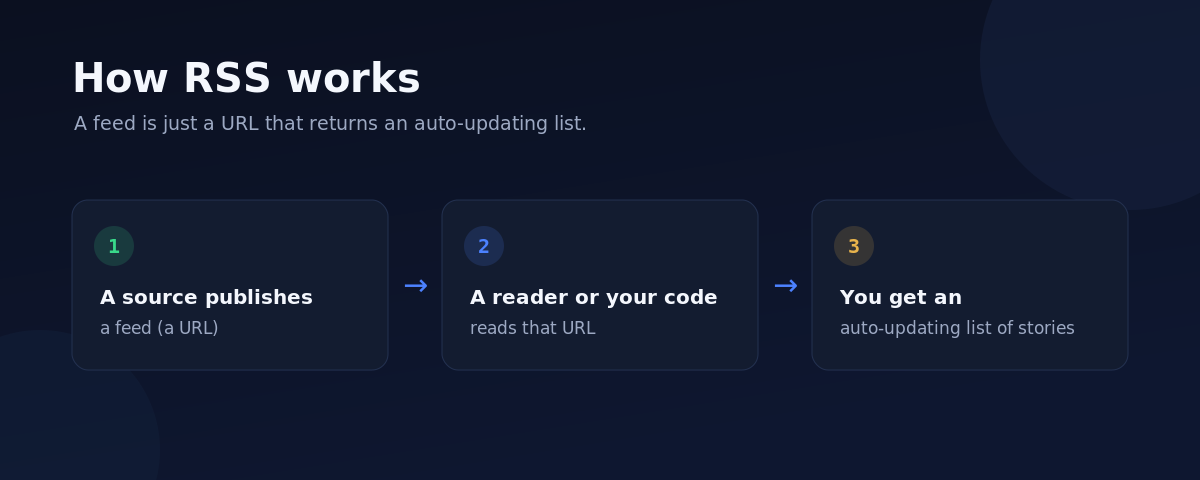
Google News publishes RSS feeds, which makes them the closest thing to an official, free way to pull Google News headlines. They need no API key, and they are the fastest way to start.
How to build a Google News RSS feed. Start from one of these:
- Top stories:
https://news.google.com/rssreturns the current top headlines. - Search by keyword:
https://news.google.com/rss/search?q=YOUR+QUERY. For example, AI news in the US:https://news.google.com/rss/search?q=artificial+intelligence&hl=en-US&gl=US&ceid=US:en. - A specific topic or section: open that topic on news.google.com, then copy the
topics/...segment from the address bar intohttps://news.google.com/rss/topics/TOPIC_ID. Google News also exposes named section feeds such ashttps://news.google.com/rss/headlines/section/topic/TECHNOLOGY(swap inWORLD,BUSINESS,SPORTS,SCIENCE,HEALTH, and so on).
Localize and refine. Append language, country, and edition codes to any feed: &hl=en-US&gl=US&ceid=US:en. In the search feed you can also use Google News operators: wrap a phrase in quotes for an exact match, add when:7d to limit to the last seven days, or site:reuters.com to restrict to one source. URL-encode multi-word queries, so “open source” becomes open+source.
What the feed returns. The response is RSS 2.0 XML. Each <item> gives the headline with its publisher appended (for example, “Headline – The Guardian”), a <pubDate>, a <source> tag with the publisher’s domain, and a <description> block listing related coverage of the same story. One catch: the <link> is a Google News redirect (news.google.com/rss/articles/...), not the publisher’s clean URL, so you follow the redirect to reach the original article.
How to read it. Paste the URL into any RSS reader, or parse it in code. In Python, feedparser.parse(url) returns each item’s title, link, source, and published date in a few lines.
RSS suits lightweight, low-volume monitoring, but it has real limits beyond the sparse fields. It caps how many items you get and gives no control over ranking or full article text. And Google’s feed carries a copyright notice restricting it to personal, non-commercial use in a feed reader, not commercial redistribution. Treat RSS as a monitoring convenience, not a commercial data pipeline. For volume, structured fields, or commercial use, move to a SERP API or a scraper.
Third-party SERP APIs (the Google News tab)
A SERP API returns Google’s results page as structured JSON, and several vendors expose a dedicated Google News endpoint. Octoparse offers a dedicated Google News Scraper (Cloud) template plus API and MCP access, so the same news data reaches non-coders, developers, and AI agents from one platform. Other providers include SerpApi’s Google News API, DataForSEO’s Google News SERP endpoint, and Bright Data’s SERP API, which also covers the Google News tab. With any of them you send a query, get back parsed news results (title, source, date, link), and skip building a scraper. The trade-off is cost per request and, on some tiers, extra charges for premium features.
https://www.octoparse.com/template/google-news-scraper-cloud
Dedicated news aggregator APIs
If you do not specifically need Google’s ranking, a news aggregator API pulls articles from thousands of publishers directly. NewsAPI.org, GNews, NewsData.io, and NewsAPI.ai are the usual names. These return clean JSON and often have a free tier, but their index is their own, not Google News, so coverage and ordering differ from what you see on news.google.com.
Getting Google News data with Octoparse
Octoparse is a data platform built to serve three kinds of users from one place: non-coders (a no-code template), developers (a Google SERP API and a CLI), and AI agents (an MCP server). For Google News, that means the same data fits a marketer, an engineer, and an automation, without three separate tools.
When a marketer needs headlines in a spreadsheet. Octoparse’s ready-made Google News Scraper (Cloud) template returns each article’s title, source, author, publish date, and link from Google News search URLs, and exports to Excel, CSV, or Google Sheets, so there is no scraper to build.
https://www.octoparse.com/template/google-news-scraper-cloud
When a developer wires news into an app. Call the Google News template over the Octoparse OpenAPI and get structured JSON back, so results feed a database or dashboard on a schedule. It is two calls: start a cloud task, then poll for the export. Authenticate with your API key (x-api-key) and a stable user ID. Create the key (it starts with op_sk_) in your Octoparse account center; the free tier covers 2,000 records a week, so you can test before paying.
The same flow in Python:
Two things to watch. parameters is a JSON string, so serialize it rather than passing a raw object. And the run is asynchronous: executeTask returns a taskId immediately, and each response carries retryGuidance and suggestedNextCall, so follow those for the wait interval (about 60 seconds by default) and poll exportData until it reports exported. google_News_Search_URLs accepts up to 10,000 Google News search URLs and language is optional. Billing is usage-based at $0.10 per 1,000 lines.
When the export completes, the result is an array of rows. Each row has two keys: keyword (the search URL you sent) and FollowField, which is itself a JSON string that you parse to get the article fields. One parsed row looks like this:
That single search URL returned 100 rows.
The snippets above cover the core flow. For a production-ready version (automatic file download, retries, timeout handling, and resumable runs), see the full script on GitHub.
When an AI agent needs live news. Through the MCP server, an assistant such as Claude or ChatGPT can pull Google News results mid-conversation and reason over them.
Unlike the retired official API, this returns live Google News data. Octoparse is free to start: the free plan includes about 8,000 records a month through the API and MCP server, and the ready-made Google News cloud template runs on usage-based pricing at $0.10 per 1,000 records (paid Standard plans start at $83/month). Browse related scrapers in the template library, and for the full picture of Google data routes see our SERP API guide, with paid options compared in best SERP APIs and free tiers in free SERP APIs, plus how to scrape Google’s AI Overview when you need AI-answer data.
Is it legal to scrape Google News?
Scraping publicly available data is broadly permitted in many places, and courts have often sided with scrapers of public information. But the method and the use matter: do not bypass logins or technical protections, respect terms where they apply, and do not republish copyrighted article text wholesale. We cover the recent case law in is SerpApi legal. For headlines and metadata, prefer hosted, rate-controlled tools over an unmanaged bot.
Frequently asked questions
- Is there a free Google News API?
Not an official one. The free routes are Google News RSS (no key, limited fields) and the free tiers of third-party services such as news aggregators (NewsAPI.org, GNews) or a data platform like Octoparse, whose free plan includes about 8,000 records a month via its API and MCP server (with a ready-made Google News template on usage-based pricing). Google’s own Custom Search and Search Console APIs do not return general Google News results.
- Is the Google News API deprecated?
Yes. Google deprecated the original Google News API in 2011 and never released a replacement. There is no official, developer-facing Google News API in 2026, which is why teams use RSS, Octoparse’s Google News API, news aggregators, or scrapers instead.
- How do I scrape Google News with Python?
You can request Google News RSS and parse it with a library like feedparser, or call a SERP API that returns the Google News tab as JSON. A no-code option like Octoparse’s template avoids code entirely and exports straight to a spreadsheet, and its API returns the same JSON for a Python client.
- What is the best alternative to a Google News API?
It depends on what you need. For Google’s own ranking, a SERP API (Octoparse, SerpApi, Bright Data) or a scraper that targets the Google News tab. For broad publisher coverage, a news aggregator (NewsAPI.org, GNews, NewsData). For a mix of no-code, API, and AI-agent access from one place, Octoparse.
- Can I get a Google News RSS feed?
Yes. Google News offers RSS feeds for its homepage, for topics, and for search queries, with no API key required. RSS is the simplest free option, but it returns limited fields and item counts, so heavier use usually moves to a SERP API like Octoparse’s Google News API or its no-code template.
Details reflect Google’s public documentation and reporting as of 2026. Verify current pricing, free-tier limits, and available templates on Octoparse’s site before relying on them.