

Most Amazon discounts are ordinary. In a sample of 1,241 Amazon.com search listings across 18 everyday categories, 43.5% showed a struck-through reference price, and the median discount was 20%. Only 7 listings were marked down 70% or more, and 6 of those 7 were wireless earbuds from no-name or little-known brands with roughly 1,000 ratings or fewer.
Data collected September 19-20, 2026 · 1,241 listings (1,232 unique ASINs) · 18 categories · Amazon.com (US)
Key Findings
- 43.5% of listings show a reference-price discount. The median markdown is 20% and the mean is 22.8%, which is normal promotional pricing.
- Discount frequency varies more than 4x by category. 71.9% of air fryer listings show a discount, compared with 16.7% of dog food listings.
- Extreme discounts are rare. Only 7 listings (0.56% of the sample) are marked down 70% or more.
- 6 of those 7 are wireless earbuds. Wireless earbuds is the only category with more than one listing at 70% off or deeper. The other 16 categories had none.
- Listing type splits the earbuds category cleanly. The 5 discounted listings from established brands (Soundcore by Anker, TOZO) are 30-48% off and have 42,100 to 117,300 ratings. The 6 listings from no-name or little-known brands are 90-92.3% off and have 36 to about 1,000 ratings.
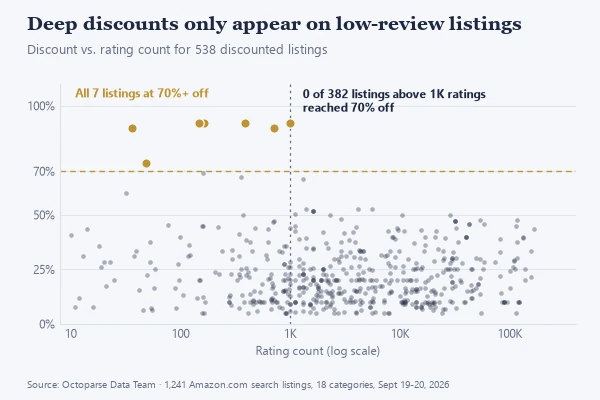
- No listing with more than about 1,000 ratings reached 70% off. All 7 extreme discounts came from low-review listings; none of the 382 discounted listings above that line did.
Why We Ran This Study
A red “-90%” badge next to a struck-through price raises an obvious question: was that original price ever real? Most answers online rely on one or two viral screenshots. We wanted numbers instead.
We picked 18 search keywords that roughly match a household’s shopping basket over a year: electronics accessories (wireless earbuds, Bluetooth speakers, gaming mice, phone cases), small appliances (air fryers, coffee makers, vacuum cleaners), apparel and fitness (running shoes, winter jackets, yoga mats, backpacks), personal care (skincare serum, electric toothbrushes, protein powder), baby and pet (baby monitors, dog food), home (desk lamps), and toys (building blocks). None was chosen because we expected a pricing problem there. The wireless earbuds pattern showed up only after collection was complete.
We captured the first two pages of Amazon.com search results for each keyword and kept every price field as Amazon displayed it at the time.
Most Amazon Discounts Are Ordinary
540 of the 1,241 listings (43.5%) displayed both a current price and a higher reference price, the “was” price that produces the percent-off badge. Here is how those 540 discounts break down:
| Discount range | Listings | Share of discounted listings |
|---|---|---|
| 0-20% | 260 | 48.1% |
| 20-40% | 213 | 39.4% |
| 40-60% | 54 | 10.0% |
| 60-70% | 6 | 1.1% |
| 70-80% | 1 | 0.2% |
| 80%+ | 6 | 1.1% |
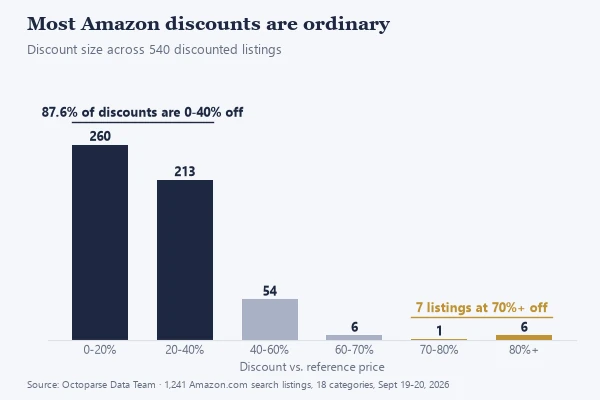
87.6% of discounted listings fall between 0% and 40% off. Only 24 listings (1.9% of the sample) reach 50% off or more, and just 7 reach 70%. All 6 listings above 80% off are actually above 90% off, so there is almost no middle ground between “aggressive” and “extreme.”
Discount Rates by Category
Discounting behaves very differently depending on what you shop for:
| Category | Listings | Discounted | Discount rate | Median discount |
|---|---|---|---|---|
| Air Fryer | 32 | 23 | 71.9% | 28.0% |
| Wireless Earbuds | 16 | 11 | 68.8% | 90.0% |
| Running Shoes | 96 | 60 | 62.5% | 26.2% |
| Vacuum Cleaner | 32 | 20 | 62.5% | 14.3% |
| Bluetooth Speaker | 42 | 26 | 61.9% | 27.3% |
| Gaming Mouse | 42 | 26 | 61.9% | 25.0% |
| Desk Lamp | 96 | 56 | 58.3% | 15.0% |
| Phone Case | 37 | 20 | 54.1% | 15.1% |
| Backpack | 32 | 17 | 53.1% | 20.0% |
| Winter Jacket | 100 | 49 | 49.0% | 21.1% |
| Skincare Serum | 96 | 46 | 47.9% | 20.0% |
| Coffee Maker | 96 | 43 | 44.8% | 20.0% |
| Baby Monitor | 32 | 14 | 43.8% | 24.0% |
| Building Blocks Toy | 96 | 34 | 35.4% | 20.0% |
| Yoga Mat | 100 | 29 | 29.0% | 13.3% |
| Protein Powder | 100 | 27 | 27.0% | 16.3% |
| Electric Toothbrush | 100 | 23 | 23.0% | 16.7% |
| Dog Food | 96 | 16 | 16.7% | 9.9% |
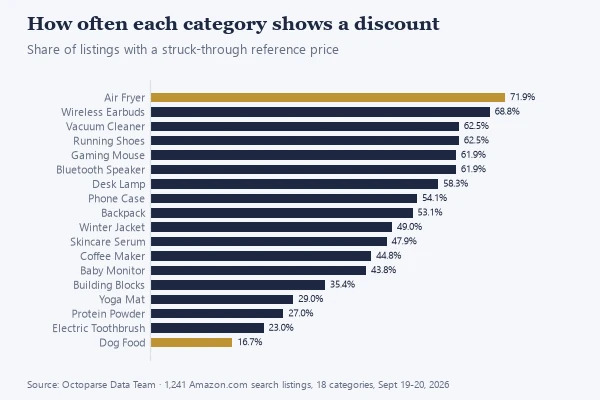
Small appliances and electronics accessories discount most often, at 55% of listings or more. Repeat-purchase consumables discount least: dog food, protein powder, and electric toothbrushes are all under 30%, with median markdowns of 10-17%. Shoppers who buy a product every month already know its price, so a reference-price badge does less work there.
The practical point for pricing analysts: never report one blended “average Amazon discount.” Mixing air fryers with dog food produces a number that describes neither.
Extreme Discounts Cluster in One Category
Across all 18 categories, only 7 listings are discounted 70% or more:
- 6 are wireless earbuds, a category with 16 listings in our sample, 11 of them discounted.
- 1 is an electric toothbrush, a generically titled listing about 74% off with 49 ratings.
The other 16 categories, more than 1,100 listings combined, produced zero listings at 70% off or deeper.
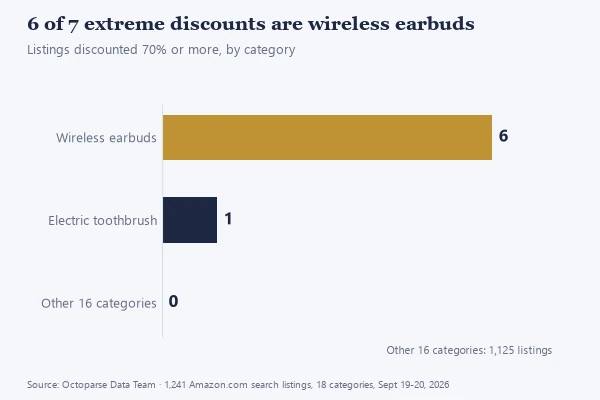
This cuts against the popular claim that “fake discounts are everywhere on Amazon.” In this sample, extreme discounting is rare and concentrated in one identifiable niche.
The toothbrush listing strengthens the pattern rather than breaking it. It sits in a category whose other 22 discounted listings have a median discount of 16.1%, yet it shares the same profile as the six earbuds: a generic product title, a low rating count, and a price under $20 set against a much higher reference price.
Established Brands vs. No-Name Listings in Wireless Earbuds
We split the 11 discounted earbuds listings into two groups:
| Listing type | Listings | Discount range | Reference price | Current price | Ratings |
|---|---|---|---|---|---|
| Established brands (Soundcore by Anker, TOZO) | 5 | 30.2-47.5% | $19.99-$49.99 | $13.96-$26.99 | 42.1K-117.3K |
| No-name or little-known brands | 6 | 90.0-92.3% | $139.99-$299.99 | $13.99-$23.98 | 36-1K |
The five established-brand listings cover three products; two Soundcore models each appear as two color variants with separate ASINs. Their discounts look like normal promotions. Of the six no-name listings, four carry no brand name in the title at all and two lead with a little-known brand name. All six sell for roughly the same $14-$24 as the branded earbuds, but against reference prices of $139.99 to $299.99.
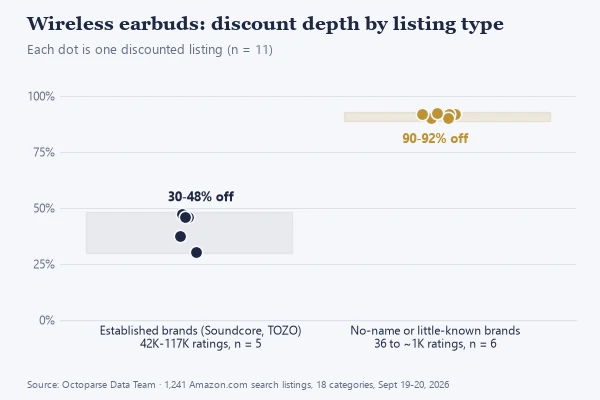
There is no overlap between the two groups. Every established-brand listing is under 48% off, and every no-name listing is over 90% off. The rating count separates them just as cleanly: at least 42,100 ratings on one side, about 1,000 or fewer on the other.
What the FTC and Amazon’s Own Rules Say
The FTC’s Guides Against Deceptive Pricing (16 CFR 233.1) describe this pattern directly: “If, on the other hand, the former price being advertised is not bona fide but fictitious… the ‘bargain’ being advertised is a false one.”
Amazon has also tightened its own rules. Since April 23, 2026, a seller’s List Price is shown as a strike-through only if the product recently sold at that price at another retailer, or customers bought it at that price as the Featured Offer on Amazon (ppc.land coverage). A May 18, 2026 update changed how the “Typical Price” baseline is calculated.
What this data can and cannot show:
- It cannot prove deception. We are not claiming any specific listing or seller broke a rule. Proving that a reference price never reflected real sales requires price history for each ASIN over weeks or months, which a one-day snapshot does not have.
- It does show a display pattern. The six no-name earbuds listings display exactly the “was/now” shape that both the FTC guidance and Amazon’s 2026 rules are aimed at. We cannot tell from this data whether Amazon has reviewed any of them.
How to Spot an Inflated Reference Price
For pricing, competitive-intelligence, and e-commerce content teams, four lessons carry over directly:
- Watch for the combination of a deep discount and few reviews. A low rating count alone is not a warning sign: 156 discounted listings had about 1,000 ratings or fewer, and their median discount was a normal 20%. But all 7 listings at 70%+ off were in that group, and none of the 382 discounted listings with more ratings came close. Rating count is already in any search-results export, so “discount above 70% and under about 1,000 ratings” makes a cheap first filter for manual review.
- Benchmark discounts within a category. A 28% air fryer discount and a 10% dog food discount are both normal for their categories. Compare each listing with its own category’s distribution, not a marketplace-wide average.
- One scrape shows today’s sticker math, not the price history. To judge whether a reference price was ever real, track the same ASIN’s selling price on a schedule over days or weeks. Consumer tools like Keepa and CamelCamelCamel do this for single products; our Amazon price history tracker comparison covers the options.
- Treat one suspicious listing as a hypothesis. Before this study, a single-category test turned up one earbuds listing marked down about 92%. It looked like a fluke. At scale, it turned out to be one of the six no-name outliers.
FAQ
Are Amazon discounts fake?
Most are not. In our 1,241-listing sample, 87.6% of discounts were between 0% and 40%, which is normal promotional pricing. Extreme discounts of 70% or more appeared on only 0.56% of listings.
How can you tell if an Amazon “was” price is inflated?
Check three things: whether the discount is far above what’s normal for the category, whether a deep discount sits on a listing with few ratings, and whether the price history (from a tracker such as Keepa or a scheduled scrape) ever showed the product selling at the reference price.
Which Amazon categories have the most extreme discounts?
In our September 2026 sample, wireless earbuds had 6 of the 7 listings discounted 70% or more. The other 16 categories had none, apart from one electric toothbrush listing.
Is Amazon doing anything about fake list prices?
Yes. Since April 23, 2026, Amazon shows a seller’s List Price as a strike-through only if the product recently sold at that price elsewhere or on Amazon as the Featured Offer.
Methodology and Limitations
- Collection window. Data reflects Amazon.com (US) search pages on September 19-20, 2026. Prices and badges change often, so a later re-scrape can return different figures.
- Sample. 18 manually chosen keywords, first two pages of search results each (about 100 results per keyword). This is not a random sample of Amazon’s catalog, and first-page ranking may over- or under-represent certain pricing tactics.
- Duplicates. The 1,241 rows contain 1,232 unique ASINs; 9 rows (6 in gaming mouse) are the same ASIN appearing twice in one keyword’s results. Removing them leaves every headline figure unchanged within 0.2 points (43.3% discounted, 20% median, 7 listings at 70%+).
- Export cap. Four categories (electric toothbrush, protein powder, winter jacket, yoga mat) collected 101-113 rows, but the export capped each at 100 rows, so the extra 1-13 rows were excluded.
- What “discount” means. A discount is the gap between the current price and the reference price shown on the page at scrape time. We did not cross-check any reference price against a price-history tool.
- Sponsored flag. The sponsored field returned “false” for all 1,241 rows, which is implausible and likely reflects incomplete detection. We did not use it.
- Small category. Wireless earbuds has only 16 listings. Read the brand split as a directional signal; a larger sample may show a less clean divide.
- Listing type. “Established brand” means a brand name in the title and more than 40,000 ratings. “No-name or little-known” means no brand name in the title, or a brand name on a listing with about 1,000 ratings or fewer (Amazon displays counts above 999 rounded, e.g. “1K”). We report ranges rather than individual listings and do not name any seller.
Data Source
We collected the data with Octoparse, a web data platform, using an Amazon Product Scraper template from the Octoparse Templates Gallery.
The template returns product name, ASIN, current price, reference price, rating, and rating count from Amazon search results for any keyword list. It can also run on a schedule in Octoparse Cloud for ongoing price tracking.
https://www.octoparse.com/template/amazon-product-scraper-by-keywords
To reproduce or extend this study, run the same template on the same 18 keywords or on your own list. For more on the method, see our guides to scraping Amazon product data and building an Amazon price scraper.
We collected no seller account data or personal information. Aggregated statistics appear in the tables above.
Collected September 19-20, 2026 by the Octoparse Data Team. Report v2. Citation welcome with attribution.