

On August 6, 2026, OpenAI, Amazon, Cursor, Microsoft, and Vercel published Agent Plugins, an open standard for packaging the tools and data connections AI agents rely on. Google has since joined as a core maintainer. Here’s what the standard actually does, and what it means for the data infrastructure behind AI agents.
Quick Answer
Agent Plugins is an open, vendor-neutral packaging format that bundles Agent Skills (instructions) and MCP servers (live tool and data connections) into one portable folder, so any AI client, ChatGPT, Cursor, GitHub Copilot, VS Code, can read the same package instead of needing its own setup.
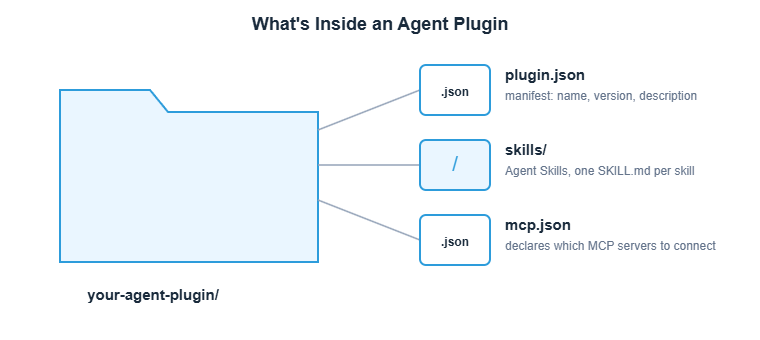
Agent Plugins Package Structure
| Component | What it does |
plugin.json | Manifest with name, version, description |
skills/ | Agent Skills, reusable instructions in SKILL.md files |
mcp.json | Declares which MCP servers to connect |
What Problem Agent Plugins Solves
Before this standard, a developer building a tool for AI agents had to package it differently for every client. Claude, Cursor, GitHub Copilot, and ChatGPT each expected their own directory structure and configuration format. A team supporting five clients maintained five slightly different versions of the same tool.
Agent Plugins removes that duplication. A plugin is just a folder: a manifest, an optional skills/ directory, and an optional mcp.json. Any conformant client reads the same folder. The specification also requires non-fatal failure handling, so if one MCP server in a plugin fails to load, the rest of the plugin still works.
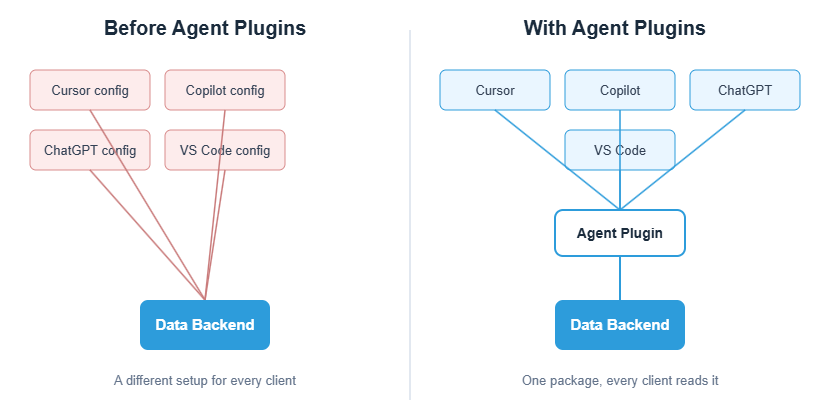
For a data backend like Octoparse, that points to one practical benefit down the line: calling it from inside an agent should get simpler over time, regardless of which client the agent happens to run in.
How Agent Plugins Relates to MCP and Agent Skills
Agent Plugins does not replace MCP or Agent Skills. It packages them.
- Agent Skills are instructions that tell an agent how to do something, stored as a SKILL.md file.
- MCP (Model Context Protocol) is the connection layer that lets an agent read and act on external data and tools in real time.
- Agent Plugins is the folder structure that bundles both into one distributable unit.
Agent Skills vs MCP, in short, comes down to instructions versus connections: one tells an agent what to do, the other gives it something to do it with. Agent Plugins doesn’t pick between them, it just packages both.
A team that already has an MCP server or a set of Agent Skills doesn’t need to rebuild anything. Agent Plugins just gives those existing pieces one shared packaging format instead of a different one for every client.
What Agent Plugins Means for AI Agent Data Infrastructure
Most of what an AI agent does well depends on the data it can reach. An agent that can only see its training data is limited to what it already knows. An agent connected to a live data backend, through MCP, can pull current information and act on it.
Agent Plugins standardizes how that backend gets wired in. Instead of a data provider writing custom integration code for every AI client, the data connection ships once, as a plugin, and any conformant client can use it. For teams that run data infrastructure meant to feed AI agents, this lowers the cost of being usable across the entire agent ecosystem rather than one client at a time.
Octoparse already operates in this space, and its role covers more than pulling data off a page. The Octoparse MCP Server connects Claude, Cursor, ChatGPT, VS Code, and other MCP-compatible clients to Octoparse’s data backend, so an agent can search templates, schedule and monitor cloud tasks, chain multiple templates into one workflow, and export the results in the format it needs, all through plain-language requests instead of custom code. Alongside it, the Octoparse Agent Skills repository gives agents scenario-specific instructions, covering lead generation, competitor monitoring, and template-chain design, so the agent knows which template to call, how to configure it, and how to sequence it with others.
Octoparse’s data extraction work already touches the AI space directly, separate from MCP or Agent Skills. GetCOAI, an AI-education platform, uses Octoparse to keep data on AI tools, pricing, and course listings current across dozens of sites, the kind of continuously updated dataset that becomes more valuable once an agent can query it directly.
Packaging both into a single Agent Plugin is a natural next step now that the standard exists, and it’s a direction we’re actively looking at.
How to Connect an AI Agent to Octoparse Today
Want to stay ahead of the trend? You don’t need to wait for a full Agent Plugin package to do it. Three mainstream access paths are already live, MCP, CLI, and OpenAPI, so there’s likely one that already fits your workflow:
- Connect the Octoparse MCP Server to Claude, Cursor, ChatGPT, or VS Code. The free tier includes 8,000 records per month via MCP or API, no credit card required.
- Prefer the terminal or a CI/CD pipeline? The Octoparse CLI runs the same templates locally or in automation, with JSONL streaming for agent workflows.
- Browse the Octoparse Agent Skills repository on GitHub for ready-made scenario instructions.
- Building directly against an API instead of MCP? The Octoparse OpenAPI reference covers authentication, task management, and data export for the same template-driven workflows.
- See real examples in 9 AI Scraping Use Cases (With Octoparse MCP & Live Data Examples) and 11 Best MCP Servers for Claude & AI Assistants.
FAQs About Agent Plugins
- What are Agent Plugins?
Agent Plugins is an open specification, version 1.0, that packages Agent Skills and MCP server configurations into one portable folder. It was published on August 6, 2026 by a steering committee including OpenAI, Amazon, Cursor, Microsoft, and Vercel, with Google as a core maintainer.
- Who created Agent Plugins?
The initial Technical Steering Committee includes core maintainers from Amazon, Cursor, Microsoft, OpenAI, and Vercel. Google joined afterward as a core maintainer, as detailed on the Google Developers Blog, and is adding support in its Agents CLI and Data Agent Kit.
- Is Agent Plugin the same as MCP?
No. MCP is the protocol that connects an agent to live tools and data. Agent Plugins is a packaging format that bundles MCP server configuration together with Agent Skills so both can be distributed as one unit.
- Which AI clients support Agent Plugins?
At launch, ChatGPT and Codex support the format, along with Cursor, GitHub Copilot, Kiro, and VS Code. Google is adding support through its Agents CLI and Data Agent Kit.
- Does Octoparse have an Agent Plugin?
Octoparse has a live MCP Server and a public Agent Skills repository, the two components Agent Plugins packages together, and a combined Agent Plugin package is on the way. Keep an eye on Octoparse’s site for updates when it ships.
- How do I connect an AI agent to Octoparse’s data today?
Add the Octoparse MCP Server endpoint to any MCP-compatible client, such as Claude, Cursor, ChatGPT, or VS Code, using OAuth or an API key. Full setup steps are in the Octoparse MCP documentation.