

GEO and SEO share the same goal — getting your brand found — but on different surfaces. SEO earns your pages a ranking in the list of links. GEO earns your brand a mention or citation inside AI-generated answers — the kind of visibility Octoparse‘s templates are built to track. They aren’t rivals: most of what makes a page rank also makes it easy for an AI to cite. What changes is the scoreboard — rankings and clicks for SEO, mentions and citations for GEO.
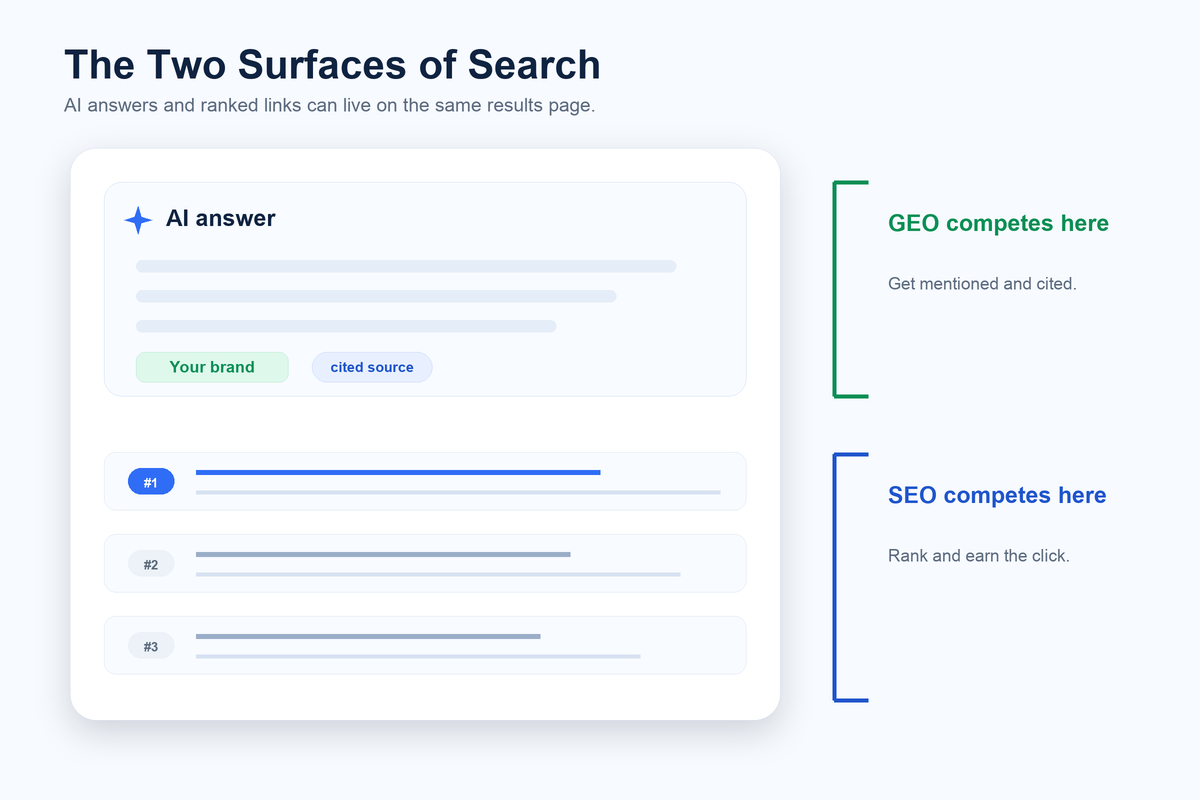
Search is splitting into two surfaces. Below the AI answer sit the familiar blue links that search engine optimization (SEO) has targeted for two decades; inside the answer sit the brands and sources that generative engine optimization (GEO) is built to win. Here’s how the two disciplines differ, where they overlap, and whether you still need both.
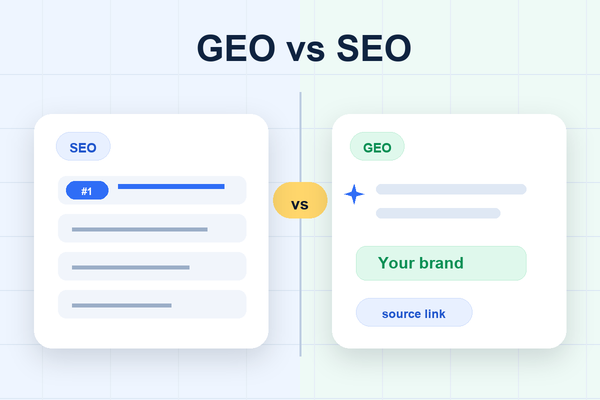
GEO vs SEO comparison table
| Dimension | SEO | GEO |
| Goal | Rank your page in the list of results | Get your brand named or cited inside the AI’s answer |
| Surface | The search results page (the blue links) | AI answers — ChatGPT, Google AI Overviews, AI Mode, Perplexity |
| Unit of success | Position + clicks | Mentions, citations, and share of voice |
| What decides it | The ranking algorithm (relevance, authority, links) | The model’s synthesis — what it chooses to lift and name |
| How you win | Keywords, backlinks, technical health, content depth | Direct answers, clean structure, entity consistency, being cited by trusted sources |
| How you measure | Rank trackers, Search Console, analytics | AI visibility tracking — run a prompt set, record mentions and citations |
| Feedback loop | Clicks show up in analytics | Often invisible — there’s no click to log |
What Is SEO?
Search engine optimization (SEO) is the practice of improving a page so it ranks higher in a search engine’s results for a given query. It works through relevance signals (keywords, content quality), authority signals (backlinks and reputation), and technical health (crawlability, speed, mobile-friendliness). The payoff is a click: a searcher sees your listing and visits your page. SEO has been the default way to be found online for roughly twenty years, and for transactional and navigational searches it still is.
What Is GEO?
Generative engine optimization (GEO) is the practice of structuring your content and online presence so your brand appears inside AI-generated answers — named in the text (a mention) or linked as a source (a citation). Where SEO competes for a position in a list, GEO competes for a spot in the paragraph the AI writes. The tactics lean on clear structure, direct answers, consistent entity signals, and being referenced by sources the model already trusts.
GEO is a big topic on its own — this article is only the comparison. For the full breakdown of what GEO is and how to track where your brand shows up, see our guide to AI search visibility.
GEO vs SEO: The Key Differences
The table above captures the split; three differences matter most in practice.
The surface is different. SEO targets the ranked list of links. GEO targets the generated answer above or instead of that list. A page can rank first and still go unmentioned in the AI answer sitting on top of it — and vice versa.
The unit of success is different. SEO counts position and the clicks that follow. GEO counts whether you’re named, whether you’re cited, and how you stack up against competitors named in the same answer. Being cited (linked as a source) is usually the entry point; being mentioned (named in the sentence) is the goal.
The feedback loop is different. A ranking change shows up in your analytics as traffic. A mention inside an AI answer usually doesn’t — the user often gets what they need without clicking, so nothing lands in your reports. That invisibility is exactly why GEO needs its own measurement layer rather than riding on your existing SEO dashboards.
Where GEO and SEO Overlap
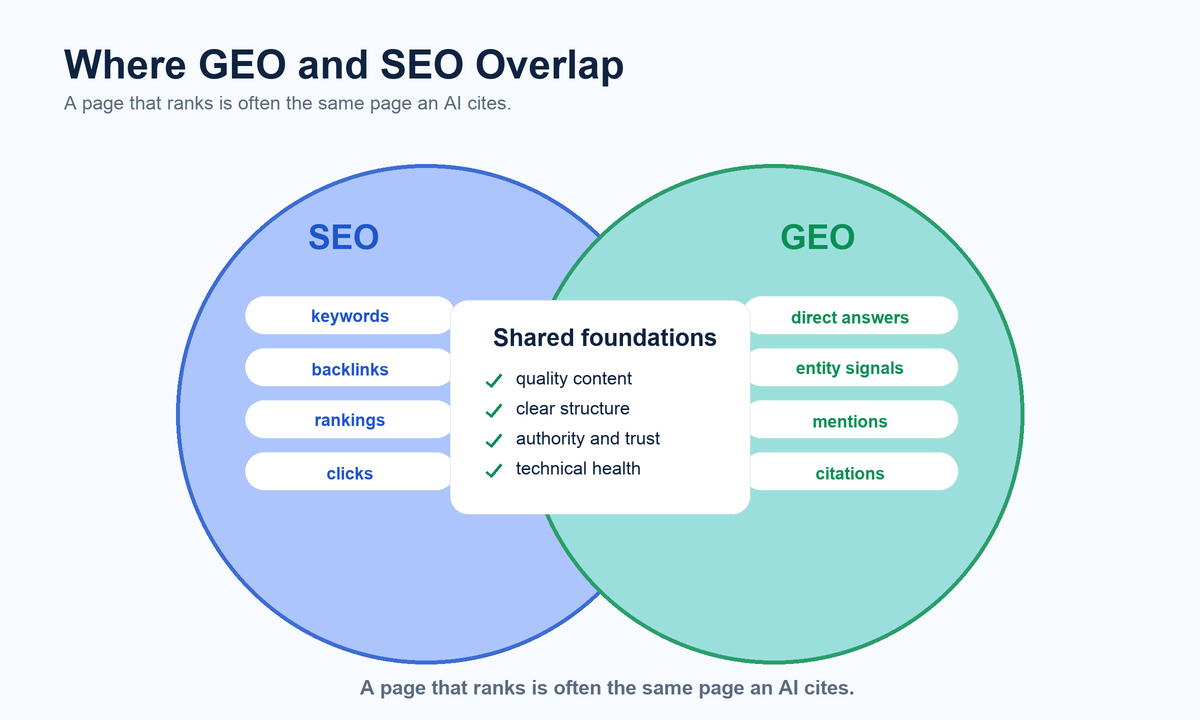
GEO and SEO overlap more than the contrast suggests, because AI answers are built partly from the same web the search index draws on. The pages an AI Overview cites are frequently pages that already rank well. So the foundations are shared: original, accurate content; clean heading structure; fast, crawlable pages; and real authority and trust signals. Work that improves any of these tends to help both a ranking and a citation. In practice, GEO builds on top of solid SEO rather than starting from a blank page.
Is GEO Replacing SEO?
No — GEO is expanding what “being found” means, not replacing SEO. AI answers do absorb some clicks that used to go to the results page, especially for informational, “what is” and “how to” queries (our AI search visibility guide has the sourced data on how far click-through can fall). But two things keep SEO essential. First, transactional, navigational, and local searches still send people to pages, not summaries. Second, GEO largely depends on SEO’s foundations — to be cited by an AI, your content usually needs the same quality, structure, and authority that earns a ranking. The honest framing is complementary, not either-or: SEO keeps your pages visible in the links, and GEO fights for your brand inside the answers.
GEO vs AEO vs SEO: How They Relate
You’ll also see the term AEO — answer engine optimization. For practical purposes, GEO and AEO are near-synonyms: both aim to get your brand into AI-generated answers, and practitioners use the labels interchangeably (some reserve “AEO” for direct-answer engines like ChatGPT and Perplexity). SEO is the distinct one — it targets the ranked links, not the generated answer. If the naming feels muddy, that’s because the field is new; our guide covers the full GEO/AEO glossary. Treat GEO and AEO as the same effort, and SEO as its companion on the other surface.
Should You Focus on SEO or GEO?
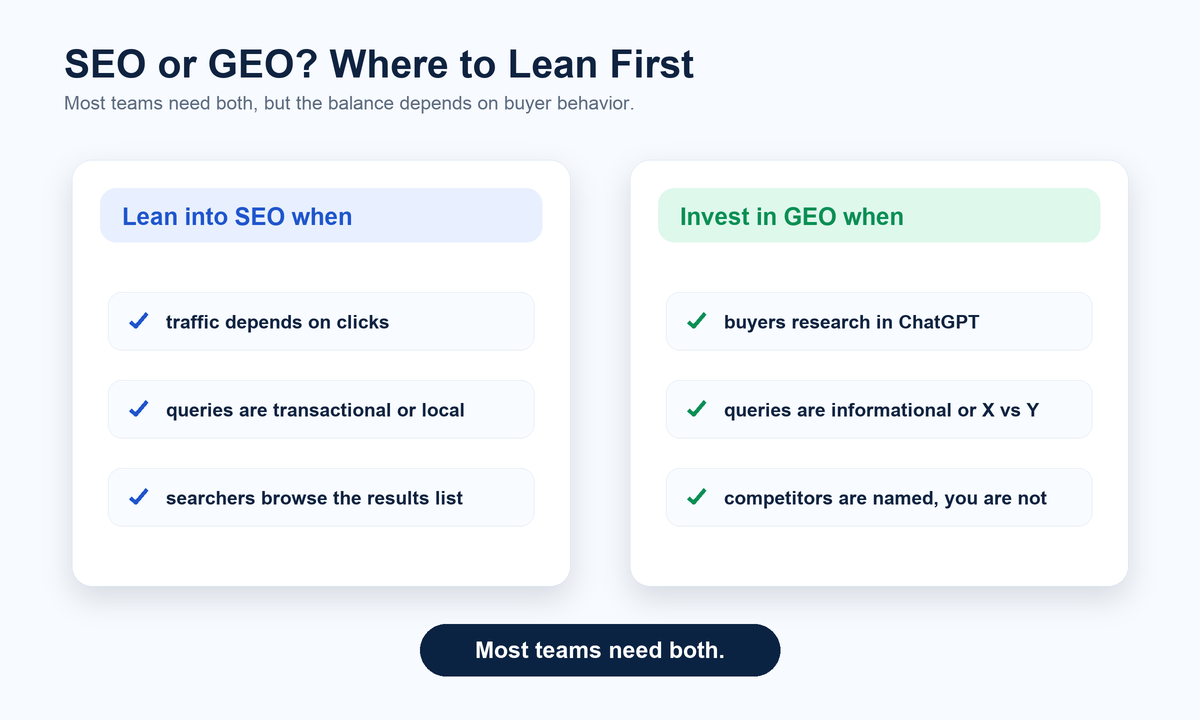
For most brands the answer is both, but the balance depends on where your buyers actually are.
Lean into SEO when your traffic and revenue depend on clicks to your pages, your key queries are transactional or local (“buy,” “near me,” “pricing”), or you’re in a category where searchers still browse the results list before deciding. SEO remains the higher-certainty channel for driving visits.
Invest in GEO when your audience researches inside ChatGPT or reads Google’s AI answers before clicking anything, your important queries are informational or comparison-style (“best tool for X,” “X vs Y”), or you’ve checked and found competitors named in AI answers while your brand is absent. That absence is invisible until you measure it — and it compounds while you’re not looking.
The realistic move for most teams is to keep doing SEO and add GEO on top, because the two share foundations and the incremental cost of GEO is mostly measurement plus a few structural habits.
How to Do Both at Once
The good news is that GEO and SEO compound. Leading a page with a crisp, direct answer, using descriptive question-style headings, adding schema markup, keeping entity descriptions consistent across the web, and earning references from trusted sources — every one of those helps a page rank and makes it easier for an AI to lift and cite. You don’t run two separate content programs; you run one, structured well.
The one genuinely new habit is measurement. Rankings show up in your existing tools; AI mentions and citations don’t. So alongside your rank tracker, run a fixed prompt set through the AI engines your buyers use and record where your brand appears. You can buy a monitoring platform, or export the raw answers yourself for free — the https://www.octoparse.com/template/chatgpt-visibility-tracker and https://www.octoparse.com/template/google-aio-scraper templates do exactly that. Our AI search visibility guide walks through the full tracking workflow.
https://www.octoparse.com/template/chatgpt-visibility-tracker
https://www.octoparse.com/template/google-aio-scraper
FAQ
- What is the difference between GEO and SEO?
SEO (search engine optimization) improves your pages to rank in a search engine’s list of links, measured by position and clicks. GEO (generative engine optimization) structures your content so your brand is named or cited inside AI-generated answers, measured by mentions and citations. Same goal — being found — on two different surfaces.
- Is SEO dead in 2026?
No. AI answers absorb some informational clicks, but transactional, navigational, and local searches still drive people to pages, and GEO itself relies on SEO’s foundations of quality, structure, and authority. SEO has changed and shares the stage with GEO, but it remains essential to being found.
- Does GEO help SEO, and vice versa?
Yes, in both directions. The pages AI answers cite are often pages that already rank, so the shared foundations — clear structure, authoritative content, technical health — improve rankings and citations at once. Most GEO tactics are SEO best practices applied with AI extraction in mind.
- Is GEO the same as AEO?
Effectively yes. GEO (generative engine optimization) and AEO (answer engine optimization) both aim to get your brand into AI-generated answers, and the terms are used interchangeably. Some people reserve AEO for direct-answer engines like ChatGPT and Perplexity, but the practice is the same.
- Which matters more, GEO or SEO?
It depends on where your buyers research. If they still click through search results, SEO drives more measurable traffic. If they increasingly ask ChatGPT or read AI Overviews before clicking, GEO decides whether you’re in the conversation at all. Most brands need both, with the balance set by their audience.
- Do I need to rewrite my content for GEO?
Usually not rewrite — restructure. Lead sections with direct answers, use descriptive question-style headings, add schema markup, and keep your brand described consistently across the web. These changes help AI systems cite you while also strengthening traditional SEO, so you’re improving one body of content, not maintaining two.
- How do I track whether AI answers mention my brand?
Run a fixed set of buyer questions through ChatGPT, Google AI Overviews, and Google AI Mode, and record whether your brand is named or cited. Octoparse’s templates — the https://www.octoparse.com/template/chatgpt-visibility-tracker, https://www.octoparse.com/template/google-aio-scraper, and https://www.octoparse.com/template/google-ai-mode-scraper — export each answer’s mentions, citations, and sources to a spreadsheet, so you can watch the trend over time.
https://www.octoparse.com/template/chatgpt-visibility-tracker