

AI search visibility is how often your brand shows up in the answers generated by tools like ChatGPT, Google AI Overviews, and Google AI Mode. You measure it by running a fixed set of questions through each engine and recording which brands get named and which sources get cited. You can do this with a paid monitoring platform — or, for free, by exporting the raw AI responses yourself with a web scraper such as Octoparse and analyzing them in a spreadsheet.
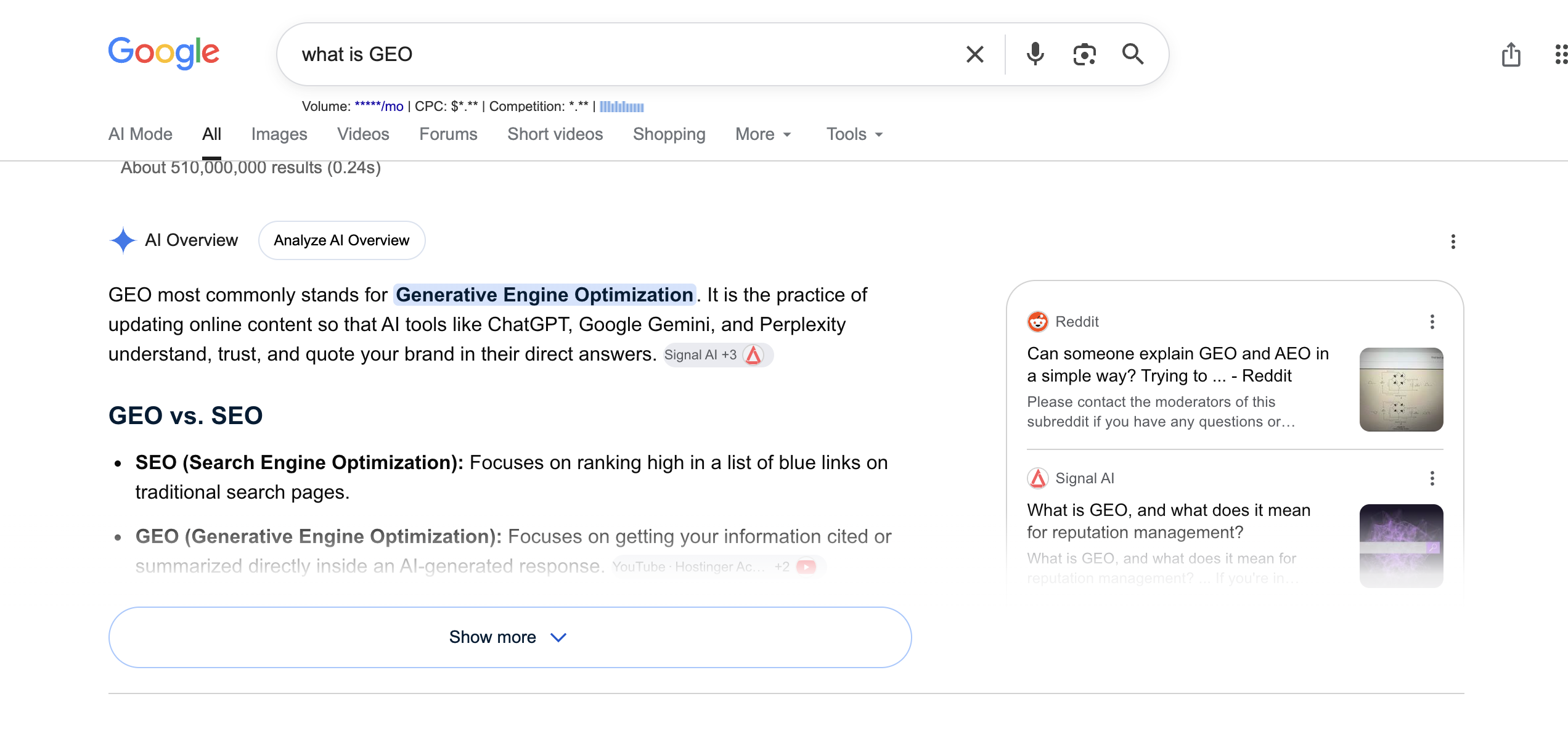
The search box is quietly turning into an answer box. Ahrefs, analyzing 146 million search results, found AI Overviews appear on about one in five of them — and far more for the informational, question-style queries where buyers do their early research. When one appears, clicks dry up: Pew Research Center tracked the browsing of 900 U.S. adults and found people clicked a traditional result just 8% of the time when an AI summary was present, versus 15% without, and only 1% clicked a source cited inside the summary. A separate Ahrefs study of 300,000 keywords put the top-ranking page’s click-through drop at 34.5%.
Here’s the problem that creates. A search ranking is visible — you can watch position 8 climb to position 3. A mention inside an AI answer is not. If ChatGPT recommends three competitors and never names you, nothing on your dashboard turns red. You’re losing the sale at the moment of consideration and you can’t see it happening. AI search visibility is the practice of making that invisible layer measurable.
What Is AI Search Visibility?
AI search visibility is a measure of how present your brand is inside AI-generated answers — how often you’re named, how often you’re cited as a source, and how you’re positioned next to competitors. It’s the AI-era counterpart to keyword rankings, except the “position” you care about is whether your brand appears in a generated paragraph at all.
Two things get measured, and they’re not the same:
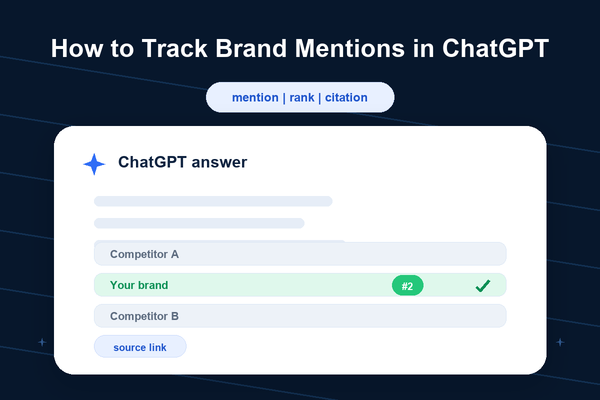
- A mention is when the AI names your brand in the text of its answer (“tools like Octoparse, Semrush, and…”).
- A citation is when the AI links your page as one of the sources behind its answer.
A citation is the entry ticket; a mention is the goal. Most brands start with neither, earn a citation first, and then work toward being named in the sentence itself.
The whole discipline of shaping content to earn those mentions and citations has a few interchangeable names. Here’s the vocabulary in one place.
Key Terms, Defined
| Term | What it means |
| AI search visibility | How often and how prominently your brand appears in AI-generated answers. |
| Generative Engine Optimization (GEO) | Structuring content and online presence to improve visibility in AI answers. The most common name for the practice. |
| Answer Engine Optimization (AEO) | A near-synonym for GEO, emphasizing “answer engines” like ChatGPT and Perplexity. |
| AI SEO / LLM SEO | Informal labels for the same idea — SEO adapted for large language models. |
| Mention | The AI names your brand in its answer text. |
| Citation | The AI links your page as a source for its answer. |
| Share of voice | Your mentions as a proportion of all brand mentions for a set of prompts. |
| Prompt set | The fixed list of questions you run through each engine to measure visibility over time. |
| Query fan-out | How an AI splits one question into several sub-queries, then merges the sources it finds. |
GEO, AEO, AI SEO — Are They the Same Thing?
For practical purposes, yes. GEO, AEO, AI SEO, and LLM SEO all describe the same goal: getting your brand surfaced inside AI answers instead of only in the blue links below them. There’s no settled academic line between them, and practitioners use them interchangeably. If you want the deeper distinction between this and classic search, see our companion piece on GEO vs SEO. Throughout this guide we’ll use “AI search visibility” for the outcome and “GEO” for the practice.
Why AI Search Visibility Matters in 2026
AI search visibility matters because buyers now form opinions inside the AI answer, before they ever reach a results page. When someone asks ChatGPT “what’s the best tool for X,” the brands it names become the shortlist. If you’re not on it, you’re not in the consideration set — and there was no click for your analytics to record.
Three shifts make this urgent:
- AI answers are now a default surface. AI Overviews show on roughly one in five searches overall and on the large majority of informational, “how-to” and “what-is” queries — so for research-stage questions, the AI answer is the first thing most people read.
- The click is disappearing. When an AI answer resolves the question on the page, far fewer people click through. Your traffic can fall even while your “rankings” hold.
- Being cited pays off. Brands cited inside an AI Overview can actually win more clicks, not fewer — which is exactly why earning a citation has become the objective, not a side effect.
- The channel is invisible by default. Traditional mention-monitoring tools watch indexed web pages. AI answers are generated on the fly and aren’t indexed, so they slip past the tools most teams already run.
You can’t fix what you can’t see. Measuring your presence in AI answers is the first step to influencing it.
Mentions vs. Citations: What Actually Gets Measured
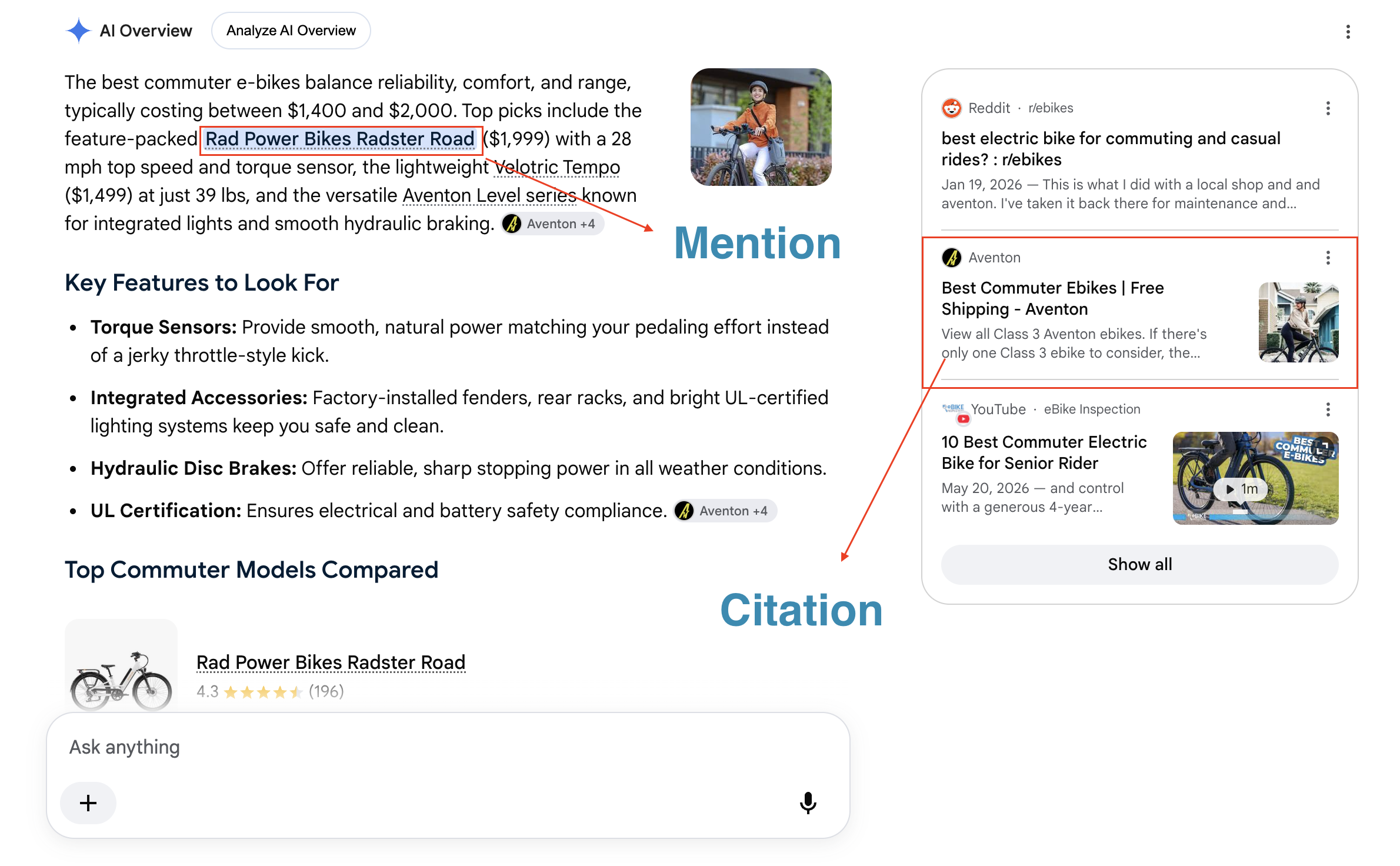
When you track AI search visibility, you’re recording a handful of concrete data points for every prompt you test. Getting these definitions straight is what turns “the AI didn’t mention us” into an action plan.
- Mention (yes/no + position): Is your brand named, and how early in the answer? The brand named first tends to capture the most intent.
- Citation (yes/no + source URL): Did the AI link one of your pages? Which one?
- Competitor coverage: Which rival brands appear alongside you, and how are they described?
- Cited sources: Which domains did the answer pull from? These are the pages you’d need to appear on or displace.
- Sentiment: Is your brand described positively, neutrally, or with caveats?
Run those same measurements on the same prompt set over time and you get a trend line — the AI-era equivalent of a rank-tracking chart, except it’s measuring whether you exist in the answer at all.
How to Track Your AI Search Visibility
Tracking AI search visibility comes down to four repeatable steps: build a prompt set, run it through each engine, record what comes back, and repeat on a schedule. You can pay a platform to do this, or run it yourself and keep the raw data. Here’s the workflow either way.
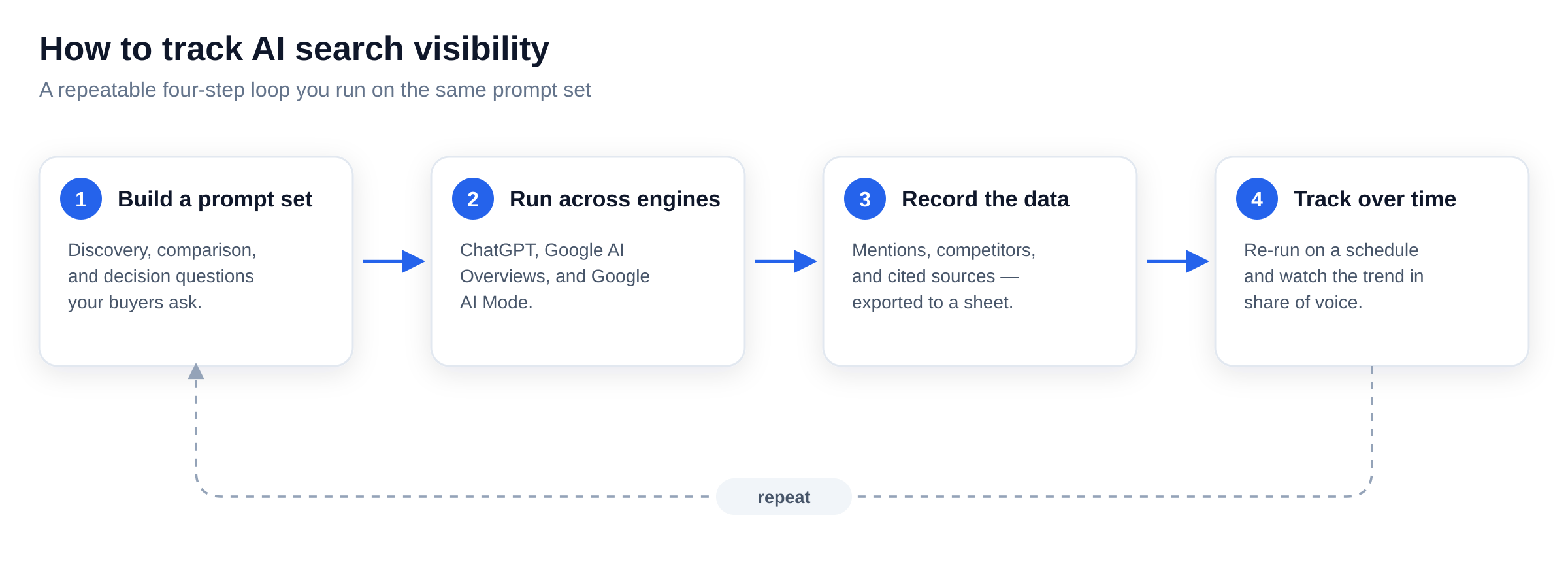
Step 1 — Build a prompt set. List the real questions a buyer would ask on the way to choosing you. Cover three intents: discovery (“how do I solve X”), comparison (“best tools for X”), and decision (“X vs Y”). Thirty prompts split evenly across the three is a solid working minimum. This list becomes fixed — you’ll reuse it every run so results are comparable.
Step 2 — Run the prompts through each engine. Submit every prompt to the AI surfaces your buyers actually use — ChatGPT, Google AI Overviews, and Google AI Mode at minimum — and capture the full response plus any cited links. Doing this by hand means opening each engine, pasting each prompt, and copying each answer, which is why most teams automate it.
Step 3 — Record mentions, competitors, and cited sources. For each response, log whether your brand was named, which competitors appeared, and which URLs were cited. A web scraper such as Octoparse can export the AI response, the cited source titles, and the source URLs straight to a spreadsheet, so this becomes a structured dataset instead of a folder of screenshots.
Octoparse has a ready-made template for each of the three engines, so you don’t build anything from scratch — run it point-and-click in the browser, or call it through the Octoparse API if you’d rather trigger and pull results programmatically. Here’s what each captures and what it costs:
What Each Template Captures
| Template | AI surface | Captures & setup |
| Google AIO Scraper | Google AI Overviews | Captures: Query, AI Overview text, cited source titles, and source URLs. Setup/cost: No API key. Free to run; cloud or scheduled runs use your Octoparse plan. |
| Google AI Mode Scraper | Google AI Mode | Captures: Prompt, AI Mode answer, links, and cited source pages. Setup/cost: No API key. Free to run; cloud or scheduled runs use your Octoparse plan. |
| ChatGPT Visibility Tracker | ChatGPT | Captures: Timestamp, prompt, market, full ChatGPT response, citations, source domains, and per-brand mention/rank fields. Setup/cost: Built-in access; 2,000 rows/week free via API or MCP. |
All three export to Excel, CSV, or JSON, so the output drops straight into whatever you already use for analysis.
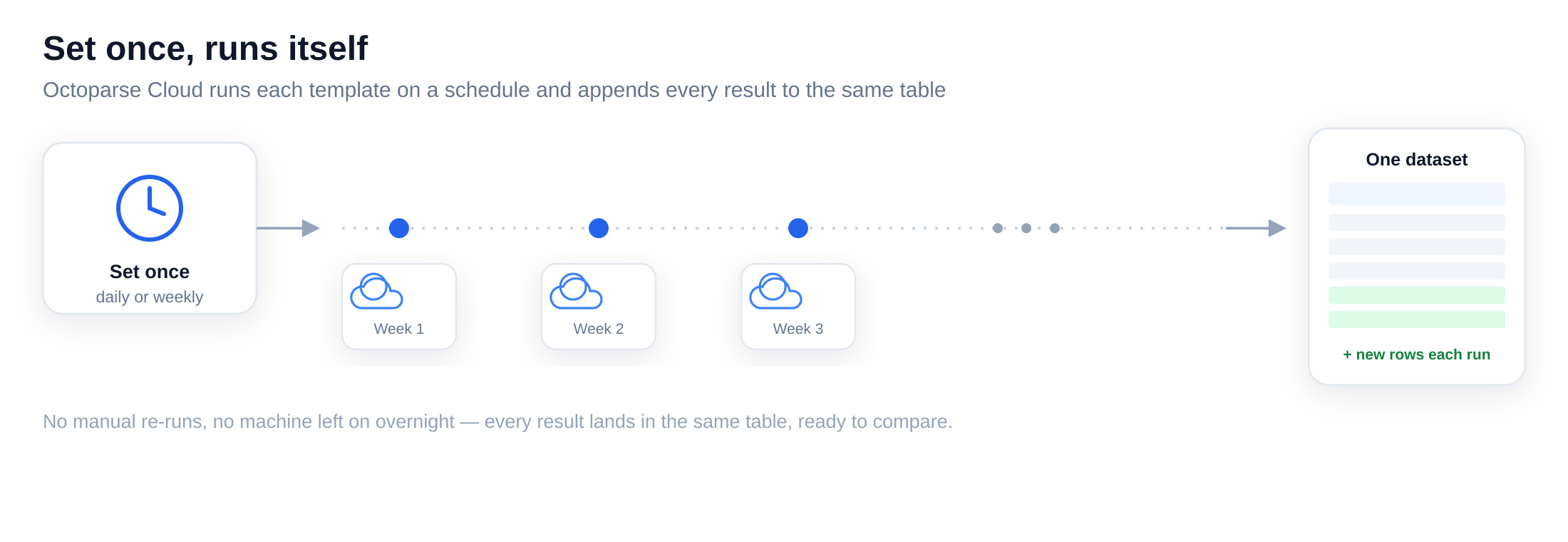
Step 4 — Track changes over time. AI answers drift between runs, so a single snapshot tells you little. Re-run the same prompt set on a schedule — monthly at minimum, weekly once you start changing content — and watch the trend in mentions, share of voice, and cited domains. This is where automation earns its keep: Octoparse can run each template on a schedule in the cloud — daily or weekly, with no machine left on overnight — so your AI-citation dataset refreshes itself and every run lands in the same consistent table.
Which AI Engines Should You Track?
Track the engines your buyers use to make decisions. For most brands in 2026 that means three, each of which surfaces and cites sources differently — so each deserves its own view.
Google AI Overviews
Google AI Overviews are the AI summaries that appear above traditional results for many searches. They pull from multiple web pages and cite them inline, which makes them the most SEO-adjacent surface: the sources cited are often pages that already rank. To track them, collect the AI Overview text and its cited sources across your keyword set — our guide to tracking Google AI Overviews goes deeper. The Google AIO Scraper template does this without a Google API key and returns one row per cited source per query, so you can see exactly which domains each Overview trusts. If you also need organic rankings and the rest of the SERP alongside the Overview, our guide to Google’s official Search API and alternatives covers that.
https://www.octoparse.com/template/google-aio-scraper
Google AI Mode
Google AI Mode is a separate, conversational search experience built for complex, multi-part questions rather than single queries. Because it’s designed for research journeys, it surfaces brands during deeper comparison and “help me decide” moments. Track it with the same prompt set to see how visibility differs between a quick answer and an extended research session. The Google AI Mode Scraper template captures the prompt, the AI Mode answer, and every cited source page — again with no API key — so you can compare who gets surfaced in a deep research session versus a one-line Overview.
https://www.octoparse.com/template/google-ai-mode-scraper
ChatGPT
ChatGPT is where a large share of buyers now do product research, often before touching a search engine at all. Tracking it means running your prompt set through ChatGPT on a schedule and recording which brands it names and links. Our walkthrough on tracking brand mentions in ChatGPT covers the method, and the ChatGPT Visibility Tracker template runs your prompts through ChatGPT — with ChatGPT access built in, no API key to manage — and exports each response with its citations, plus, for every brand you track, whether it was mentioned, how it was described, and where it ranked in the answer. (Using ChatGPT to do the scraping itself is a different job — see our guide on ChatGPT and scraping tools.)
https://www.octoparse.com/template/chatgpt-visibility-tracker
Perplexity and Gemini are worth adding as your program matures — the same prompt-set method applies to any answer engine.
How to Improve Your AI Search Visibility
Once you can measure it, you can move it. Improving AI search visibility is mostly about making your content the kind of source AI systems prefer to lift and cite.
- Answer the question directly, up top. Lead a page with a crisp, self-contained answer to the question it targets. AI systems lift the clearest answer they find — if your brand is inside that sentence, a citation becomes a mention.
- Structure for extraction. Use descriptive headings phrased as real questions, short definitional openers, tables for comparisons, and clean lists. Each section should make sense pulled out on its own.
- Get cited by the sources AI already trusts. AI answers lean on listicles, review sites, and community threads. Being named on the pages an answer already cites is often faster than trying to rank your own page first.
- Be consistent across the web. Models reward entities that are described the same way in many places — consistent naming, category, and positioning across your site, profiles, and third-party mentions.
- Add structured data. Schema markup (Article, FAQ, Product) helps engines parse what your page is about and what it can be cited for.
Free vs. Paid Ways to Track AI Visibility
There are two honest paths, and the right one depends on whether you want a finished dashboard or your own dataset.
Monitoring Platform vs. DIY Export
| Monitoring platform | DIY data export (no-code / API) | |
| Product | Semrush, Ahrefs, Peec.ai, Otterly… | Octoparse |
| What you get | A finished dashboard — visibility score, sentiment, share of voice, competitor benchmarks, and alerts, computed for you. | The raw AI responses, brand mentions, and cited URLs, exported into a spreadsheet or database you build and own. |
| Control over collection | The vendor’s schedule, prompt limits, and refresh window — you track on their terms. | Yours — you set the prompt set, the engines, and the exact collection window and cadence. |
| Best for | Teams with budget that want the analysis handed to them. | Price-sensitive teams that want to own their AI-citation data and don’t need a full analytics suite. |
| Cost | Subscription per seat/project — and the capabilities you actually want (more engines, sentiment, extra prompts) are often sold as separate add-ons. | The Google templates are free; the ChatGPT tracker is billed per row (the first 2,000 rows a week are free). No API keys to manage. |
The trade-off cuts both ways. A monitoring platform saves you setup time and hands you scoring you’d otherwise build yourself. The catch is that these platforms are expensive, each one collects on its own frequency and time window — so the numbers from two tools rarely line up, and a metric you pulled last month may not be comparable to this month’s — and the capabilities you actually need are frequently billed as separate features. Building the dataset yourself takes more setup, but you control the collection window and cadence, every data point lands in one consistent database you own, and you’re not paying per feature. If you’re watching budget and care more about a consistent, self-owned AI-citation dataset than a polished dashboard, doing it yourself is the stronger starting point.
FAQs About AI Search Visibility
- What is generative engine optimization?
Generative engine optimization (GEO) is the practice of structuring your content and online presence so your brand appears in AI-generated answers from engines like ChatGPT, Google AI Overviews, and Perplexity. It’s the AI-era counterpart to SEO, focused on earning mentions and citations inside answers rather than rankings in a list of links.
- How do I check if my brand appears in AI search?
Build a fixed list of questions your customers would ask, run each one through ChatGPT, Google AI Overviews, and Google AI Mode, and record whether your brand is named or cited. You can do it by hand, or use a tool like Octoparse to export each response and its cited sources into a spreadsheet for review.
- Can I track AI search visibility for free?
Yes. You can run a prompt set through the AI engines yourself and export the answers, mentions, and cited URLs using a free web scraper such as Octoparse, then analyze the results in a spreadsheet, feed them to an AI model to summarize and flag changes, or wire them into your own automated analysis workflow. Paid platforms add dashboards, sentiment scoring, and alerts, but the underlying tracking can be done for free.
- How is AI search visibility different from SEO rankings?
SEO rankings measure where your page sits in a list of links. AI search visibility measures whether your brand is named or cited inside the AI’s generated answer, and how it’s positioned next to competitors. A page can rank well and still be absent from the AI answer above it — see our GEO vs SEO guide for the full comparison.
- What’s the difference between a mention and a citation?
A citation is when the AI links one of your pages as a source for its answer. A mention is when the AI names your brand in the answer text itself. Citations usually come first; the goal is to move from cited source to named brand.
- How often should I track AI search visibility?
Monthly is the minimum useful cadence because AI answers drift slowly enough to see month-over-month change. Move to weekly once you start changing content to influence the results, so you can tell what’s working.
- Which AI engines should I track first?
Start with the engines your buyers actually use — for most brands that’s ChatGPT, Google AI Overviews, and Google AI Mode. Add Perplexity and Gemini as your program grows, using the same prompt set.
- Do I need an API key to track AI answers with Octoparse?
No — Octoparse’s templates handle access for you. The Google AI Overview and AI Mode templates simulate a browser-based search and are free. The ChatGPT Visibility Tracker has ChatGPT access built in (no OpenAI key to supply); it’s billed per row, with the first 2,000 rows a week free.
The Takeaway
For twenty years, being found meant ranking. Now it increasingly means being named — inside an answer most of your buyers read before they ever reach your site. That layer is invisible until you measure it, and you can’t optimize a number you can’t see. Whether you buy a monitoring platform or export the raw answers yourself, the move that matters is the same: pick a prompt set, run it across the engines your customers use, and start watching where your brand shows up. Everything in GEO follows from that first measurement.