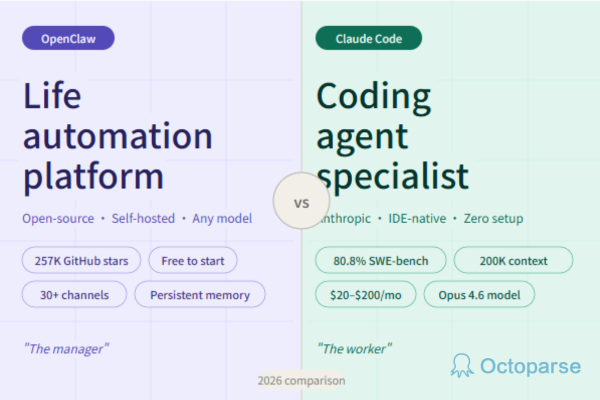


A post claiming that OpenClaw “crushes” RPA has been making the rounds in the process automation space. The argument: AI agents are smarter, more flexible, and will make traditional RPA obsolete.
But “AI agent vs RPA” frames a competition that isn’t really there. These tools were built for different contexts and serve different users. Here is the difference between AI agents and RPA, and why it matters for anyone making automation decisions right now.
AI Agent Review
What Is an AI Agent?
An AI agent is a software system that takes a goal as input and figures out how to reach it autonomously. Unlike scripted automation, it interprets intent, breaks tasks into steps, and adapts when conditions change. The key distinction from traditional automation is that you define the outcome, not the steps.
How AI Agents Work
AI agents are powered by large language models (LLMs) that reason over instructions at runtime. When given a task, the agent decides which tools to call, in what order, and how to handle unexpected results. This makes it flexible by design, but also non-deterministic: the same prompt can produce different outputs on different runs.
AI Agent Use Cases
AI agents are best suited for tasks that are dynamic, unstructured, or require judgment:
- Personal productivity. Morning briefings, email triage, calendar management.
- Content workflows. Research, drafting, cross-platform repurposing.
- Developer automation. Code review assistance, deployment triggers, monitoring alerts.
- Data gathering. Brand monitoring, competitor tracking, social media summarization.
- Ad hoc research. Pulling and synthesizing information from multiple sources on demand.
Who Should Use an AI Agent
AI agents are primarily used by individual developers, technical enthusiasts, and early adopters building personal or experimental workflows. They are not designed for teams that need centralized oversight, audit trails, or guaranteed uptime.
OpenClaw as an Example
OpenClaw is one of the most prominent AI agent frameworks available today. It is open-source, self-hosted, and connects an LLM to your local machine, messaging apps, and the web. It crossed 335,000 GitHub stars in four months, surpassing React to become the most-starred project on GitHub. For a deeper look at how it works and where its limits are, see our full OpenClaw breakdown.
RPA Review
What Is RPA?
RPA (Robotic Process Automation) automates rule-based workflows by executing predefined steps across software systems, exactly as configured, every time. It does not interpret intent or make decisions. It follows instructions. That predictability is the point.
How RPA Works
RPA bots interact with software interfaces the same way a human would: clicking, copying, entering data, navigating between systems. Every action is scripted in advance. When a process runs, it executes the same sequence every time, regardless of volume or time of day. This deterministic execution is what makes RPA reliable enough for financial, compliance, and operational workflows.
RPA Use Cases
RPA is best suited for high-volume, structured, repeatable processes:
- Finance. Invoice processing, accounts payable, financial reconciliation.
- HR. Employee onboarding, payroll data entry, offboarding workflows.
- Compliance. Audit data collection, regulatory reporting, access control management.
- Operations. Cross-system data migration, bulk approvals, report generation.
- IT. Password resets, ticket routing, system provisioning.
Who Should Use RPA
RPA is built for enterprise IT teams, business operations managers, and compliance functions in regulated industries. It is designed to run at scale, with centralized oversight and a full audit trail for every execution.
Octoparse AI: A Real-World Enterprise RPA Example
Octoparse AI is a representative enterprise RPA platform built for organizations that need automation to run reliably at scale. Key capabilities include deterministic process execution, a centralized scheduler that coordinates hundreds of bot processes concurrently, and a full compliance and audit trail for every workflow. It is purpose-built for financial reconciliation, compliance approvals, and bulk data migrations that need to run correctly every time.
Agentic AI vs RPA: Where They Actually Differ
Both automate tasks. That is where the overlap ends. Comparing robotic process automation with autonomous AI agents reveals three differences that matter in practice.
Execution Model: Autonomous Decisions vs. Deterministic Rules
OpenClaw determines its execution path at runtime based on LLM inference, which is flexible for unstructured tasks, but two identical prompts can produce two different outcomes. Enterprise RPA defines every step explicitly and executes it the same way every time. For regulated workflows like financial reconciliation or compliance approvals, that determinism is not a limitation; it is the requirement.
Scale: Personal Automation vs. Enterprise RPA
OpenClaw runs one task at a time for a single user, fast to deploy but hard to scale. Enterprise RPA platforms run hundreds of bots concurrently with centralized scheduling, load balancing, and exception handling across distributed infrastructure. That operational layer is an engineering challenge in its own right, entirely separate from the automation logic itself.
Compliance and Auditability: Built-In vs. None
OpenClaw ships with no access controls, no audit logging, and no role-based permissions, which is acceptable for a solo developer, but a non-starter for regulated business workflows. Enterprise RPA provides a full operational audit trail: every execution logged, every access controlled, every exception traceable.
The table below uses Octoparse AI as the RPA reference to make each dimension concrete.
OpenClaw vs. Octoparse AI: Side-by-Side Comparison
| Dimension | OpenClaw | Octoparse AI |
| Core positioning | Personal AI agent framework | Enterprise process automation platform |
| Primary users | Developers, technical enthusiasts | Enterprise IT, business ops, compliance teams |
| Typical use cases | Email management, scheduling, and code deployment | Financial reconciliation, report generation, cross-system data migration, bulk approvals |
| Execution model | Agent makes autonomous decisions, processes sequentially | Process engine schedules in bulk, executes concurrently |
| Throughput | Single user, single task stream | Hundreds of bots in a cluster; hundreds of thousands of transactions per day |
| Reliability | Depends on LLM inference; hallucination risk present | Deterministic execution; fully auditable and traceable |
| Compliance | None | Regulatory compliance, access controls, and a full operational audit trail |
| Deployment & ops | Self-hosted and maintained by the user | Enterprise-grade platform with SLA guarantees and professional support |
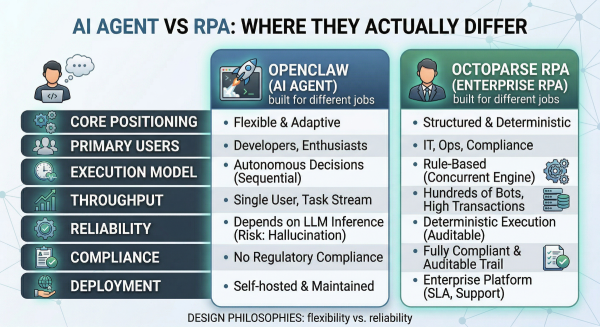
OpenClaw prioritizes flexibility, handling ambiguous and unpredictable tasks well. Octoparse AI automated tool is engineered for reliability, running the same process the same way, at scale, every time.
One is optimized for a single user navigating unpredictable tasks. The other is optimized for an organization running hundreds of structured workflows simultaneously. The overlap in terminology has created a lot of confusion, but at the operational level, these tools are not competing for the same use cases.
Three Reasons the “AI Is Killing RPA” Argument Falls Short
The “crushing blow” framing makes for a compelling headline, but the pros and cons of AI agents versus RPA tell a more nuanced story. Here are the three blind spots that argument tends to miss.
Can AI Agents Replace RPA in Enterprise Workflows?
OpenClaw depends on LLM inference, and large models are not deterministic. The same expense report that gets processed correctly today might get a wrong figure tomorrow because of a subtle prompt variation. Enterprises need processes that execute the rule every time, not ones that are probably correct. Determinism is a design property, not a performance threshold, and a more capable model does not change that.
Does AI Handle Enterprise-Scale Complexity?
Enterprise automation means hundreds of processes running at different hours, bots that need load balancing, strict access controls on core systems, and tiered exception handling with a clear path for human escalation. A smarter model does not solve any of that. Most enterprise deployments run into trouble not because the automation logic is wrong, but because the operational layer was underestimated. These are engineering problems, not intelligence problems.
Is OpenClaw Safe for Business Use?
Being a capable open-source tool and being safe for production use are two different things. Cisco’s AI Defense team tested a top-ranked third-party Skill on ClawHub and found it was functionally malware, silently exfiltrating data to an external server and using prompt injection to bypass safety guidelines, with no vetting process in place. OpenClaw’s own core maintainers have publicly warned that the project is “too dangerous” for non-technical users.
The Real Opportunity: AI + RPA Working Together
AI agents and RPA are not competitors. They are complementary layers in the same automation stack, and the most effective enterprise deployments are already treating them that way.
AI Agent vs. RPA: Which Tool Fits Your Workflow
When to use AI agents instead of RPA comes down to one question: is the task defined by rules, or by outcomes? AI agents handle intent, ambiguity, and judgment. RPA handles precise execution, bulk processing, and workflow reliability at scale. Together, they deliver what neither can alone.
What This Looks Like in Practice
AI Handles the Thinking. RPA Handles the Doing
| You tell the AI: | “Process all outstanding payables over $50,000 this month. Rank them by supplier priority and generate payable approval forms.” |
| AI Agent: | Parses the intent, breaks the task into steps, and applies priority logic. |
| Octoparse AI: | Calls the pre-built “payables query,” “approval form generation,” and “ERP data entry” automation flows — executing them in bulk, reliably, with a full audit trail. |
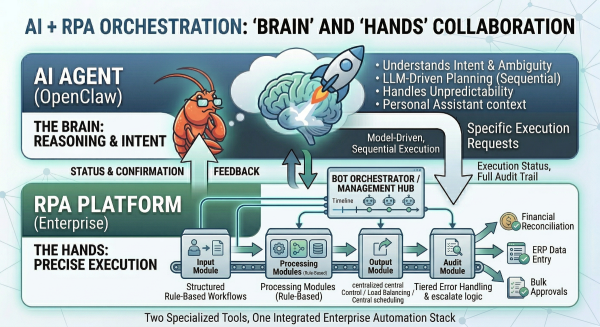
AI Agent and RPA Integration: How MCP Makes It Work
Integrating AI agents with existing RPA workflows is already a standard pattern. Protocols like MCP (Model Context Protocol) let AI agents and RPA platforms connect in standardized ways, with AI handling the “what and why” and RPA handling the “how and how consistently.”
What This Means for Your Enterprise Automation Stack
RPA does not need to become an agent. It needs to become the execution layer that agents trust: stable, secure, and auditable. The question for enterprise teams is not whether to choose AI or RPA. It is whether your current RPA platform is ready to be called on demand by the AI systems you are already deploying.
If you are planning to use OpenClaw for web search tasks, see our guide to OpenClaw search providers for a full breakdown of your options.
Conclusion
“AI is killing RPA” makes for a good headline. Enterprise automation tells a different story.
OpenClaw is an impressive project that shows what AI agents can do with real autonomy. For developers and technical users, it is worth the time. Enterprise automation, though, runs on determinism, compliance, and reliability. Those requirements stay fixed regardless of how capable the underlying model gets, which is why RPA and AI agents end up in different positions in the stack, doing different jobs.
The more productive framing is integration, not competition. AI agents handle intent and judgment. RPA handles execution at scale. The organizations getting the most out of automation right now are the ones figuring out how to connect the two, and that work is already well underway.
FAQs About AI Agents and RPA
- Will RPA be replaced by AI?
Not by design, and not anytime soon. RPA and agentic AI solve different problems. RPA is built for deterministic, rule-based execution at scale: it runs the same process the same way, every time, with full auditability. Agentic AI handles tasks that require judgment, context, and flexibility. What is more likely than replacement is convergence: AI agents handle the reasoning layer, RPA handles the execution layer. The organizations getting the most out of automation in 2026 are already running both.
- What best distinguishes agentic AI from traditional RPA solutions?
The core distinction is how work gets defined. RPA follows explicit instructions: if this, then that, executed the same way every run. Agentic AI operates on intent: you describe the goal, and the agent reasons about how to reach it, adapting when conditions change. That flexibility is powerful for unstructured tasks, but it introduces variability that enterprise workflows, including financial reconciliation, compliance approvals, and bulk data migration, cannot tolerate. RPA’s determinism is not a limitation; it is a design requirement for that category of work.
- Are agentic AI and RPA the same?
No, and conflating them creates real planning mistakes. RPA is a process execution engine: scripted, predictable, auditable. Agentic AI is a reasoning layer that interprets goals, breaks them into steps, and makes decisions. The confusion comes from surface-level overlap: both automate tasks, and both can interact with software interfaces. But an RPA bot does not decide what to do next. An AI agent does. That difference determines which one belongs in which part of your automation stack.
- How do agentic AI and RPA work together?
AI agents handle the reasoning layer: they parse intent, break tasks into steps, and decide what needs to happen. RPA handles the execution layer: it calls pre-built automation flows reliably, at scale, with a full audit trail. Protocols like MCP (Model Context Protocol) are making this integration increasingly plug-and-play, and it’s already being adopted as a standard architectural pattern in enterprise automation.