Yes, Temu has an API, but probably not the one you are looking for. It’s built for sellers and their software partners to run their own stores. If what you want is market data, such as competitors’ prices, discounts and stock across a category, the official API won’t give it to you.
This guide explains what the official API covers and compares the three ways teams actually get Temu product data, from a do-it-yourself scraper to a managed Temu data feed.
TL;DR
| Option | Best for | Main trade-off |
|---|---|---|
| Temu Partner API | Sellers managing their own listings and orders | No access to other sellers’ data |
| Build your own scraper | Small, one-off jobs | Temu blocks scrapers fast; you maintain it |
| Temu scraper API | Developers who want raw JSON | You still build scheduling, QA and the schema |
| Managed data service | Recurring, large-scale price and stock feeds | Needs a defined scope up front |
What does Temu’s official API do?
Temu runs a Partner Platform with portals for the US, EU and global markets. Software vendors and sellers build apps on its open APIs, but every call acts on behalf of a seller who has authorized the app in the seller center.
In practice, it lets a seller, or an app connected to the seller, work with that seller’s own business:
- product listings and inventory
- orders
- shipping and fulfillment details
What it doesn’t do is open up Temu’s public catalog. You can’t use it to pull a competitor’s prices, follow discounts across a category or see which variants are sold out on other sellers’ listings. The endpoints and permission packages change, so check Temu’s documentation before you build on it.
Option 1: Build your own Temu scraper
You write a script, usually with a browser automation tool like Playwright, that loads Temu pages and extracts the fields you need.
This is fine for a one-off pull of a few hundred products. It gets harder quickly after that. Temu detects automated traffic aggressively, so you’ll need rotating residential proxies, real browser sessions and someone to fix the scraper each time the page or the defenses change.
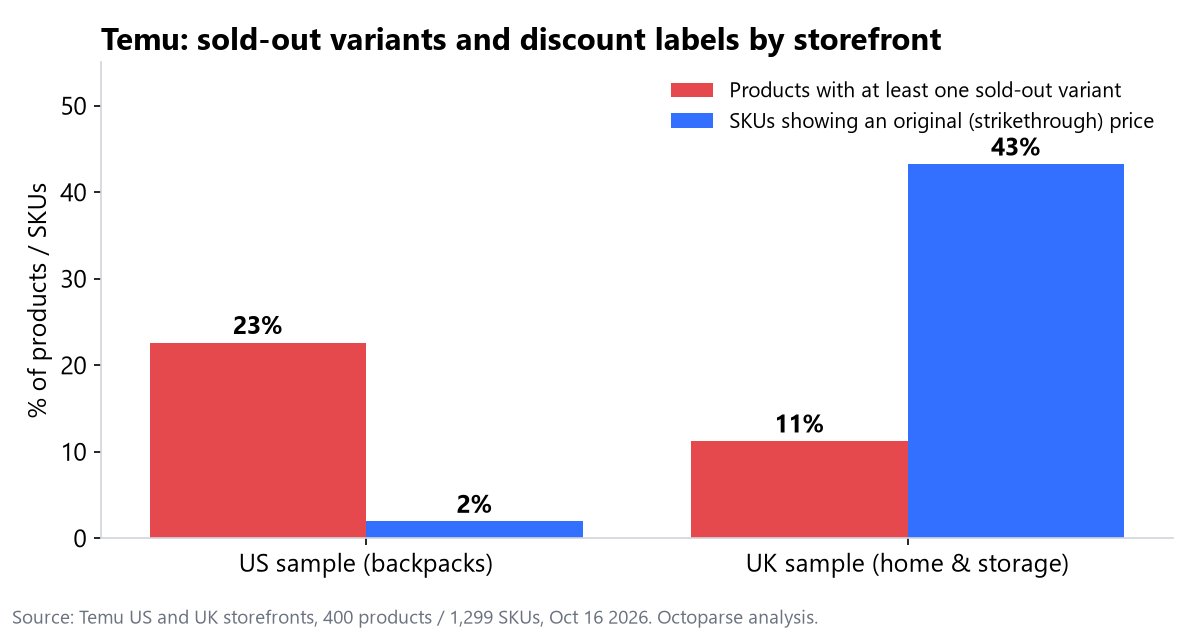
There’s also a data problem that catches most first attempts: Temu prices and stock live on each variant. A scraper that reads only the product page gets one color’s price and no availability. In our own study of 1,299 Temu SKUs, the cheapest and most expensive variants of the same UK product differed by 29% at the median, and 23% of US products had a sold-out variant while the listing stayed live.
Option 2: Use a Temu scraper API
Several vendors sell Temu scraping APIs or ready-made “actors”, usually priced per 1,000 results. You send a product URL or keyword and get JSON back.
This removes the proxy and blocking problem, which is the hardest part. What it doesn’t remove is the rest of the pipeline: scheduling runs, retrying failures, filling gaps, deduplicating, and mapping each provider’s output to your own schema. Check exactly which price a provider returns, and whether it covers variants and availability.
It’s a good fit for engineering teams that want raw access and already run data pipelines.
Option 3: Use a managed Temu data service
A managed service builds and runs the collection and delivers structured data on a schedule: files, an API, or straight into your warehouse.
You agree on the storefronts, products or categories, fields and cadence once. After that, someone else deals with Temu’s changes, and each delivery is checked before it reaches you. This is what most teams end up with once Temu data becomes something they need every day rather than once.
It’s the approach we use in our Temu data scraping service. The largest pipeline we run on it delivers more than 8 million records a month into Snowflake, described in this Temu pricing pipeline case study.
How do the options compare?
| Own scraper | Scraper API | Managed service | |
|---|---|---|---|
| Setup | Write and test per storefront | Integrate, then build the pipeline | Share storefronts, products and fields |
| When Temu changes | You fix it | Provider fixes access; gaps are yours | Provider repairs the pipeline |
| Variant price and stock | Only if you build it | Depends on the provider | Defined per field |
| Quality checks | Yours to build | Request success only | Duplicates, completeness, product-variant links |
| Best for | Small one-off jobs | Teams that want raw access | Recurring, large-scale feeds |
Which Temu fields should you collect?
Whichever route you choose, get these per variant (SKU), not just per product:
- sale price and original (strikethrough) price
- on-sale or sold-out status
- variant options such as color, size or bundle
- shipping fee and delivery guarantees
And from the product: title, category, shop, the sales label and the rating count. You can see all of these in our free Temu product and SKU sample before deciding.
FAQs about the Temu API
Is there a free Temu API for product data?
No. The official API is for authorized sellers and partners working on their own stores. Public product and price data is collected from Temu’s web pages.
Can I get Temu sales numbers through an API?
Temu shows sales as labels like “214 sold” or “7.3K+”. They are rounded, all-time display values. For recent sales, collect the same products on a schedule and compare snapshots.
Does the Temu Partner API work in every country?
There are separate portals for the US, EU and global markets. Access depends on the seller account and the app’s permissions.
Is it legal to collect Temu data?
Collecting publicly displayed product and price information is common practice, but the rules depend on the country, the data and how you use it. Avoid personal data, keep request rates reasonable and get legal advice for your use case.
How fast can I get a Temu data sample?
With Octoparse, a free Temu sample built on your storefronts and products usually takes 1-2 business days after the scope is agreed.