Tracking a few Shopee listings by hand is easy. Tracking a category across several Shopee markets, every day, without the numbers drifting is a different job. Most of the problems we see aren’t about collecting data at all. They come from collecting the wrong price, or the right price at the wrong level.
This guide is for sellers, brands and analysts who need competitor or market prices, not shoppers looking for a deal alert. It walks through what to collect, how often, and how to set it up, based on the Shopee data feeds we run for clients.
TL;DR
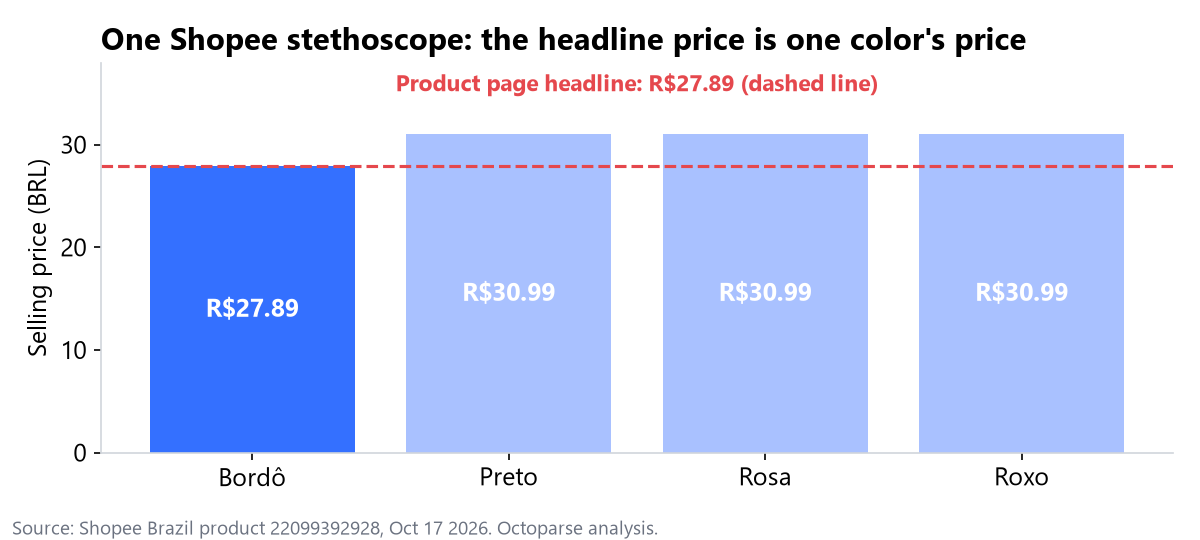
- Collect prices per variant (SKU). The product page price is one variant’s price.
- Define every price field before you start. Displayed, selected-variant and payment-specific prices can all differ.
- Treat each Shopee market as its own site. Different domain, currency, language and category tree.
- Keep every snapshot. Price history only exists if you store each run with its capture time.
- Daily is the usual cadence. Weekly for slow categories, hourly only around big sale events.
Step 1: What do you want the price data to answer?
Start with the decision the data supports, because it changes which products and fields you need:
- Competitor pricing: the same or similar products from named competitors
- Reseller monitoring: your own products sold by other shops, and whether they follow your price policy
- Category trends: price and discount levels across a niche
- Demand: which products are selling fastest
Write the question down. It saves you from collecting thousands of fields nobody uses.
Step 2: Which Shopee fields should you collect?
Collect at the variant (SKU) level wherever the data lives there. In our study of 922 Shopee SKUs, every product with several variants priced them differently, with a median gap of 26%.
| Field | Level | Why it matters |
|---|---|---|
| Selling price | SKU | What buyers pay for that variant |
| Strikethrough (list) price | SKU | How the seller frames the discount |
| Variant options | SKU | Color, size or bundle, so you compare like with like |
| Headline price and price range | Product | What shoppers see first |
| Sold in last 30 days, total sold | Product | Demand, and how fast it is growing |
| Rating and rating count | Product | Context for price gaps |
| Shop name and ID | Product | Who you are competing with |
| Shipping fee | SKU | Depends on delivery location |
| Capture time | Both | The basis of price history |
Step 3: Which price do you mean?
This step causes more bad data than anything else.
On one Shopee Brazil listing we checked for a client, the page showed R$175.18. That was the price with Pix payment and a coupon. Paying another way, the same item cost R$204.88. A tracker that captured the first number and one that captured the second would both be “right”, and every comparison built on them would disagree.
So before collecting anything, write down which price each field holds:
- the price shown when the page first loads
- the price after a specific variant is selected
- whether payment-method or voucher discounts are included
Step 4: How do you handle Shopee’s different markets?
Treat each market as a separate site.
| Market | Site | Currency |
|---|---|---|
| Singapore | shopee.sg | SGD |
| Malaysia | shopee.com.my | MYR |
| Thailand | shopee.co.th | THB |
| Indonesia | shopee.co.id | IDR |
| Vietnam | shopee.vn | VND |
| Philippines | shopee.ph | PHP |
| Taiwan | shopee.tw | TWD |
| Brazil | shopee.com.br | BRL |
Keep prices in local currency in the raw data and convert later, recording the exchange rate and date. Match products across markets by your own SKU, or by brand, title and attributes, because Shopee item IDs differ between sites. Shipping fees depend on the postcode, so pick one or more fixed postcodes per market and stick with them.
Step 5: How often should you collect Shopee prices?
- Daily for competitor and reseller tracking, and for fast-moving categories
- Weekly for category trends and slower products
- Several times a day only around big sale events such as 11.11 and 12.12, when prices change by the hour
Whatever the cadence, store every run. If each run overwrites the last one, you have a price but no price history.
Step 6: How should you collect the data?
| Option | Good for | Watch out for |
|---|---|---|
| Browser extensions and price-history sites | Checking a handful of products by hand | No bulk export, few fields, usually one market |
| A no-code tool or your own scraper | Small or occasional jobs | Shopee’s anti-bot measures; you maintain it |
| Scraper APIs | Engineering teams that want raw access | You build scheduling, retries, schema and QA |
| Managed data service | Recurring, multi-market, large-scale tracking | Needs a clear scope up front |
For a do-it-yourself start, our guide on how to scrape Shopee walks through the steps. If you track Lazada too, see how to build a Lazada price tracker.
Mistakes that skew Shopee price data
- Tracking only the headline price. It’s one variant, often the cheapest.
- Leaving price definitions vague. In the Brazil example above, the payment-specific price was 17% below the price for other payment methods, on the same page.
- Ignoring shipping. Two listings at the same price can cost the buyer very different amounts.
- Converting currencies at collection time. Keep local prices; convert in analysis.
- Overwriting old runs. No snapshots, no history.
When does a managed service make sense?
Once you’re tracking hundreds or thousands of products, in more than one market, and need the data somewhere every morning, keeping scrapers alive becomes a job in itself. Octoparse’s Shopee data scraping service delivers product and SKU prices, strikethrough prices, sold counts and shipping fees from any Shopee market, on your schedule, by file, API, S3, Snowflake or BigQuery. To track Shopee next to Amazon, Lazada or Temu, see our multi-marketplace price monitoring, and get a free Shopee sample for your markets first.
FAQs about Shopee price tracking
Can I see the price history of a Shopee product?
Shopee doesn’t show it on the product page. You build it by collecting the same products on a schedule and keeping every snapshot.
Does Shopee have an API for prices?
The Shopee Open Platform is for sellers and partners managing their own shops. It doesn’t provide competitors’ prices, which come from public product pages.
How do vouchers affect tracked prices?
Voucher and payment-method discounts can make the checkout price lower than the displayed price. Decide which one you need and document it.
How many products can I track?
It depends less on the tool than on how often you collect and how many markets you cover. A no-code scraper suits a focused list you manage yourself. Managed feeds handle hundreds of thousands of products and millions of variants per cycle, with someone else keeping them running.