
How to Scrape Shopee Data in 2026: Products, Prices and Sales
Shopee Brazil now asks visitors to log in, and product pages round sold counts. Here's how to scrape Shopee products, prices and sales in 2026.
You can scrape Shopee, but it’s harder than it was a few years ago. In our tests in November 2026, Shopee Brazil sent signed-out visitors to a “Login Necessário” page before showing any product, and product pages showed sales as rounded labels such as “3mil+” instead of exact numbers.
This guide explains what you can collect from Shopee, what changed, and three ways to do it: a no-code scraper, your own code, or a managed Shopee data feed.
TL;DR
- Expect a login page. In our November 2026 tests, Shopee Brazil asked visitors to sign in before showing product pages, and other markets may do the same. Plan for a logged-in session.
- Product pages round sales. “3mil+ sold” is a display label, not the exact count, so check where your scraper reads sales from.
- Prices need a definition. The price on the page can already include a shop voucher, a platform coupon or a Pix discount.
- Each Shopee market is a separate site. Different domain, currency, language and categories.
- Small jobs: no-code tool. Large or recurring jobs: managed feed. Building your own scraper means maintaining logins, anti-bot handling and pacing yourself.
Can you scrape Shopee?
Yes. Product names, prices, ratings, sold counts and shop details are shown to any logged-in shopper, and that public information is what scrapers collect. What you shouldn’t collect is personal data about buyers, such as reviewer names linked to other details, and you should keep your request rate low.
Shopee runs separate sites for Singapore, Malaysia, Thailand, Indonesia, Vietnam, the Philippines, Taiwan and Brazil. The rules that apply depend on the market and on how you use the data, for example Singapore’s PDPA or Brazil’s LGPD. If the data feeds a commercial product, check with your own counsel.
What changed on Shopee in 2026?
Three things will break an older Shopee scraper or tutorial:
| What you’ll see | What it means for scraping |
|---|---|
| A “Login Necessário” / login-required page instead of the product | Your scraper needs a logged-in browser session |
| “3mil+ Vendido(s)” instead of an exact number | Product and shop pages only show rounded sales |
| “R$21,30 com cupom” | The displayed price already includes a voucher; the price before the voucher is higher |
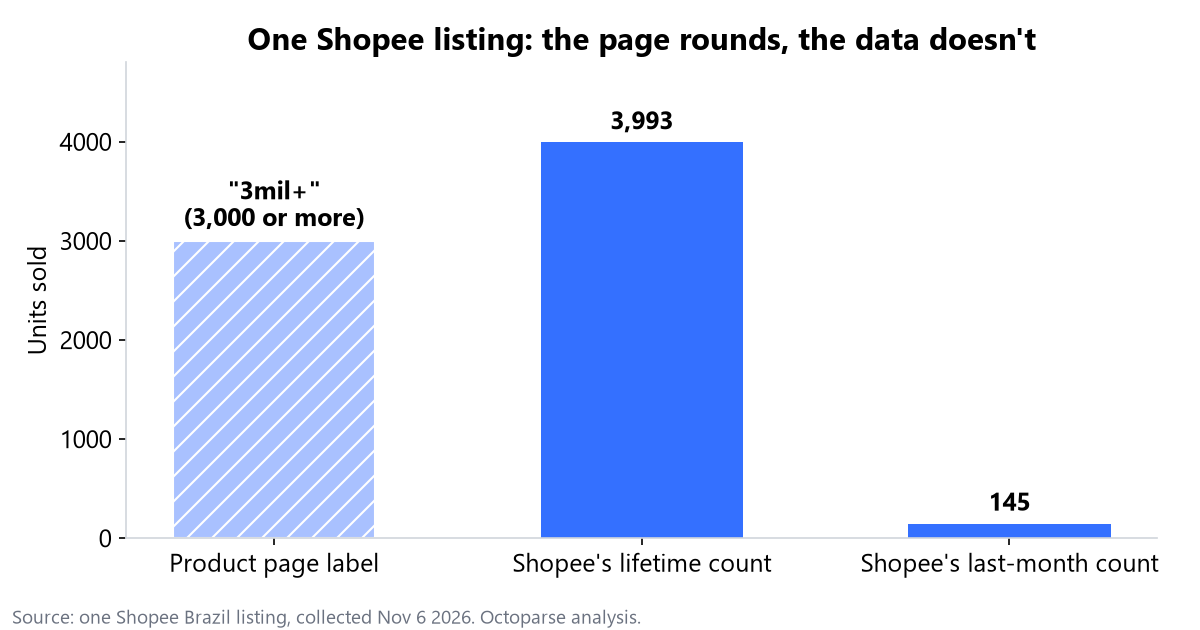
On one Shopee Brazil listing we checked, the product page showed “3mil+” sold, while Shopee’s own data for the same item reported 3,993 lifetime sales and 145 in the last month. A scraper that only reads the product page gets the rounded label.
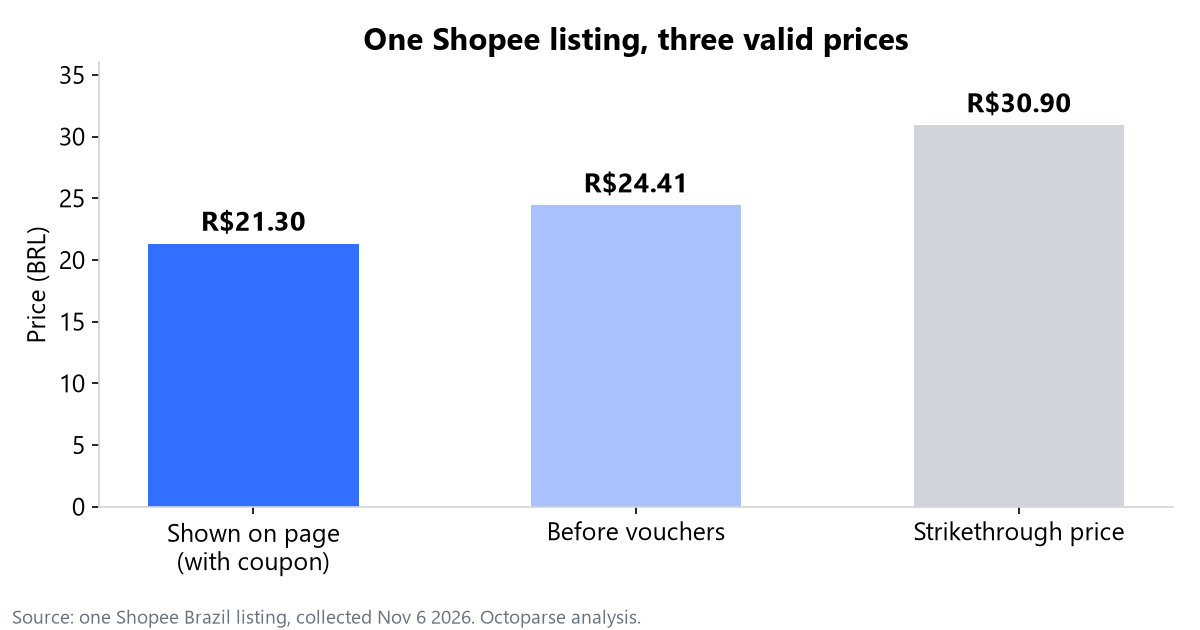
Prices need the same care. The same listing showed R$21.30, but that already included a coupon. Before vouchers it cost R$24.41, and the strikethrough price was R$30.90. Three numbers, all “the price”, depending on what your scraper reads.
What data can you scrape from Shopee?
| Data | Where it comes from | Notes |
|---|---|---|
| Title, brand, category path, attributes, description, images | Product page | |
| Price, price range, strikethrough price | Product page and search results | Prices may include vouchers; record which price you capture |
| Variant (SKU) options and prices | Product page | Each color or size can have its own price |
| Monthly sold and lifetime sold | Product page (rounded) and Shopee’s listing data | Product pages show labels like “3mil+” |
| Rating and rating count | Product page and search results | |
| Shop name, shop ID, ships-from location | Product page and search results | |
| Shipping fee | Product page | Depends on the delivery address |
| Reviews | Product page | Avoid storing reviewers’ personal data |
Variant prices matter more than most people expect. In our study of 922 Shopee SKUs, every product with more than one variant priced them differently, with a median gap of 26% between the cheapest and most expensive.
Does Shopee have a public API?
Not for market data. The Shopee Open Platform is for sellers and their software partners to manage their own shops: listings, orders, logistics. It doesn’t return competitors’ products, prices or sales. That data comes from Shopee’s public pages, which is why people scrape it.
Method 1: Scrape Shopee without coding (Octoparse)
For a few hundred to a few thousand products, a no-code scraper is the fastest route. Octoparse runs a real browser, so you can log in to Shopee inside it and the session is reused when the task runs.
Step 1: Start a task with a Shopee search URL. Search Shopee for your keyword or category, copy the results URL (for example https://shopee.com.br/search?keyword=...) and paste it into Octoparse.
Step 2: Log in inside the built-in browser. When Shopee shows its login page, sign in with your own Shopee account in the Octoparse browser and complete any verification yourself. Then save the login with the task so later runs reuse it. The help center shows both steps with screenshots: scrape data behind a login and save and use cookies.
Step 3: Auto-detect the product list. Let Octoparse detect the result cards, then check the fields: title, price, sold label, rating, shop location and product URL. Turn on pagination to go through more result pages. See how auto-detect works and our guide to handling pagination.
Step 4: Add product details if you need them. Have Octoparse open each product URL and collect variant prices, strikethrough prices, attributes and shipping fee.
Step 5: Run and export. Run the task locally or in the cloud on a schedule, and export to Excel, CSV, JSON, Google Sheets or a database.
Keep the pace slow. Loading many pages quickly from one account is the kind of traffic marketplaces tend to flag, so we recommend adding waits between pages and splitting big jobs into smaller runs. If you also track Indonesia, the https://www.octoparse.com/template/tokopedia-scraper covers the other big marketplace there.
Method 2: Scrape Shopee with Python
If you build your own scraper, the main challenges aren’t parsing:
- Session. You need a logged-in browser session (for example Playwright with a saved storage state). On Shopee Brazil, signed-out requests got the login page in our tests.
- Anti-bot checks. Shopee protects its pages against automated traffic, so most working scrapers drive a real browser rather than sending plain requests.
- Rounded values. Sold counts on product pages are rounded labels. Decide which figures you need before you build, and test that your scraper returns them.
- Maintenance. Field names and page structure change. Budget time to fix the scraper every few weeks.
Never try to get around Shopee’s verification checks. If you hit them often, slow down or use a managed feed.
Method 3: Use a managed Shopee data feed
When you need thousands of products, several Shopee markets or a daily schedule, keeping scrapers and logins alive becomes a job of its own. With Octoparse’s Shopee data scraping service, we build and run the collection and deliver product and SKU files with every price field defined: displayed price, price before vouchers, strikethrough price, exact monthly and lifetime sold counts, and shipping fees for a fixed postcode. Data arrives by file, API, S3, Snowflake or BigQuery.
You can start with a free sample for the products you name. One recent request asked for a single Brazilian listing with its 30-day and lifetime sales, and the sample went out the same day.
Which method should you choose?
| No-code (Octoparse) | Your own code | Managed feed | |
|---|---|---|---|
| Best for | Hundreds to a few thousand products | Engineering teams with time to maintain it | Large, multi-market or daily data |
| Login and verification | You log in once in the app | You manage sessions | Handled for you |
| Exact sold counts | Depends on the page you scrape | Depends on your build | Included |
| Maintenance | Low | High | None on your side |
Tips for clean Shopee data
- Write down which price you capture. Displayed (with voucher), before voucher, or a specific variant. Read how to track Shopee prices across 8 markets for the full checklist.
- Check whether your sold counts are exact or rounded before you analyze them.
- Keep each market separate and store prices in local currency.
- Store every run with its capture time, or you’ll have prices but no price history.
- Fix one delivery postcode per market for shipping fees.
FAQs about scraping Shopee
Why does Shopee show a login page when I scrape it?
In our tests, Shopee Brazil asked signed-out visitors to log in before showing product pages, and other markets may do the same. If you see it, your scraper has to run in a logged-in session, either in a browser-based tool like Octoparse or in your own browser automation.
How do I get exact Shopee sales numbers?
Product pages show rounded labels like “3mil+”. Exact monthly and lifetime counts exist in Shopee’s own data, but getting them reliably takes a carefully built scraper. A managed Shopee data feed includes them by default.
Is the Shopee “sold” number accurate?
It’s Shopee’s own reported figure, not audited sales. It’s good for ranking products and spotting fast movers, especially when you compare monthly sales with the lifetime total.
Can I scrape Shopee reviews?
Yes, review text and ratings are public. Avoid storing reviewers’ personal details, and check the rules for your market and use case.
Can I scrape all Shopee countries the same way?
The approach is the same, but each market is its own site with its own domain, currency and categories. Set up and test each one separately.
Is there a Shopee scraper API?
Shopee’s official Open Platform only covers your own shop. For market data, use a scraper, a third-party scraping API, or a managed Shopee data feed delivered by API.


Get started with Octoparse today
Related Articles
Ansel Barrett
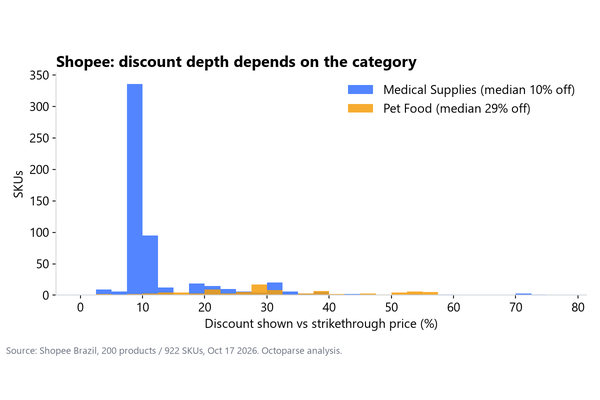
How sellers and brands track Shopee prices across 8 markets: which fields to collect, how often, and the price-definition mistakes that skew results.2026-11-06T10:09:36+00:00 · 5 min read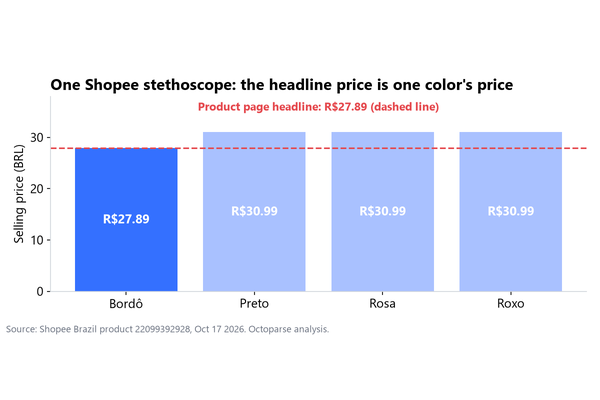
Abigail Jones
One Shopee page showed R$175.18 and R$204.88 for the same item. Our 922-SKU study shows why variant, discount and payment prices matter.2026-11-06T10:09:35+00:00 · 5 min read Learn how to find winning products with real data: scrape Amazon Best Sellers, track TikTok trends, and validate demand before you spend. Free method inside.2026-06-17T09:54:55+00:00 · 6 min read
 Yahoo Finance is one of the important sites to get the price of stocks. In this article, we will teach you how to extract stock prices from Yahoo Finance to a spreadsheet within 4 steps using Octoparse web scraping tool.2024-04-23T00:00:00+00:00 · 3 min read
