

With over 1 billion active users and millions of videos published daily, TikTok sits on one of the largest pools of real-time consumer behavior data on the internet.
But that is only part of the picture. TikTok data powers competitor research, influencer vetting, comment sentiment analysis, and content strategy. The problem is that TikTok is also one of the hardest platforms to scrape reliably, since its anti-bot system validates session signatures, rotates device fingerprints, and detects non-human request patterns in ways most scrapers never get past.
This guide covers exactly how to scrape TikTok data: what is accessible, every practical method ranked by technical effort, ready-to-run workflow combinations for the most common use cases, and how to keep scraping working when TikTok’s defenses push back.
If you’re scraping more than TikTok, see our guide to social media scraping, covering X, YouTube, Reddit, and Xiaohongshu too.
Quick Answer: How to Scrape TikTok Data
| Goal | Method | Time to First Data |
| Scrape a creator’s profile and all their videos | TikTok Profile Scraper template | Under 5 minutes |
| Find videos by keyword or topic | TikTok Search Scraper (No Login Required) template | Under 5 minutes |
| Extract video details and comments | TikTok Video Details & Comments Scraper template | Under 5 minutes |
| Search creators or videos without logging in | TikTok Search Scraper (No Login Required) | Under 5 minutes |
| Search creators using your TikTok account (no per-result cost) | TikTok Search Scraper (Login Required) | Under 10 minutes |
| Custom extraction logic | Octoparse no-code workflow builder | 5 to 30 minutes |
| Full control, own infrastructure | Python (Selenium or Playwright) | Hours, plus ongoing maintenance |
👉Get Octoparse today! Try Octoparse for free!
What TikTok Data Can You Actually Scrape?
Data Availability Overview
| Category | What You Can Scrape | What You Cannot |
| Video and post data | URLs, upload dates, captions, hashtags, view counts, likes, shares, bookmarks, duration | Direct video file downloads, certain technical metadata |
| User profiles | Usernames, display names, bios, follower/following counts (public), verification status | Emails, phone numbers, gender, location, private account content |
| Engagement metrics | Like counts, comment counts, share numbers, basic engagement ratios | Exact watch times, completion rates, user behavior analytics |
| Comments | Public comments, timestamps, commenter usernames, reply threads, comment like counts | Hidden or deleted comments, private DMs |
| Search and hashtags | Hashtag search results, trending topics, public search pages | Internal algorithm signals, non-public trend data |
That covers most of what you need for research, competitive analysis, and influencer work. Private account content, internal analytics, and personal contact details are off limits regardless of what tool you use.
Why Scrape TikTok Data? Four Use Cases That Actually Pay Off
Spot Trends Before They Peak
Manual hashtag tracking means you notice a trend when it is already everywhere. Scraping lets you monitor hashtag growth, video publication rates, and engagement velocity across multiple topics simultaneously. One Octoparse user running a beauty data platform tracks 550 beauty brand accounts on TikTok weekly, capturing what content formats and hashtags are gaining traction before they peak. By the time trends surface in mainstream marketing reports, they already have weeks of structured data to act on.
Understand What Audiences Actually Think
A video with 100k likes shows it was popular, but comments explain why. Sentiment analysis on scraped comments reveals patterns that likes and views cannot show: recurring complaints, unanswered questions, and the exact language customers use to describe products. For example, a fashion retailer discovered that popular haul videos were causing confusion about sizing. After updating content based on these insights, returns dropped by 40%.
Find and Qualify Influencers at Scale
Filtering creators manually by niche, follower count, and engagement rate means clicking through dozens of profiles before finding one worth contacting. Scraping pulls hundreds of creators from a keyword or hashtag search, lets you filter by criteria that matter (real engagement rate, recent posting activity, topic alignment), and produces a qualified shortlist before you ever open TikTok. Another Octoparse user maintains a UGC and influencer database covering 2,000 to 3,000 creator accounts, collected every two weeks, to keep their influencer pipeline current at scale. For the full workflow, from filters to outreach, see how to find TikTok influencers who fit your brand.
Benchmark Competitors Systematically
Manual competitor monitoring captures fragments. Scraping builds a structured dataset: which content formats are gaining traction, which hashtags they are riding, how engagement changes over time, how they respond to negative feedback. That data turns reactive observation into proactive strategy.
How to Scrape TikTok Data: Every Method That Actually Works
Method 1: Use Octoparse’s Pre-Built Templates (Fastest)
Octoparse is a no-code web scraping platform with five purpose-built TikTok templates. Most TikTok scrapers break because TikTok actively fights them with signature checks, session tokens, device fingerprinting, CAPTCHAs. These five TikTok templates handle all of that in the background. You just configure what data you want and run.
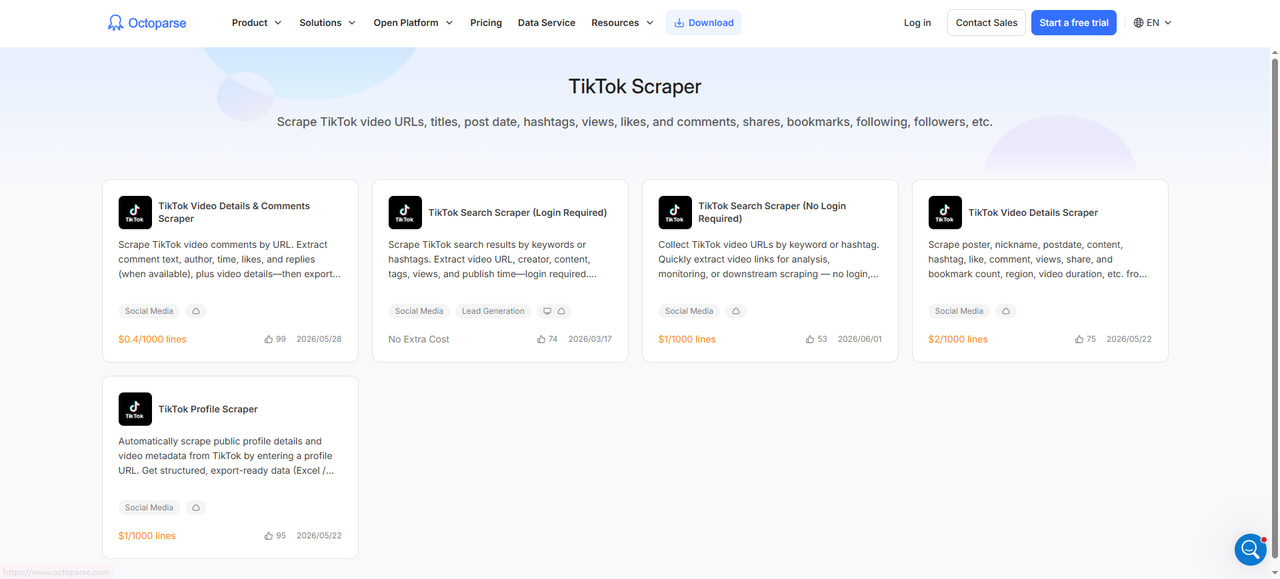
Use TikTok Profile Scraper to Get a Creator’s Full Video History
Use this when you need complete data on a specific creator: every video they have published, all engagement metrics, and full profile details. No login required.
Input: A TikTok creator profile URL.
Output Fields
| Field | What It Contains |
| original_url | Input TikTok profile URL used for the scrape |
| author | Creator username or handle |
| author_subtitle | Creator display name or nickname |
| author_bio | Profile bio text |
| author_webpage | External website link shown in the bio |
| author_iconurl | Creator avatar image URL |
| following | Number of accounts the creator follows |
| followers | Number of followers |
| is_verified | Whether the creator account is verified |
| is_private | Whether the creator profile is private |
| video_url | URL of each video from the profile |
| post_date | Date and time when the video was posted |
| description | Video caption text |
| hashtag | Hashtags extracted from the caption |
| like_num | Number of likes |
| comment_num | Number of comments |
| views_num | Number of views |
| bookmark_num | Number of saves or bookmarks |
| covers_url | Video cover or thumbnail URL |
| video_duration | Video duration in seconds |
| video_download | Direct video playback or download URL (note: URLs expire after a period of time) |
| video_id | Unique TikTok video ID |
| music_name | Name of the sound used |
| music_author | Author of the sound |
| music_url | TikTok music or sound page URL |
📑Practical tip: Use the full profile URL including the @ handle. Username-only inputs sometimes fail to resolve. This template also accepts batch inputs: import a list of profile URLs to scrape multiple creators in one run. Cloud execution requires a paid plan. If you plan to use video download URLs, export and access them promptly. These links expire after a period of time.
https://www.octoparse.com/template/tiktok-profile-scraper
For more on downloading TikTok profile content in bulk, see TikTok profile downloader options compared.
Use TikTok Video Details & Comments Scraper to Extract Comments at Scale
Use this when you need depth on individual videos: extended metadata plus full comment threads including first-level comments and their replies.
Input: Up to 10,000 video URLs. Each input unit returns up to 50 results (comments and replies combined), with a maximum of 1,000 input units per run, giving up to 50,000 comment rows. It should be noted that, if the first comment has an exceptionally large reply thread, subsequent top-level comments may not be collected within the same run.
Output Fields
| Field | What It Contains |
| Video_URL | Input TikTok video or photo URL |
| Tiktoker | TikTok handle of the video author |
| Tiktoker_nikname | Display name of the video author |
| Post_date | When the video or photo was published |
| Description | Post caption or description text |
| Hashtags | Hashtags used in the post |
| Like_count | Number of likes |
| Comment_count | Total number of comments |
| View_count | Number of views |
| Share_count | Number of shares |
| Bookmark_count | Number of saves or bookmarks |
| Region | Geographic region where the post was created |
| Post_type | Type of post (Video or Photo) |
| Cover_URL | Thumbnail or cover image URL |
| Video_duration | Video length in seconds |
| Video_download_URL | Direct video download link, if available (note: URLs expire after a period of time) |
| Video_ID | Unique TikTok video or photo ID |
| Music_name | Name of the sound or music used |
| Music_author | Author or creator of the sound |
| Music_URL | TikTok sound or music page URL |
| Commentor_nickname | Display name of the commenter |
| Commentor_URL | TikTok profile URL of the commenter |
| Commentor_avatar_URL | Avatar image URL of the commenter |
| Comment | Full top-level comment text |
| Comment_like_count | Number of likes on the comment |
| Comment_reply_count | Number of replies under the comment |
| Comment_date | When the comment was posted |
| If_author_likes | Whether the video author liked the comment |
| Replier | Display name of the reply author |
| Replier_URL | TikTok profile URL of the reply author |
| Replier_avatar_URL | Avatar image URL of the reply author |
| Reply | Full reply text |
| Reply_like_count | Number of likes on the reply |
| Reply_date | When the reply was posted |
| error_massage | Error message if collection fails |
📑Practical tip: Start with 2 to 3 pages of comments per video to check output volume before scaling. Comment density varies significantly by video.
Once you know the template works for your use case, it scales easily. One fitness brand ran 968 workout video URLs through it in a single session, analyzing which content formats (short vs. long, music vs. voiceover, indoor vs. outdoor) drove the highest engagement rates and where audiences differed by region. The export came back with share counts, bookmark counts, and region data alongside the full comment threads: performance data and audience reasoning in one place.
https://www.octoparse.com/template/tiktok-video-comments-scraper
If you do not need comments and only want video metadata (poster, nickname, post date, content, hashtag, like, comment, views, share, bookmark count, region, video duration), use the lighter TikTok Video Details Scraper:
https://www.octoparse.com/template/tiktok-video-details-scraper
For a free option with limited comment collection:
https://www.octoparse.com/template/tiktok-comments-scraper
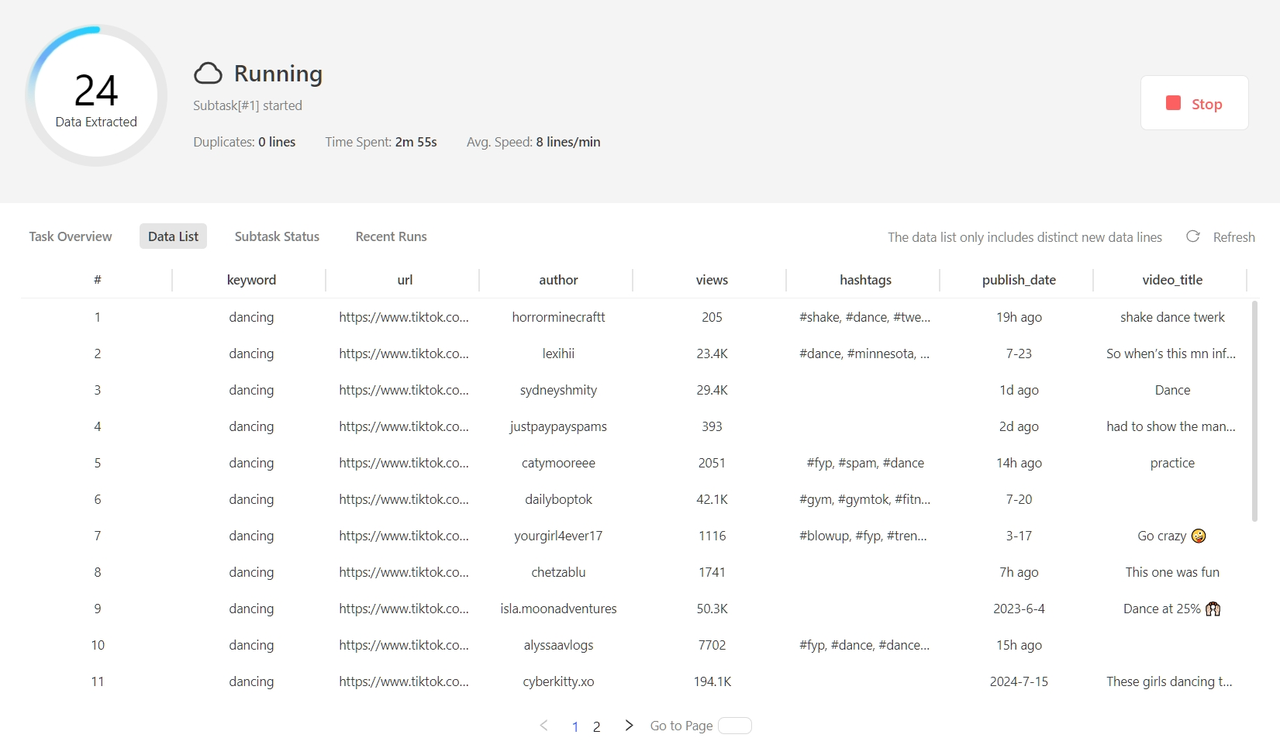
Use TikTok Search Scraper (No Login Required) to Find Videos by Keyword
Use this to discover videos or creators by keyword or hashtag without using your TikTok account. This is the paid, simpler, and more stable option. It does not require you to log in with your own TikTok account.
Input: Keyword or hashtag, number of Search Result Batches to Collect (up to 20).
Output Fields (Videos Tab)
| Field | What It Contains |
| Input_keyword | Search keyword or hashtag entered |
| Page_title | Title of the TikTok search results page |
| Page_URL | TikTok search results page URL |
| Video_title | Video caption or title text |
| Video_URL | Direct URL of the TikTok video |
| View_count | Number of video views |
| Hashtags | Hashtags used in the video |
| TikToker | TikTok handle of the video creator |
| TikToker_URL | TikTok profile URL of the video creator |
| Publish_date | When the video was published |
https://www.octoparse.com/template/tiktok-video-url-scraper
Use TikTok Search Scraper (Login Required) to Discover Creators Without Per-Result Costs
Use this if you want to avoid per-result charges and are comfortable logging in with your own TikTok account. This template supports the Top, Users, and Videos tabs from TikTok’s search interface. It requires more setup and can be less stable than the no-login version.
When to choose Login Required: Lower per-result cost, access to Users tab for creator discovery.
When to choose No Login Required: Simpler setup, more stable, no need to expose your TikTok account.
Output Fields (Users Tab)
| Field | What It Contains |
| Input_keyword | Search keyword entered |
| User_name | TikTok handle of the user account |
| User_profile_URL | TikTok profile URL |
| User_avatar_URL | Profile avatar image URL |
| User_intro | User bio or profile introduction |
| User_subtitle | Display name or subtitle shown in search |
| Follower_count | Number of followers |
| If_verified | Whether the account is verified |
https://www.octoparse.com/template/tiktok-busqueda-scraper
Method 2: Build Your Own No-Code Workflow in Octoparse
When the pre-built templates do not cover your specific requirements, Octoparse lets you build a custom extraction workflow without writing code.
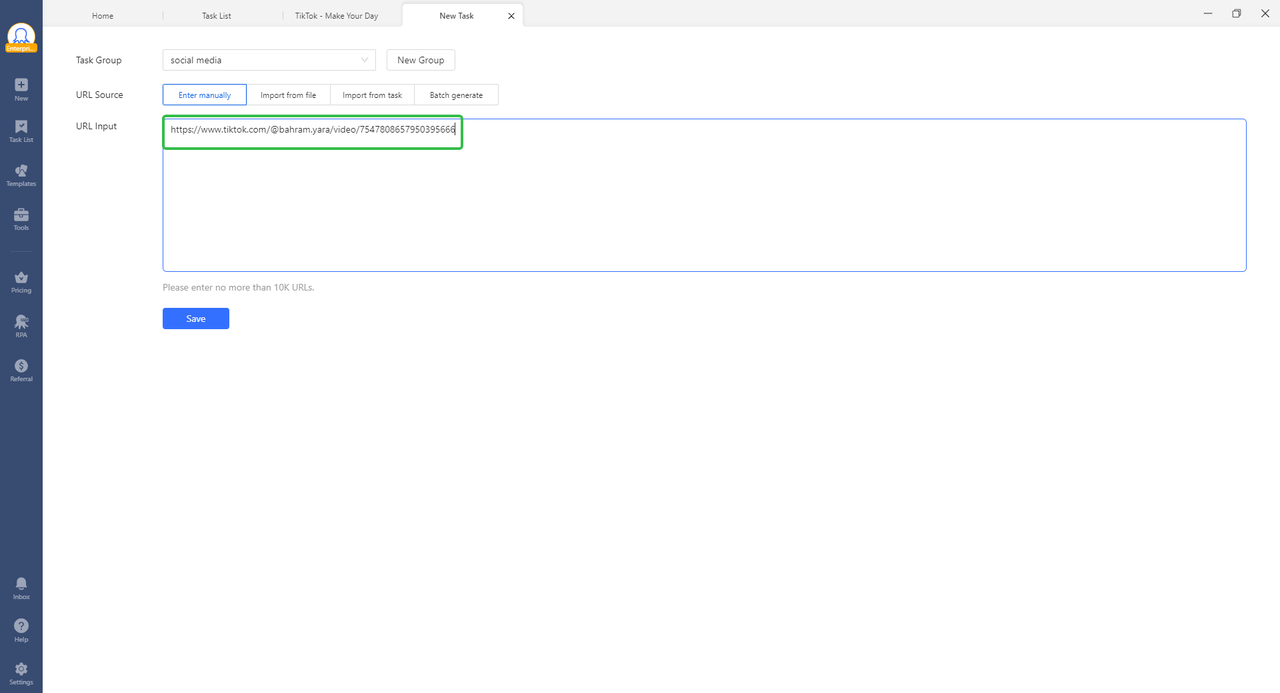
Step 1: Start a new task
Open Octoparse and click “+ New Task”. Provide your input URLs: a TikTok search results page, a profile URL, or a specific video URL depending on your goal.
Step 2: Set up Auto Login
For content that requires a session, click Auto Login, then click Use Cookies. You will see a browser window. Manually navigate to TikTok and log in. Once you are in the logged-in state, click “Set up Auto Login” to save the session cookies for reuse.
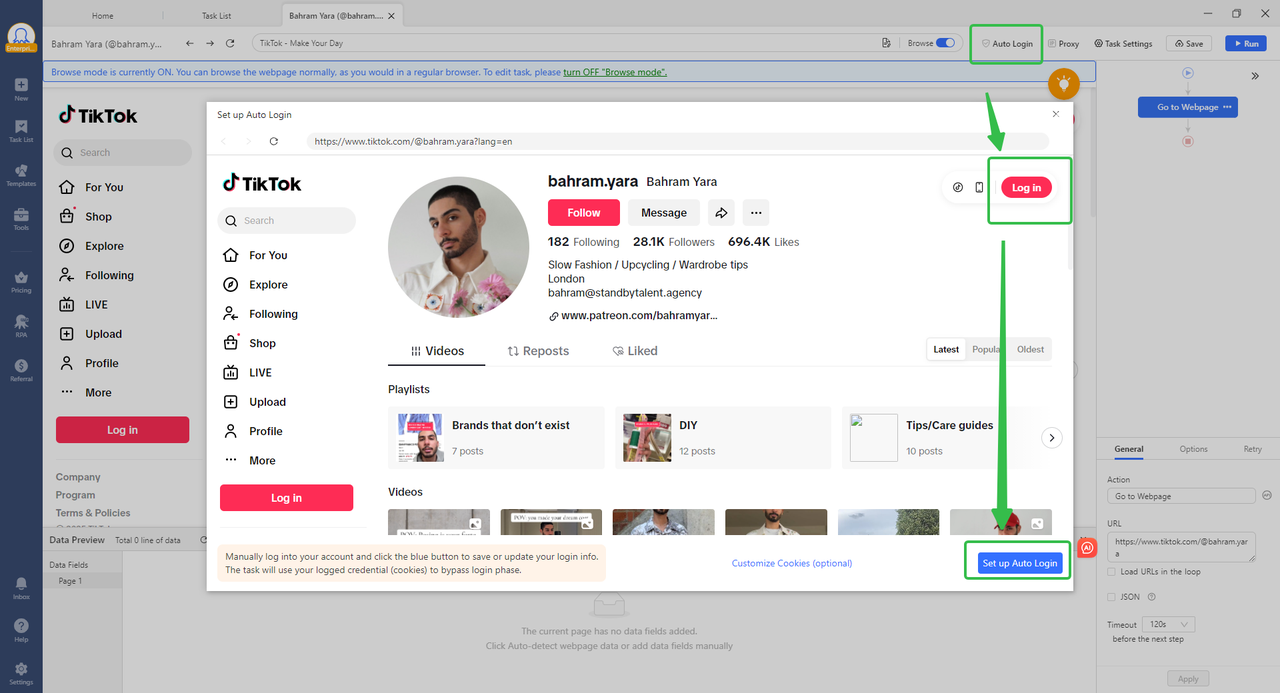
For detailed instructions, see: how to set up Auto Login in Octoparse
Step 3: Select your fields
Click the elements you want to extract: description text, hashtags, publish date, engagement metrics. Use the Auto-Detect feature if manual selection is too time-consuming.
Step 4: Handle dynamic loading
If comments or video entries load dynamically on scroll, add scroll actions or “load more” loops to your workflow. Set delays to ensure elements render fully before extraction.
Step 5: Test, run, and export
Preview a data sample to confirm fields are captured correctly. Adjust as needed, then run the full task. Export as CSV, Excel, or Google Sheets. Paid plans can schedule tasks in Octoparse Cloud for automated recurring updates.
For video-specific scraping, see the full tutorial: how to scrape videos from TikTok
Method 3: Let AI Plan and Run Your TikTok Scraping (Octoparse MCP)
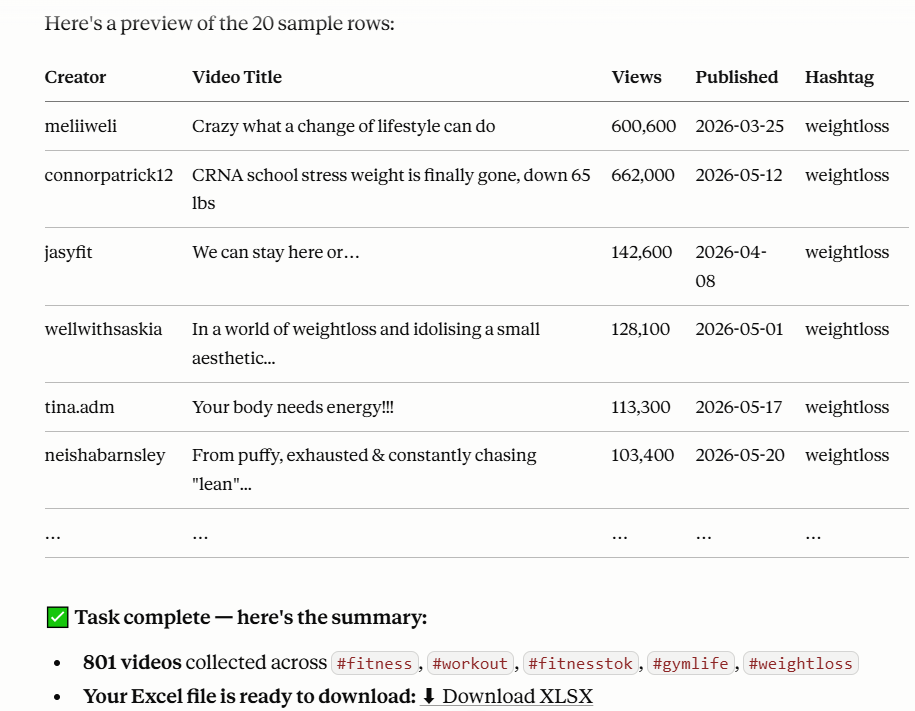
If you are working with an AI assistant such as Claude, ChatGPT, or Cursor, Octoparse MCP connects it directly to Octoparse’s scraping engine through the Model Context Protocol. Instead of opening Octoparse and configuring templates manually, you describe what data you need in plain language and the AI handles template selection, input configuration, and workflow sequencing.
For example: “Find fitness creators on TikTok with more than 50,000 followers and collect their last 30 videos with Octoparse MCP.” The AI selects the right templates, configures the inputs, and chains the steps automatically (see the screenshots below).
📖 For a full overview of what is possible:
10 AI scraping use cases with Octoparse MCP.
📖 For setup with ChatGPT or Claude:
1. how to connect Octoparse MCP for web scraping.
Method 4: Scrape TikTok Data Using Python (Advanced Users)
For developers who need full control or custom extraction logic, Python-based TikTok scraping is an option, but it requires meaningful infrastructure and ongoing maintenance.
🛠 Tools You Will Need
- requests and BeautifulSoup for static HTML or embedded JSON
- Selenium or Playwright for dynamic content (TikTok requires JS rendering)
- Rotating proxies and stealth browser settings to avoid detection
- A CAPTCHA-solving service for challenge handling
🔁 Typical Workflow
- Load the TikTok page using a headless or visible browser
- Find embedded JSON in
<script id="SIGI_STATE" type="application/json">, which contains video metadata and user info - For comments and dynamic data, use scroll or load-more loops, or intercept network requests to find TikTok’s API endpoints
- Clean and export data to CSV, JSON, or a database
📖 Code Example (Python + Selenium)
You’ll Get Data Like This
Honest limitations of the Python approach:
- Requires rebuilding whenever TikTok rotates its HTML structure or JSON keys (typically every few weeks)
- More complex setup and slower throughput than template-based scraping
- Higher detection risk without dedicated anti-bot infrastructure
- Not practical for non-technical teams or time-sensitive data needs
If you find the Python route too maintenance-heavy, Octoparse templates handle the same tasks with no infrastructure overhead. Download Octoparse to get started.
For a comparison of Python libraries and other tools for TikTok scraping, see TikTok data scraping tools.
How to Combine Templates into TikTok Scraping Workflows
Individual templates answer individual questions. Chaining them turns data points into business pipelines. Each template’s output URL column feeds directly into the next template’s input list.
Workflow A: Keyword to Comment Sentiment
Use case: Competitive intelligence, trending content analysis, audience research.
Step 1: Run the TikTok Search Scraper (No Login Required) with your target keyword. Collect 5 to 10 Search Result Batches and export the Video_URL column.
Step 2: Import that URL list as batch input into the TikTok Video Details & Comments Scraper. Set it to collect details plus comments per video.
Step 3: Export the combined dataset. You now have structured comment data, engagement metrics, and video metadata for every video surfaced by your keyword.
What you build: A dataset you can run sentiment analysis on, filter by engagement threshold to find what the algorithm rewards, and map hashtag co-occurrence to find adjacent topics worth targeting.
Workflow B: Creator Deep-Dive
Use case: KOL vetting, competitor creator monitoring, partnership research.
Step 1: Input one or more creator profile URLs into the TikTok Profile Scraper. This returns all published videos with full metadata.
Step 2: Filter the output for videos above your engagement threshold (for example, views above 100,000). This filtering step is done by you in Excel or a spreadsheet tool after export, as Octoparse does not filter within the template.
Step 3: Feed those Video_URLs into the TikTok Video Details & Comments Scraper to pull comment threads alongside extended video metadata.
What you build: A complete picture of what content actually resonates with a creator’s audience, not just what got views, but whether the audience engaged or scrolled past.
Workflow C: KOL Discovery at Scale
Use case: Building a creator database for a niche from scratch.
Step 1: Run the TikTok Search Scraper (No Login Required) in Users tab with your niche keyword. Collect 5 to 10 pages. Export the TikToker_URL column.
Step 2: Filter by follower count in your spreadsheet tool (for example, above 10,000). Import the filtered TikToker URLs into the TikTok Profile Scraper as batch input.
Step 3: You now have complete profile data and full video history for every creator in your filtered list, ready to rank by engagement rate rather than follower size.
What These Workflows Look Like in Practice
A social media agency managing beauty brand accounts used all three workflows as a single connected pipeline. Here is how it mapped to their actual business problems.
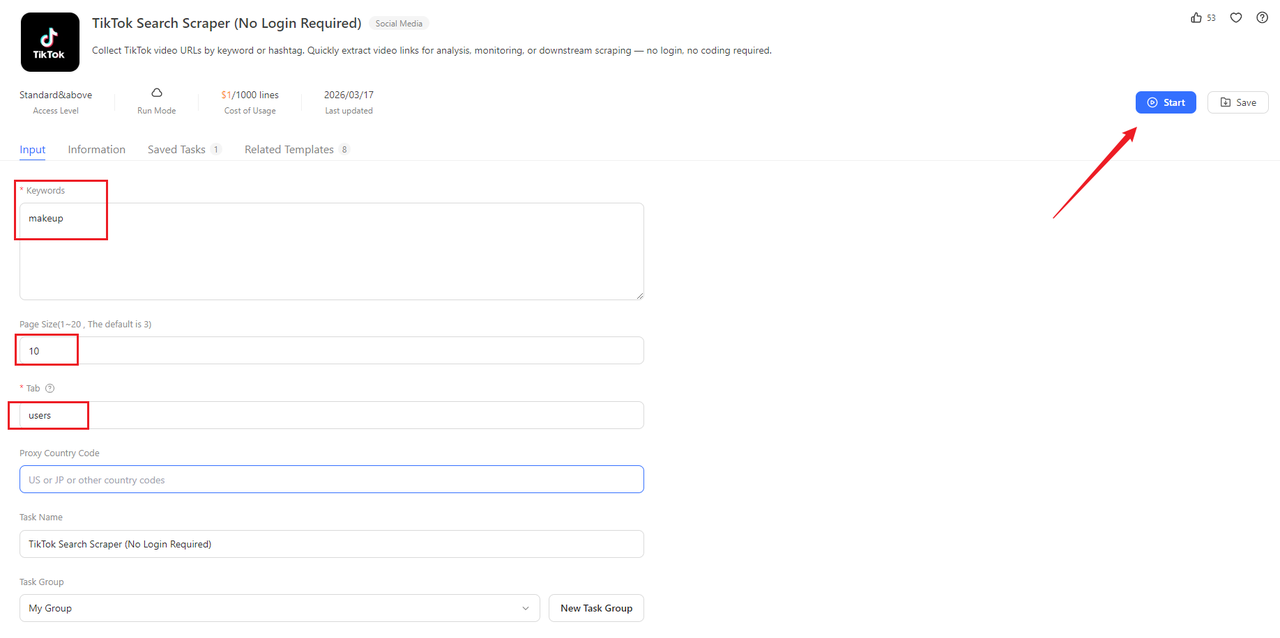
Building the KOL database (Workflow C): They ran the TikTok Search Scraper (No Login Required) with the keyword “makeup”, collected 10 Search Result Batches, and filtered for creators with more than 100,000 followers who had posted recently. The scraper input looks like this: keyword entered, Search Result Batches set to 10, then Start:
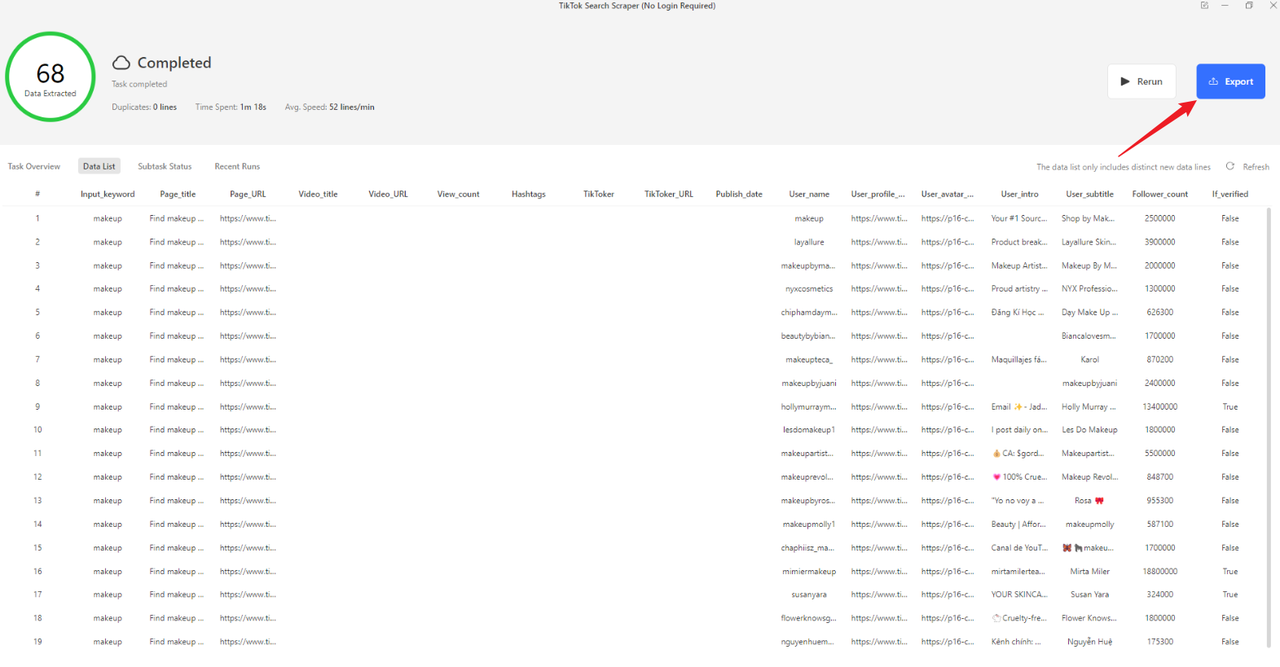
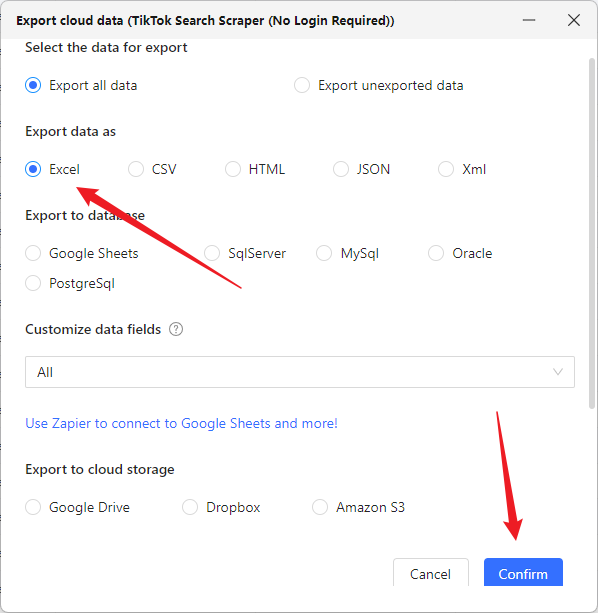
The output returned creator handles, profile URLs, follower counts, and bios. Video-related fields were empty because the Users tab was selected, and that is expected. Once the run completed, they clicked Export, selected Excel as the format, and confirmed. From the exported file they filtered the TikToker_URL column for follower count above 100,000 in Excel, and had an initial KOL shortlist ready in one session.
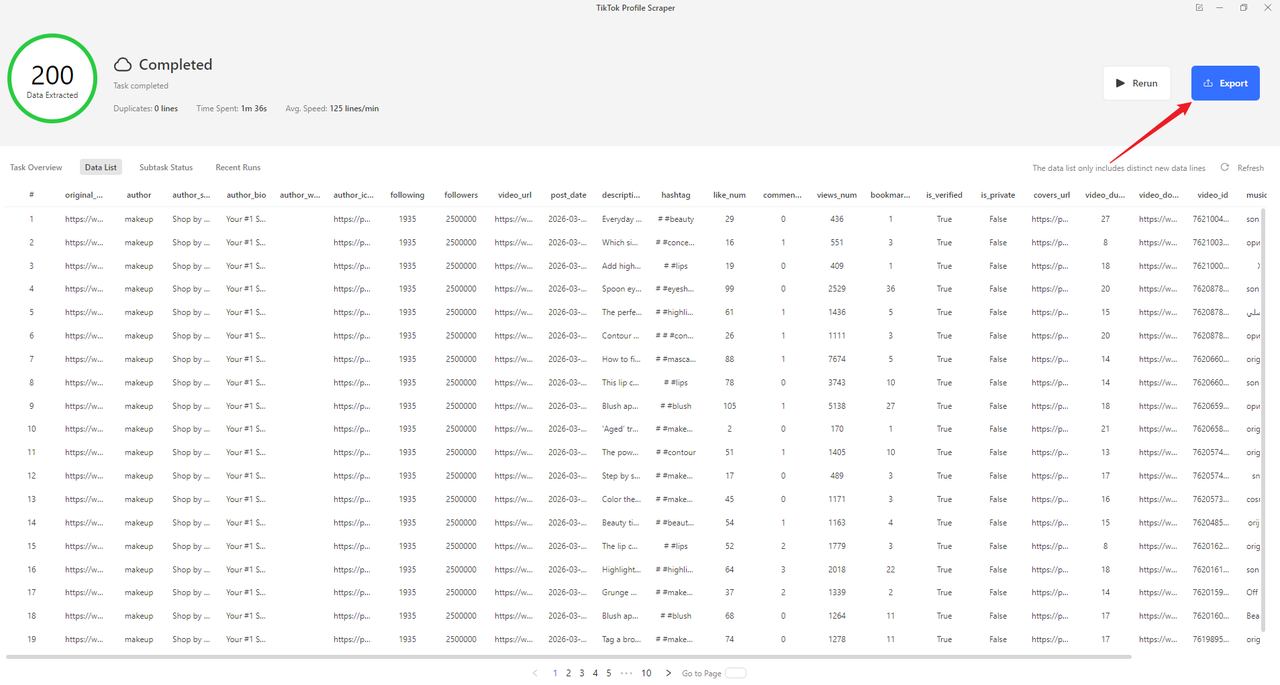
Scaling to full profile data (Workflow C continued): They imported the filtered profile URLs into the TikTok Profile Scraper as batch input. Each profile returned the creator’s complete video history: post dates, view counts, like counts, download links, and audio metadata.
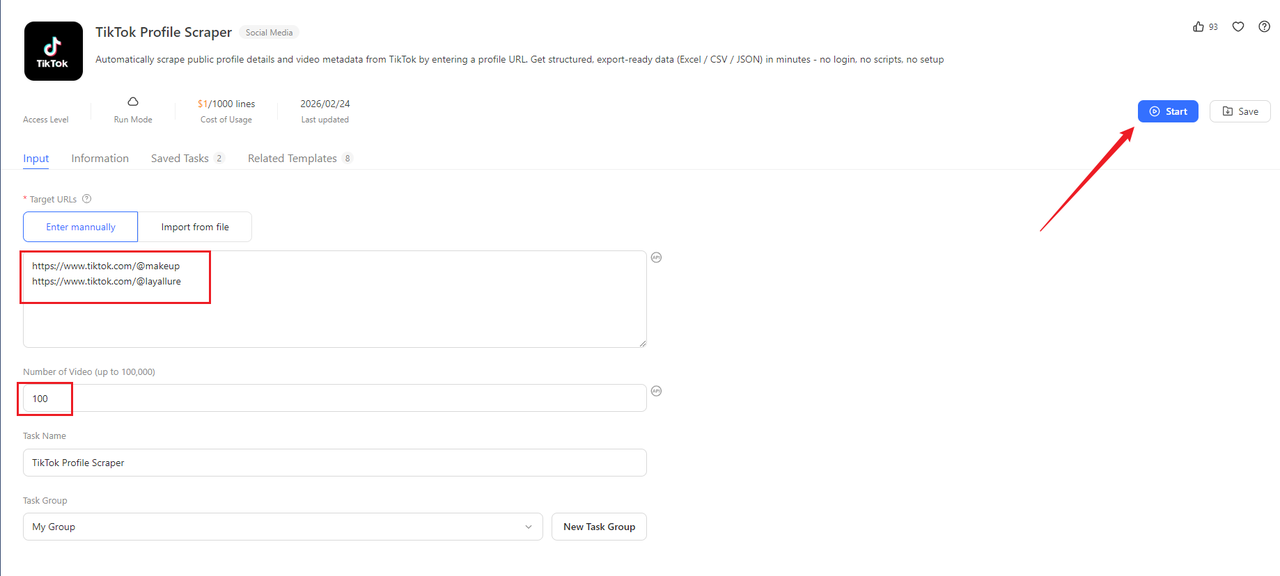
They filtered the results for videos with the highest engagement in their spreadsheet tool and exported those Video_URLs for the next stage.
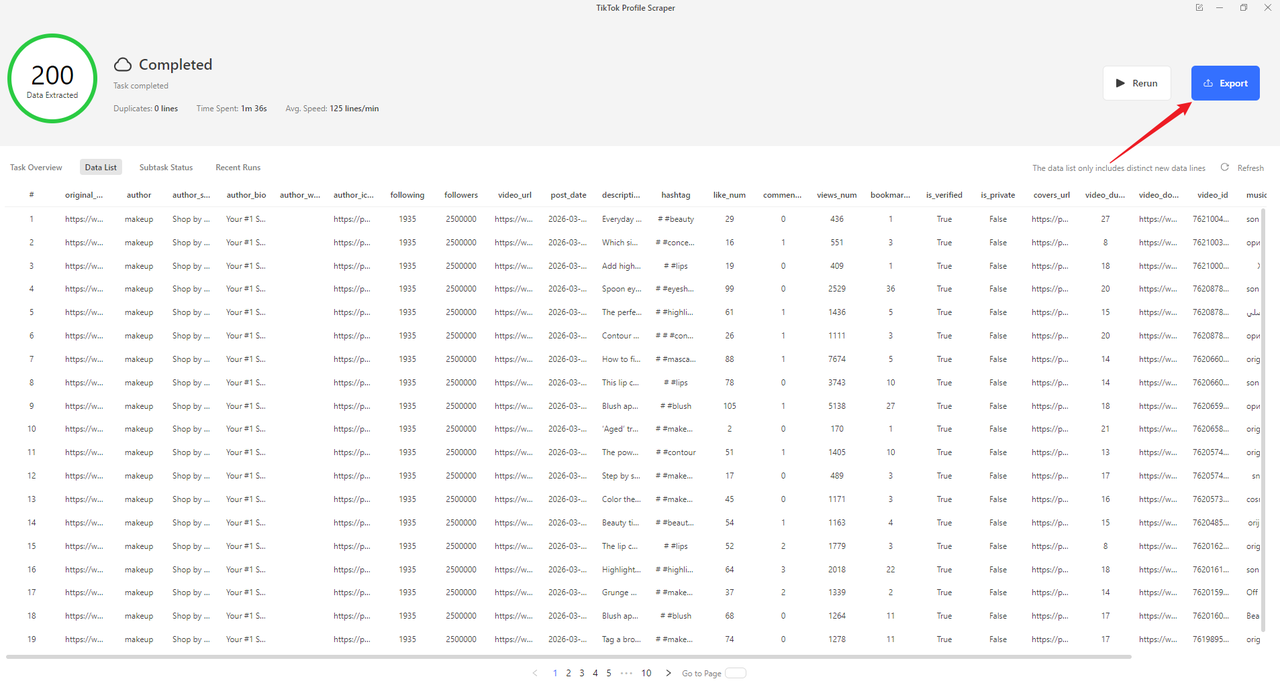
Analyzing top videos (Workflow B into A): For videos with more than 1 million views, they fed the Video_URLs into the TikTok Video Details & Comments Scraper, collecting comments per video. The exported comment dataset went into a sentiment analysis tool to measure positive, negative, and neutral ratios, and to extract high-frequency keywords from audience language.
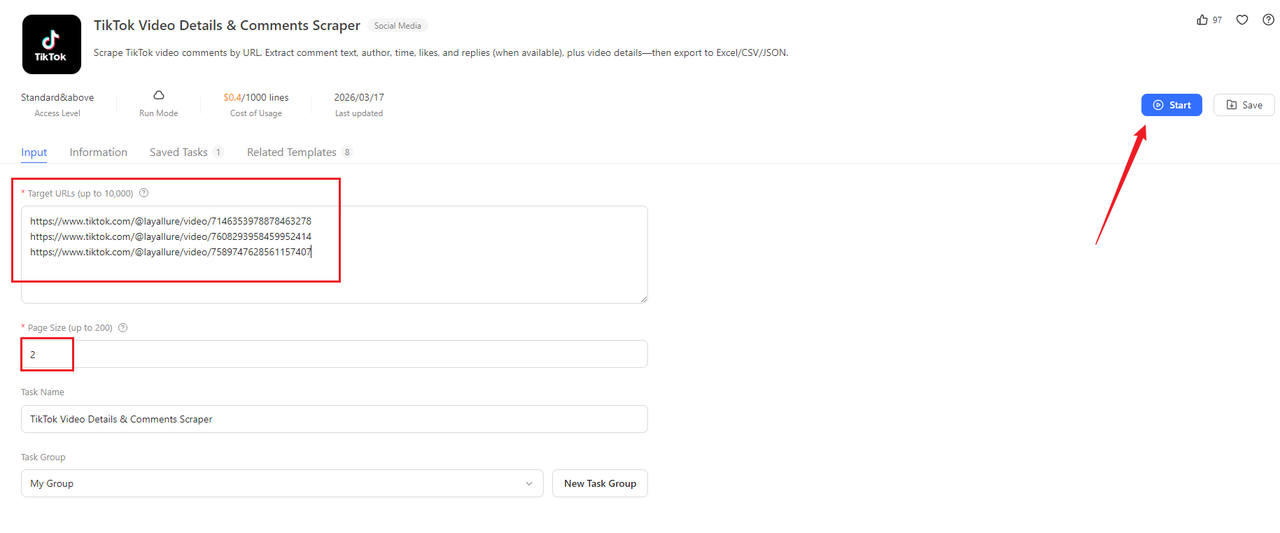
Results that came from the data, not from guessing: Weekly automated scraping replaced full-time manual monitoring. The comment analysis revealed that audiences were responding to specific product formats they had not prioritised before. Competitor account tracking, run on a fixed schedule, produced weekly reports that flagged content strategy shifts early enough to respond before a major campaign. The pipeline also produced a content reference library: video download links collected automatically across all high-performing videos, stored and tagged by niche, for internal creative reference.
Getting Started: Your First Scrape in Under 10 Minutes
- Create a free Octoparse account. The free tier includes access to the template library.
- Search “TikTok” in the Octoparse template library to see all five TikTok templates.
- Start with the TikTok Profile Scraper. Enter one creator URL, leave settings at default, and click Run.
- Let the first run complete. Verify the output fields match what you need before scaling to batch inputs.
- Export to Excel, CSV, or Google Sheets. For workflow combinations, export the URL column and use it as the next template’s input list.
👉 Start scraping TikTok free with Octoparse
Why TikTok Is Harder to Scrape Than Most Platforms
TikTok’s defenses operate at multiple layers simultaneously, and most scrapers fail before they ever see a CAPTCHA.
Signature validation is the first barrier. Every TikTok API request requires dynamically generated parameters, including X-Bogus, X-Gnarly, msToken, ttwid, and wid, computed fresh for each session. A request with missing or malformed signatures returns empty data or an immediate block.
Device fingerprinting is the second. TikTok tracks browser fingerprint consistency. Inconsistencies in User-Agent, screen resolution, or timezone data across a session trigger detection.
IP velocity is the third. High request frequency from a single IP, even with correct signatures, triggers rate limiting. Residential IP rotation is required for anything beyond minimal scraping.
Behavioral pattern analysis is the fourth. Fixed-interval requests are detectable as non-human. Human browsing has irregular timing patterns.
CAPTCHA challenges are the fallback, not the primary defense. TikTok’s rotating puzzle CAPTCHA fires when earlier signals are ambiguous.
Octoparse templates handle all of this at the infrastructure level. Verified by our engineering team:
- Signature parameters (X-Bogus, X-Gnarly, msToken, ttwid, wid) are generated and refreshed automatically per session
- IP rotation via data center and residential proxy pools with region-specific targeting
- Automatic User-Agent rotation and cookie refresh between sessions
- Built-in CAPTCHA recognition for TikTok’s rotating puzzle, plus reCAPTCHA, DataDome, and Cloudflare
- Randomized request intervals that mirror human browsing patterns
- Template maintenance when TikTok rotates its signing algorithm: you re-run the task with the updated version rather than rebuilding your scraper
📖 For a deeper breakdown of anti-scraping mechanisms and how proxy rotation addresses them, see 5 anti-scraping techniques you may encounter.
📖 For CAPTCHA-specific handling, see how to bypass CAPTCHA for web scraping.
FAQs About TikTok Data Scraping
- What are the most reliable tools for TikTok data extraction?
Octoparse is among the most reliable for non-technical users. It has five stable templates built specifically for TikTok, handles anti-bot defenses automatically, and maintains templates when TikTok updates its backend. For developers, Python with Playwright or Selenium works but requires ongoing maintenance. For a full comparison, see TikTok data scraping tools.
- Is it legal to scrape TikTok?
TikTok scraping collects publicly visible data, the same content any user can see without logging in. Legality depends on jurisdiction, use case, and how the data is handled after collection. Scraping public data for personal research and non-commercial analysis is treated differently from commercial redistribution in most regions. TikTok’s Terms of Service prohibit automated access, which creates a terms violation risk distinct from legal status. Consult legal guidance for commercial applications.
- Can I scrape TikTok without an account?
Yes. The TikTok Search Scraper (No Login Required) is specifically designed for no-login operation. It is the paid, simpler, and more stable option. The TikTok Profile Scraper and TikTok Video Details & Comments Scraper also work without an account on public profiles and content. If you prefer to avoid per-result charges and are comfortable logging in, the TikTok Search Scraper (Login Required) is an alternative, though it requires more setup and can be less stable.
- How do I scrape TikTok comments specifically?
Use the TikTok Video Details & Comments Scraper template. Input the video URL, set the number of input units (each unit returns up to 50 comments and replies), and run. Output includes first-level comments and second-level reply threads in structured format. For bulk comment scraping across many videos, first use the TikTok Search Scraper (No Login Required) to collect a Video_URL list, then batch-process those URLs through the comments template.
- What is the difference between scraping TikTok and using the TikTok API?
TikTok’s Research API and Developer API require application approval and carry strict rate limits, covering only certain data types. Scraping covers the full public data layer, including comment reply threads and video metadata not exposed through the API. The API suits formal integrations with data access agreements. Scraping is more practical for research, competitive analysis, and one-time data collection at scales or on data types the API does not support.
- Can Octoparse scrape private TikTok accounts?
No. Private account content is not publicly accessible. Octoparse’s templates only collect data that is publicly visible without logging in.
- Can I scrape TikTok hashtag and trending sound data?
You can use the TikTok Search Scraper (No Login Required) with a hashtag as your keyword input to collect video URLs under that hashtag. The TikTok Profile Scraper and Video Details Scraper output music_name, music_author, and music_url fields for individual videos you already have URLs for. There is currently no dedicated template for directly discovering trending sounds or audio trends across TikTok. For tracking trending sounds in known videos, see how to find trending sounds on TikTok.
- How often do the TikTok templates get updated?
TikTok periodically rotates its signing algorithm and API parameters. Octoparse monitors these changes and pushes template updates. You re-run the task with the updated template, with no code changes required.
Next Steps
You now know what TikTok data you can collect, every method for collecting it ranked by effort, and workflow combinations that take you from a keyword to structured comment sentiment without writing a line of code.
Pick one template, one use case, and run a small test export. Verify the fields match what you need. Then scale.
Want to go deeper into TikTok and social media data? Check these articles: