
Quick Answer
| Factor | Lower Risk | Higher Risk |
| Data type | Public, factual, non-personal | Personal data (PII), copyrighted content |
| Access method | Standard HTTP requests, respecting robots.txt | Bypassing CAPTCHAs, spoofing headers, ignoring rate limits |
| Use of data | Internal research, market analysis | Commercial resale, AI training without licensing, republishing |
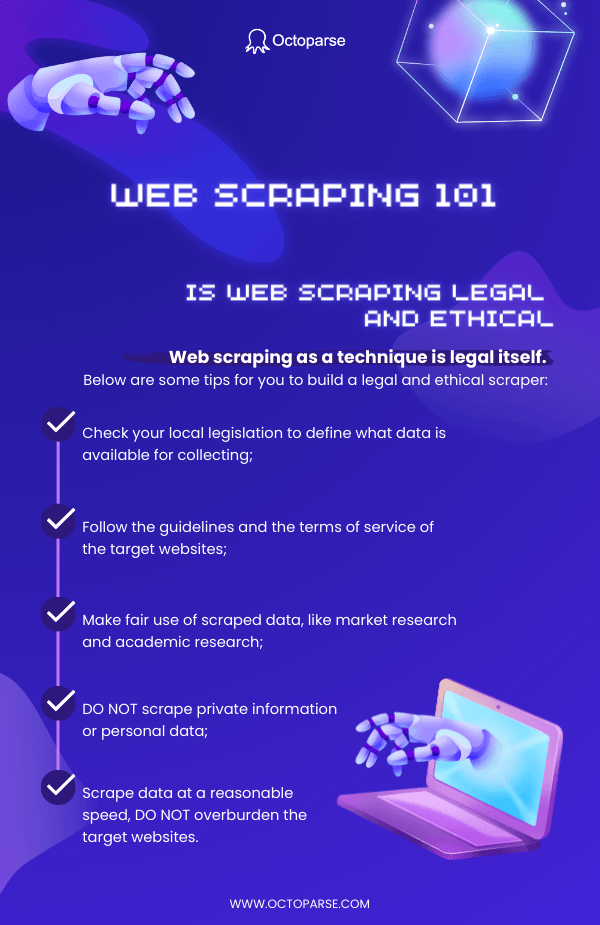
Web scraping is not illegal by default. No law explicitly bans it in the US, EU, or most of Asia. Whether a specific scraping project is legal depends on three factors: the type of data collected, how you access it, and what you do with it afterward. Scraping publicly available, non-personal data for research or internal use is generally low-risk. Scraping personal data, bypassing authentication, or violating a site’s Terms of Service moves into a legal grey area.
Disclaimer: This article is for informational purposes only and does not constitute legal advice. Consult a qualified legal professional for guidance on your specific scraping project.
What Determines Whether Web Scraping Is Legal?
Courts and regulators in every jurisdiction look at the same three questions when evaluating a scraping case. Understanding them helps you assess risk before you start any project.
1. What type of data are you scraping?
Factual, publicly available data (product prices, business addresses, job listings, public reviews) carries the least legal risk. Facts themselves cannot be copyrighted under US law. Personal data, including names, email addresses, profile photos, and any information that identifies a specific individual, is a different matter. Privacy regulations like GDPR and the California Consumer Privacy Act apply to personal data even when it appears on a public webpage.
2. How are you accessing the data?
Standard HTTP requests to publicly accessible pages sit in the safest zone. Problems arise when scraping involves bypassing login walls, circumventing CAPTCHAs, spoofing User-Agent strings to disguise automated traffic, or ignoring explicit blocks. Courts have treated technical evasion as evidence of bad faith, and it strengthens claims under laws like the Computer Fraud and Abuse Act (CFAA).
3. What are you doing with the data?
Internal research, competitive price monitoring, and academic analysis are widely accepted uses. Reselling scraped data, publishing copyrighted content, or training commercial AI models without licensing agreements moves the risk significantly higher. Several major lawsuits since 2023 have centered specifically on unauthorized AI training data use.
Is Web Scraping Legal in the United States?
The US has no single statute that governs web scraping. Legal exposure comes from a patchwork of federal and state laws.
The Computer Fraud and Abuse Act (CFAA)
The CFAA prohibits accessing a computer “without authorization” or in excess of authorized access. For years, companies used this law to threaten scrapers of publicly available data. Recent court decisions have narrowed that interpretation considerably.
In hiQ Labs, Inc. v. LinkedIn Corp., the Ninth Circuit held that scraping data accessible to the general public without authentication does not constitute “unauthorized access” under the CFAA. This is the most important ruling for web scrapers in the US: accessing a public website does not automatically violate the CFAA.
This is exactly why business directory data, such as Google Maps listings, is generally considered lower risk to scrape. Our Google Maps scraping guide covers this in full detail.
The caveat: continuing to scrape after receiving a cease-and-desist letter, or bypassing technical measures to block your access, can cross into unauthorized territory. Facebook, Inc. v. Power Ventures, Inc. established that circumventing technical blocks after being told to stop does violate the CFAA.
Copyright and the DMCA
A website owner can pursue copyright claims if the scraped content is original and creative (articles, photos, product descriptions written by humans). Raw facts, prices, and data points are generally not copyrightable. Section 1201 of the Digital Millennium Copyright Act adds another layer: using bots to circumvent technical access controls on copyrighted material can create liability separate from the underlying copyright question.
Privacy statutes
California’s Consumer Privacy Act (CCPA) and 12 other state privacy laws grant consumers rights over their personal information. Most US state privacy laws include an exception for personal data that individuals have made publicly available, which provides meaningful protection for scrapers collecting public data, but not for scraping behind-login profiles or private accounts.
Terms of Service and breach of contract
Violating a website’s Terms of Service is not automatically a criminal offense, but it can support civil claims. Courts have generally required that users be clearly on notice of the ToS before holding them to it. Violating ToS after explicit notice, especially combined with technical access circumvention, significantly increases legal exposure.
How U.S. Laws Apply to Web Scraping
| Law | What it covers | Risk for public data scrapers |
| CFAA | Unauthorized computer access | Low (post-hiQ), unless bypassing technical blocks |
| Copyright/DMCA | Original creative content | Low for facts, higher for articles/images |
| CCPA/State privacy | Personal data of state residents | Moderate if scraping names, emails, profiles |
| Breach of contract | ToS violations | Low to moderate, depends on notice and intent |
Is Web Scraping Legal in Europe?
The EU takes a fundamentally different approach from the US: privacy is treated as a fundamental right, not a consumer protection issue.
GDPR
The General Data Protection Regulation applies to any personal data of EU residents, regardless of whether that data is publicly visible. Scraping a publicly accessible LinkedIn profile of an EU citizen still triggers GDPR obligations because it is personal data. To process that data lawfully, you need one of six legal bases: consent, contract, legal obligation, vital interest, public interest, or legitimate interest.
For most commercial scraping of personal data, legitimate interest is the basis companies attempt to use. It requires a three-part balancing test, and courts have rejected it in cases involving large-scale automated collection without the individual’s awareness.
The key practical rule: if your scraping project touches any personally identifiable information belonging to EU residents, assume GDPR applies and seek legal advice.
Other EU frameworks
The Digital Single Market Directive permits data mining for research and innovation purposes. The Database Directive protects substantial database investments, meaning you cannot systematically extract large portions of a database even if individual records are public. National implementations vary across 27 member states, adding compliance complexity for pan-European operations.
UK post-Brexit
The UK maintains equivalent protections through the UK GDPR, the Data Protection Act 2018, and the Computer Misuse Act. The practical rules are nearly identical to EU requirements.
U.S. vs. EU: The Core Difference
| Jurisdiction | Public personal data | Non-personal public data |
| US | Generally low risk (with state exceptions) | Generally permitted |
| EU/UK | Requires legal basis under GDPR | Generally permitted |
| Key difference | EU requires justification even for public PII | US assumes public data is fair game |
Is Web Scraping Legal in Asia?
China, India, and Japan each present distinct compliance environments.
China
China’s Network Data Security Management Regulations (State Council Order No. 790), passed in August 2024 and effective January 1, 2025, established mandatory data localization requirements for major platform operators and enhanced audit obligations. Practically speaking, if you limit collection to publicly available, non-personal information and avoid personal data entirely, compliance becomes substantially simpler. Scraping personal data of Chinese residents without proper legal basis carries significant regulatory risk.
India
India’s Digital Personal Data Protection Act takes a narrower territorial scope than GDPR. It provides a clear exemption for “publicly available information” that data subjects have voluntarily made accessible, which is more favorable than the EU approach for scrapers collecting public data. That said, the law is still being implemented, and enforcement guidance continues to develop.
Japan
Japan is taking the most innovation-friendly stance among major economies. Proposed 2025 amendments would permit personal data use for AI training without individual consent in certain circumstances. Reciprocal adequacy arrangements with the EU and UK also create streamlined compliance pathways for data flows.
Is Scraping Public Data for Commercial AI Training Legal?
This is the fastest-moving area of web scraping law in 2026, and the answer is genuinely unsettled.
On October 22, 2025, Reddit filed a lawsuit in New York federal court against Perplexity AI and three data-scraping companies, alleging large-scale unlawful scraping of Reddit content for commercial AI training. Reddit had sued Anthropic, maker of Claude AI, on similar grounds in a separate case filed on June 4, 2025. The New York Times sued OpenAI, Getty Images sued Stability AI, and music labels have pursued AI companies over training data. A clear pattern has emerged: content owners expect compensation for commercial AI training use.
The legal theories in these cases cluster around three areas:
DMCA Section 1201: Using proxies and fake User-Agents to bypass anti-scraping measures may violate DMCA’s anti-circumvention rules, regardless of whether the underlying content would be a copyright violation.
CFAA: Continuing to scrape after a cease-and-desist establishes lack of authorization. The Reddit v. Perplexity complaint alleges that citations of Reddit content increased 40-fold after a cease-and-desist was sent, which courts will view as a bad-faith indicator.
Copyright and unfair competition: If scraped data trains a product that directly competes with the source platform, courts are more likely to find commercial harm sufficient to support claims.
What this means for you:
If you are scraping at scale for commercial AI applications, the current risk calculus has shifted. Licensing agreements, while costly, have become the standard practice among industry leaders. Google, OpenAI, and others have paid for data access. Operating without similar agreements carries litigation exposure that did not exist three years ago. For small-scale academic or research use, the risk profile remains substantially lower.
When Your Web Scraper Becomes a Legal Liability
Speed and scale are the two factors that most reliably convert a legal scraping project into a legal problem.
The trespass to chattels risk
Under the legal doctrine of trespass to chattels, dating to English common law, you can be held liable for damage to someone else’s property, including servers. In eBay v. Bidder’s Edge, 100 F. Supp. 2d 1058 (N.D. Cal. 2000), the court found that automated queries burdening a server, even without immediately crashing it, can constitute trespass to chattels. You do not need to intend harm. If your scraper causes measurable server performance degradation, you can face claims for direct damages (server costs, lost revenue), consequential damages, and injunctive relief. Note that this ruling’s broader logic was partially narrowed by the California Supreme Court in Intel Corp. v. Hamidi (2003), which held that electronic activity causing no actual damage to a computer system does not meet the trespass to chattels threshold. The practical takeaway remains: scrapers that measurably degrade server performance carry real legal exposure; those that don’t are on safer ground.
The practical problem with “maximum speed” scraping
When a scraper sends requests faster than a server can handle, the sequence is predictable: CPU utilization spikes, memory fills, response times increase, HTTP 503 and 504 errors appear. For smaller websites, this can result in a full outage. The site owner’s legal team sees this as equivalent to a DDoS attack and responds accordingly.
The fix is straightforward: implement rate limiting of at least one to two seconds between requests, identify your bot with a transparent User-Agent string, and stop immediately if you receive a cease-and-desist or technical blocking signals.
Best Practices for Legal Web Scraping
| Practice | Why it matters |
| Check robots.txt before scraping | Signals awareness of site policies; ignoring it after checking strengthens bad-faith claims |
| Implement rate limiting (1-2 sec between requests) | Prevents trespass to chattels exposure; avoids IP bans |
| Review Terms of Service | ToS violations can support breach of contract claims |
| Use official APIs when available | APIs provide explicit authorization; legally cleaner than scraping |
| Avoid personal data unless GDPR/CCPA compliant | PII triggers privacy law exposure in most jurisdictions |
| Don’t republish copyrighted content | Separates data collection (lower risk) from content reproduction (higher risk) |
| Identify your scraper with a real User-Agent | Deception strengthens claims against you; transparency reduces them |
| Stop when asked | Continuing after a cease-and-desist converts a civil matter into a stronger legal case |
| Document your compliance decisions | Shows good faith if challenged |
| Monitor legal developments | Laws in this area are changing faster than in almost any other tech-adjacent domain |
These practices reduce legal risk across all jurisdictions. None of them guarantee compliance for every use case, but they demonstrate good faith, which courts and regulators weigh in your favor.
We run Octoparse with configurable request intervals and full robots.txt compliance by default. If you’re setting up a new scraping project and want to see how rate limiting and compliant data collection work in practice, download Octoparse free and test it against a public dataset before scaling up.
Wrap-Up
Web scraping is not illegal, but whether a specific project is legal depends on what you scrape, how you access it, and what you do with the data. The US has moved toward greater clarity through court decisions like hiQ v. LinkedIn, while the EU maintains stricter requirements around personal data. AI training data scraping is the fastest-changing legal frontier in 2026, with major lawsuits still unresolved.
For most commercial scraping projects, the practical path to compliance is consistent: stick to public, non-personal data, respect rate limits and robots.txt, use APIs when available, and get legal advice before scaling up.
If you want a tool built for compliant data collection, try Octoparse free for 14 days. It handles rate limiting, robots.txt compliance, and structured data extraction without requiring you to write code.
Turn website data into structured Excel, CSV, Google Sheets, and your database directly.
Scrape data easily with auto-detecting functions, no coding skills are required.
Preset scraping templates for hot websites to get data in clicks.
Never get blocked with IP proxies and advanced API.
Cloud service to schedule data scraping at any time you want.
FAQs About Web Scraping Legality
1. Is web scraping publicly available data always legal?
Not automatically, but it carries the lowest legal risk. Public data that is factual and non-personal (prices, addresses, product listings) is generally permissible in the US and most of Asia. In the EU, even publicly visible personal data, like names on a public profile, triggers GDPR obligations. The method of access matters too: even public data accessed by bypassing technical controls creates legal exposure.
2. Does violating a website’s Terms of Service make scraping illegal?
Violating ToS is not automatically a criminal offense. Courts have generally treated ToS violations as civil contract matters, not criminal hacking. However, ToS violations strengthen other claims (CFAA, unfair competition) and give site operators grounds to pursue injunctions and damages. If you receive explicit notice that your scraping violates a site’s terms, continuing creates substantially higher risk.
3. Can a website legally block my scraper?
Yes. Websites have broad authority to implement technical measures to restrict automated access. IP blocking, CAPTCHAs, and rate limiting are all legal. Attempting to circumvent these measures, such as by rotating IPs or spoofing headers, may violate the DMCA’s anti-circumvention provisions and strengthens CFAA claims against you.
4. Is scraping personal data from LinkedIn or social media legal?
In the US, the hiQ v. LinkedIn ruling established that scraping publicly accessible profile data does not violate the CFAA. However, copyright and state privacy laws still apply to how that data is used. In the EU, scraping LinkedIn profiles of EU residents triggers GDPR obligations regardless of the data being publicly visible, and you need a lawful basis to process it.
5. Is scraping data for AI training legal in 2026?
This is the most contested area in 2026. Scraping public data for AI training is not explicitly illegal, but multiple lawsuits are testing the boundaries. Scale, commercial intent, and technical circumvention are the key risk factors. Industry norms are shifting toward licensing agreements for large-scale commercial AI training use. Small-scale academic research carries substantially lower risk.
6. What should I do if I receive a cease-and-desist letter about web scraping?
Stop scraping immediately and consult a lawyer before responding or resuming. Continuing after receiving a cease-and-desist is one of the strongest indicators of bad faith in court and significantly increases your legal exposure under the CFAA and other statutes.