Etsy provides an official Open API v3 for approved applications, but it is not an unrestricted public feed for every listing or shop. For permitted page-level collection, start with known listing URLs and verify a small run before scaling.
Does Etsy Have an API?
Yes. Etsy Open API v3 uses an API key and OAuth 2.0. It supports authorized applications working with shop, listing, inventory, order, and other approved resources. It is not an unrestricted endpoint for any Etsy page or shop.
- Approval is required. You need a registered application and the appropriate Etsy access before making API calls.
- Limits are application-specific. Etsy’s rate-limit documentation shows example limits, but your actual limits depend on your application and Developer Portal settings.
- Use the API for authorized workflows. For your own shop or an approved integration, the API is the right starting point. Do not assume that competitor research or bulk market monitoring is covered by API access.
For current scope and authentication requirements, see the Etsy authentication documentation.
Collect Etsy Product Data by URL
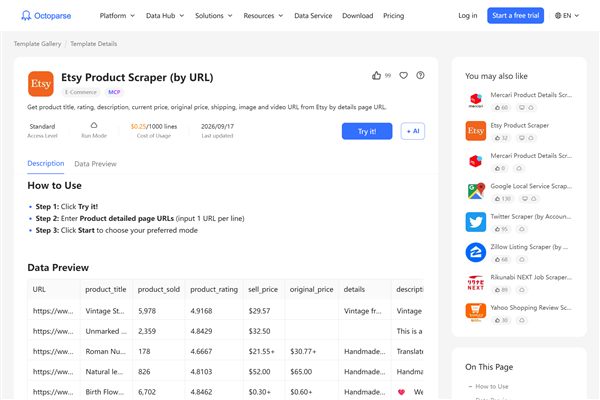
If you already have specific Etsy listing URLs and have permission to collect the data, a URL-based workflow is easier to validate than a broad search crawl. The product template can return fields such as product title, rating, current price, original price, description, shipping information, image URLs, and video URL when those fields are available on the page.
https://www.octoparse.com/template/etsy-product-scraper-by-url
For a step-by-step walkthrough, see the official Octoparse Etsy product scraping tutorial. It covers the page-level setup and field selection before you run a small, authorized test.
Real Test: 15 Etsy Listings
We ran the URL-based template on September 21, 2026 using 15 live Etsy listing URLs across three categories: personalized necklaces, handmade ceramic mugs, and wedding invitation templates. The Octoparse task completed all 15 inputs. Thirteen rows returned full data; two rows returned empty fields and were kept in the count rather than removed.
| Test field | Observed result |
|---|---|
| Task ID | 76fc8368-d162-45e8-8393-9dfcb74428c7 |
| Run date | September 21, 2026 |
| Input | 15 Etsy listing URLs |
| Completed inputs | 15/15 |
| Full-data rows | 13/15 |
| Rows with empty fields | 2/15 |
| Observed price range | $9.99–$82.00 across populated rows |
| Observed review range | 0–12,031 across populated rows |
The two empty-field rows were retained because a verifiable test should show incomplete output instead of silently hiding it. The result is useful for planning: direct product URLs completed in this run, while broader search and shop inputs may require a CAPTCHA pause and manual review.
Collect Products from an Etsy Shop
For an authorized shop-level workflow, use a shop URL rather than entering individual listing URLs one by one. Confirm the current input rules, output schema, and record pricing on the template page before starting a larger run. The shop template may be useful for catalog-level research, but it should not be treated as permission to collect another seller’s data.
https://www.octoparse.com/template/etsy-shop-products-scraper
Permissions and Compliance
Public visibility does not automatically grant permission to collect or reuse Etsy data. Etsy’s Terms of Use and API Terms of Use set restrictions on automated access and data use. Review those terms, obtain the permission required for your use case, minimize collection of personal data, and ask qualified counsel when the use case is unclear.
If a CAPTCHA, 403 response, login wall, or other access restriction appears, pause the run and confirm that the collection is authorized. Do not bypass access controls or use proxy rotation to evade a restriction. For broader background, see Is Web Scraping Legal in Some Countries.
Choosing an Octoparse Workflow
Octoparse is a web data platform with a Templates Gallery for ready-made workflows and Octoparse Desktop for point-and-click authoring. Choose the input that matches the job:
- Known product URLs: use the Etsy Product Scraper (by URL).
- An authorized shop catalog: use the Etsy Shop Products Scraper.
- A page or field not covered by a template: validate the target page and permissions before building a custom task in Octoparse Desktop.
- Repeatable automation: keep the template version, input set, export, and run receipt together so failures can be diagnosed instead of hidden.
FAQs About Scraping Etsy
- Does Etsy have a public API?
Etsy has an official Open API v3, but it requires an approved application and appropriate authentication. It is not an unrestricted endpoint for any Etsy page or shop. - Which template should I use for one product?
Use the URL-based product template when you already have the product detail URL and have permission to collect it. - Which template should I use for a shop?
Use the shop template for an authorized shop-level collection. Confirm its current output fields and pricing on the template page before running at scale. - Do I need proxies or CAPTCHA workarounds?
Do not treat proxies as a way to bypass an access restriction. If a CAPTCHA or block appears, pause the task and verify authorization and the permitted collection method. - Can I collect my own Etsy shop data?
For your own shop, start with Etsy’s authorized API workflow where it meets your requirements. A template may also be suitable for permitted page-level collection, but you still need to follow Etsy’s terms and keep a test record.
If you need structured marketplace data beyond Etsy, compare the Amazon product-data workflow to see how URL inputs, fields, and output validation are handled.
Conclusion
Etsy’s Open API is useful for approved applications, while URL-based templates are a practical way to organize permitted page-level collection. In our September 21 test, 15 direct listing URLs completed, with 13 full-data rows and 2 incomplete rows. Start with the smallest test you can verify, keep one standalone template link per workflow, and confirm Etsy’s current terms and access requirements before scaling.