

Pinterest research looks simple until the tenth search. Pins load as you scroll, page layouts change, and copying titles, owners, links, and image URLs by hand soon becomes the work instead of supporting it.
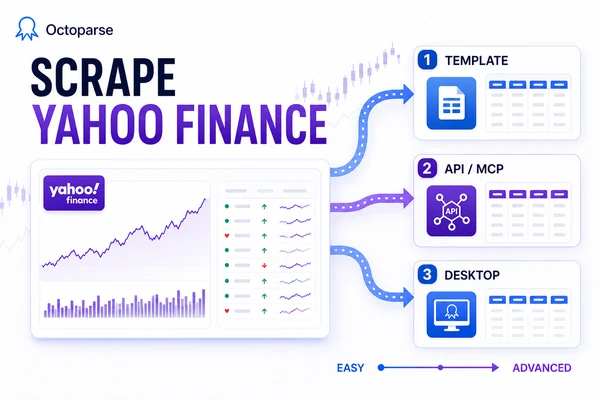
For most users, the fastest route is the Pinterest Search Scraper Template. Add API or MCP when a working cloud task needs automation, and use the desktop client when the page requires custom interaction logic.
Octoparse offers four practical routes for structuring public Pinterest data: a ready-made Template, the Octoparse AgentTools API, Octoparse MCP, and a desktop Custom Task. Start with the Template because it requires the least setup. Use API or MCP when the same cloud workflow must run repeatedly. Choose the desktop client when the page needs custom visual logic.
This guide documents all four routes. It also separates three kinds of evidence: official product documentation, a successful 20-row Template run, and an MCP run that completed but returned no rows. That distinction matters because a completed task is not always a useful dataset.
Which Pinterest scraping method should you choose?
The best Pinterest scraping method depends on whether an existing cloud Template covers the intended result type and whether the workflow needs automation.
| Route | Best for | Main limitation |
| Octoparse Template | A quick keyword search for Pins, Videos, or Boards | Output still needs validation |
| Octoparse API | Applications, scheduled pipelines, and repeatable jobs | A request can succeed while extraction returns no data |
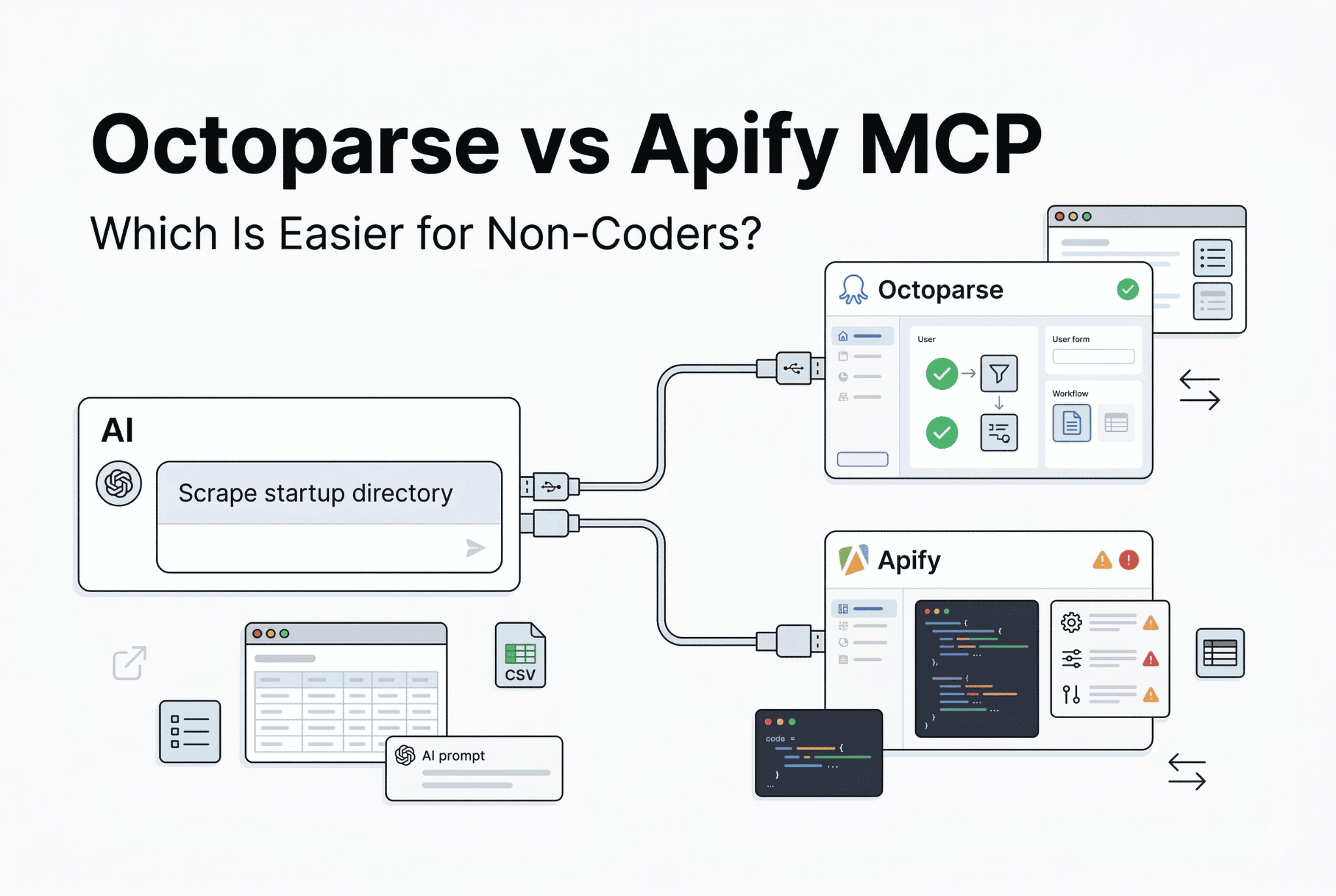
| Octoparse MCP | Running Octoparse tools from ChatGPT or another AI client | It cannot repair a failing Template workflow |
| Desktop Custom Task | Custom clicks, scrolling, fields, or page logic | More setup and maintenance |
| Pinterest API | Authorized application or business use covered by Pinterest endpoints | Data and permissions are platform-defined |
The routing rule is straightforward: test the Pinterest Search Scraper first. If it returns the required fields, add API or MCP only when automation creates real value. Use the desktop client when the Template cannot represent the page interaction.
What is a Pinterest scraper?
A Pinterest scraper is a tool or workflow that converts information displayed on Pinterest pages into structured records for analysis or export. Depending on the page and workflow, candidate fields may include a Pin name, owner, Pin URL, image URL, result type, board reference, and originating query.
The phrase can refer to different access models:
- Public-page collection: A workflow reads fields rendered on pages it is permitted to access.
- Official API access: An authorized application uses the Pinterest API and its defined permissions.
- Account-controlled export: A user exports data from an account or business asset they control.
- Octoparse workflow: A Template, API request, MCP client, or desktop task runs an Octoparse extraction process.
These methods are not interchangeable. A scraper does not create permission, and an API does not guarantee access to every field visible in a browser.
How do you use the Pinterest Search Scraper Template?
https://www.octoparse.com/template/pinterest-search-scraper
The Pinterest Search Scraper is a cloud-supported Octoparse Template for Pinterest keyword searches. On August 20, 2026, the live page listed Pins, Videos, and Boards as result types and showed an MCP label.
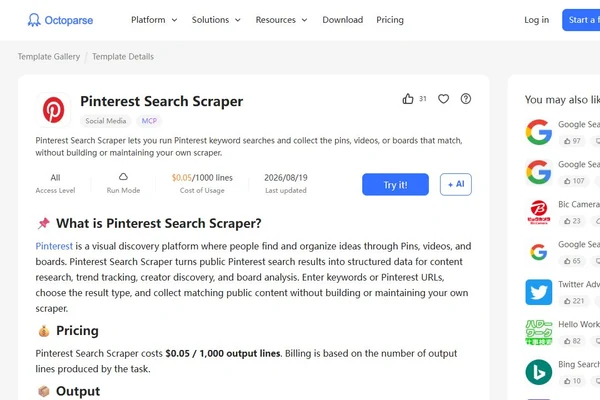
The live Template page identifies its cloud run mode, supported Pinterest result types, MCP availability, and current usage price.
Step 1. Choose the Pinterest result type
Select All Pins, Videos, or Boards. The choice controls both the extraction logic and the fields that can be populated. A video result can expose duration or caption fields, while a board result may expose a Pin count or board reference.
Step 2. Enter a keyword or Pinterest URL
Enter one search query per line. The current Template accepts up to 1,000 entries. For a first test, use one broad keyword such as home decor. A URL is useful only when the Template explicitly accepts that page type.
Step 3. Set a small result limit
Set Maximum Results per Search to 20 for the first run. A small sample makes it easier to spot empty fields, duplicates, unexpected result types, and noncanonical URLs before a larger job consumes time or usage.
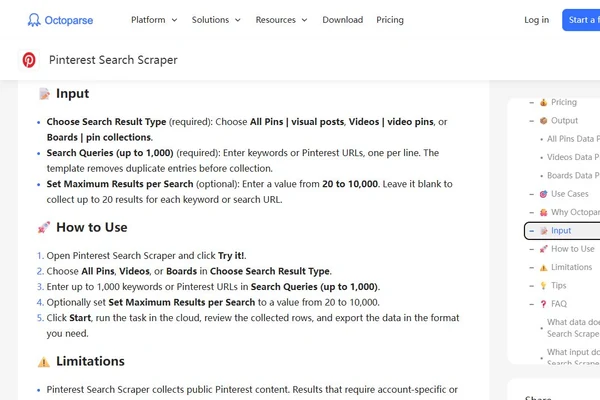
The Template input panel documents the result-type selector, multi-query input, per-search limit, and cloud workflow.
Step 4. Run the Template and inspect the Data List
The authenticated Template test used home decor, All Pins, and a 20-row maximum. The cloud run returned 20 rows. Visible columns included coverURL, id, name, owner, owner metadata, and related Pin fields.
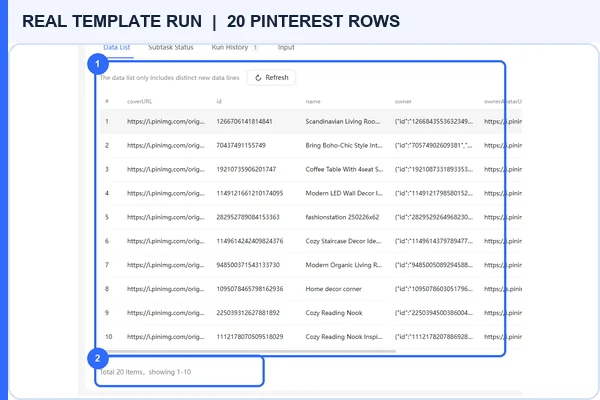
The real Template run returned 20 rows for the keyword home decor. The screenshot shows the first 10 rows and the total row count.
This successful Template run proves that the workflow can return data under the tested account and input. It does not prove that every query, URL, locale, or future Template version will return the same fields.
What did the tests prove?
| Test route | Observed result | Supported conclusion |
| Authenticated Template console | 20 rows for home decor, All Pins, maximum 20 | The Template returned a dataset under the tested account and inputs |
| API and ChatGPT MCP | Task creation or execution completed, export contained zero rows | Connectivity worked, but a usable automated Pinterest export was not demonstrated |
The tests were run on August 20, 2026. Results may change with the query, locale, access state, Template revision, and Pinterest page behavior.
Step 5. Validate before exporting
Check at least five rows manually. Confirm that names match the linked Pins, URLs resolve to the intended records, and image links point to the asset type you need. Then export to CSV, Excel, JSON, or the format supported by the current task interface.
How much does a Pinterest scraper cost?
The live Template page showed a usage price of $0.05 per 1,000 rows on August 20, 2026. Octoparse’s current MCP documentation also states that Free and Basic users receive 2,000 MCP extraction records per week. Pricing and allowances can change, so check the live Template and account plan before estimating a production run.
How does the Octoparse API automate a Pinterest Template?
The Octoparse AgentTools API is the official Octoparse API workflow for template discovery, parameter validation, cloud execution, monitoring, and export. It is useful when another application needs to run the Pinterest Template without a person clicking through the console. For the underlying terminology, see this web scraping API guide.
The official AgentTools workflow guide defines the new-task sequence as:
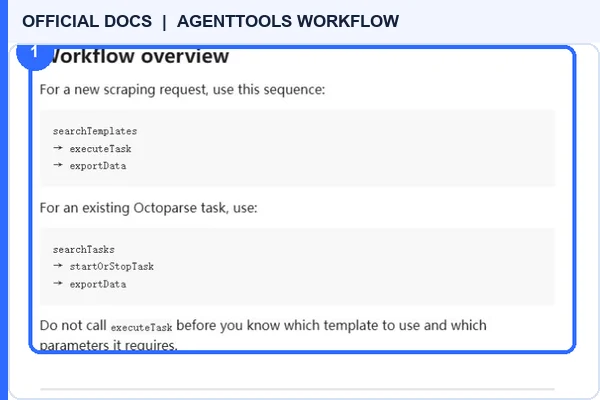
The official guide requires template discovery before execution, followed by export polling with the same task ID.
Step 1. Search for the current Pinterest Template
Call searchTemplates with a Pinterest-related keyword or the known Template ID. Read the returned slug, executionMode, inputSchema, sourceTree, and outputSchema before building the request.
The authenticated discovery test returned Template ID 2349 and slug pinterest-search-scraper. It confirmed three inputs:
| Input field | Type | Required | Tested interpretation |
choose_Search_Result_Type | String | Yes | Use the source option key, such as `All Pins |
search_Queries | String array | Yes | Send one or more keywords or supported Pinterest URLs |
set_Maximum_Results_per_Search | Number | No | Use a small value for validation |
Source-backed fields require the option key returned by the API, not a display label guessed from the interface.
Step 2. Create and start one cloud task
Send the selected Template name, task name, serialized parameters, and required headers to executeTask. Save the returned taskId and lotNo. An accepted response means the task was created and the cloud start was requested. It does not mean rows are ready.
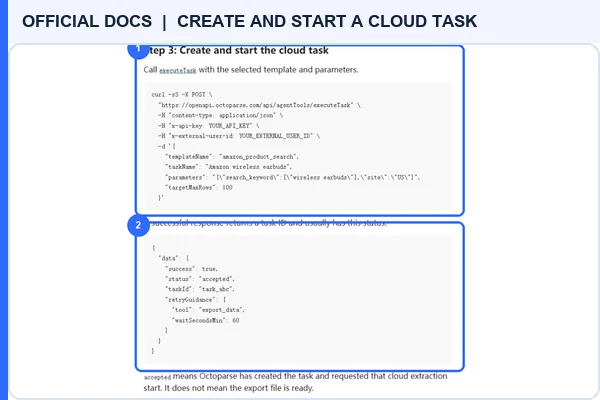
The official API guide separates task acceptance from export readiness and tells the caller to retain the returned task ID.
Step 3. Wait for the instructed interval and export
Follow retryGuidance rather than inventing a timer. Call exportData again with the same task ID until the response reaches a terminal state. The documented states include collecting, exporting, exported, no data, failed, and invalid.
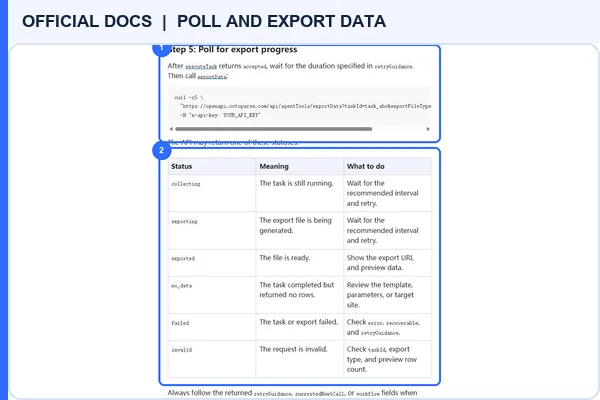
The official status table explains when to wait, when to download, and when to inspect parameters or the target site.
What happened in the authenticated API test?
The discovery call returned the live Template contract and the cloud task was accepted, but export ended with NoDataToExport and zero rows. This proves the connection and task-creation path, not a successful dataset. Keep Template availability, request validity, task acceptance, extraction, and export as separate checks.
How do you connect Octoparse MCP to ChatGPT?
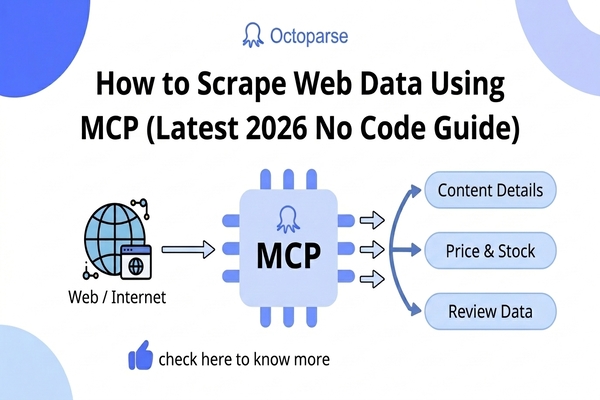
Octoparse MCP connects compatible AI clients to Octoparse tools for template search, cloud task execution, task monitoring, and data export. MCP changes the interface; it does not replace the Template, extraction logic, or access rules. The broader MCP scraping guide explains the same workflow outside this Pinterest example.
According to the official Octoparse MCP documentation, ChatGPT setup uses four steps.
Step 1. Open ChatGPT customization settings
Open the profile menu and select Customize ChatGPT.
Step 2. Enable Developer Mode
Open Apps, choose Advanced Settings, and enable Developer Mode (Beta).
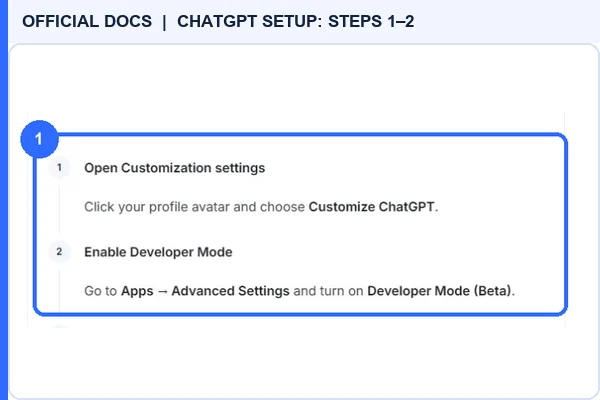
The official documentation places ChatGPT customization and Developer Mode before app creation.
Step 3. Create the Octoparse app
Choose Create app, name it Octoparse, and set the MCP URL to:
Leave the OAuth Client ID and Client Secret blank, acknowledge the app connection, and create it.
Step 4. Authorize Octoparse through OAuth
ChatGPT redirects to Octoparse. Sign in, review the requested access, and select Allow. Return to ChatGPT and verify that the Octoparse app shows as connected before running a task.
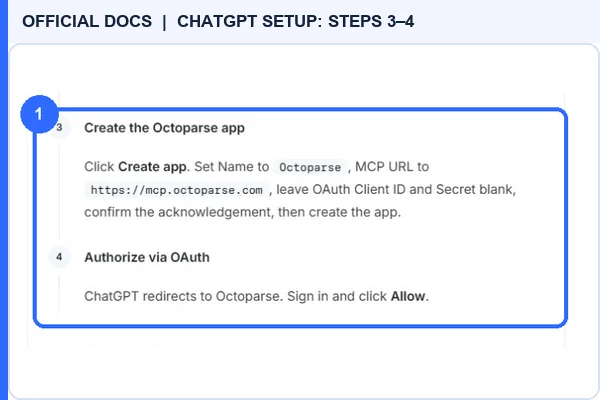
The official flow uses the Octoparse MCP URL and browser-based OAuth authorization.
The same documentation says MCP can search preset Templates, create compatible cloud tasks, monitor runs, and export JSON or CSV. It cannot create a fully custom visual workflow, edit pagination or loops, or run a local-only task.
What did the real Pinterest MCP test return?
The real ChatGPT MCP test searched for pinterest-search-scraper, created one cloud task, used home decor, and limited the request to 20 rows.
| Test field | Result |
| Template and input | pinterest-search-scraper; home decor; maximum 20 |
| Final status | completed |
| Export result | 0 rows; data: [] |
Test record
Task ID: cab03861-ce57-42d5-8fd7-9b5c1bc3f972
Lot No: 639228139922786386
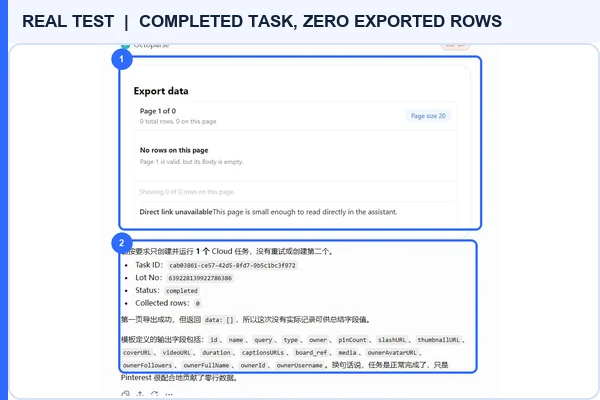
The MCP tool chain completed and reached the export step, but the exported body contained no Pinterest rows.
This negative result verifies authorization, tool discovery, task creation, execution, status reporting, and export access. It cannot establish data accuracy because there were no rows to inspect. Until the difference from the successful Template run is reproducible, describe MCP as a connected workflow, not a guaranteed extraction shortcut.
When should you use the Octoparse desktop client?
Use the Octoparse desktop client when no suitable cloud Template exists or the page needs custom clicks, scrolling, field selection, pagination, or interaction rules.
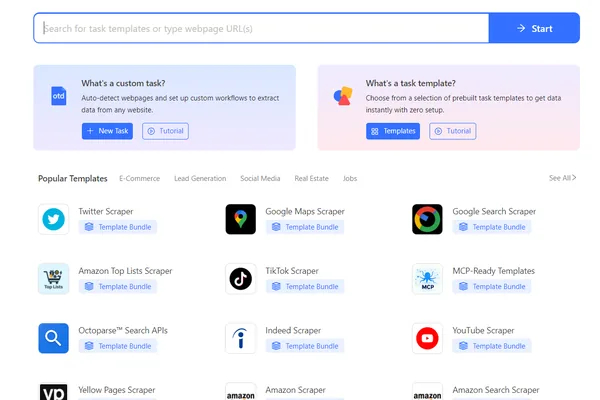
The desktop home screen separates ready-made Templates from Custom Tasks, so you can try the lower-setup route first.
A desktop Custom Task usually follows five steps: enter permitted URLs, select visible fields, configure required actions, run a small local test, and inspect the result before export. Pinterest-style feeds may also require careful infinite-scroll handling. The desktop route provides more control, but page changes can require workflow maintenance.
Do not add Pinterest login credentials or cookies merely to make a workflow run. Stop and confirm the access basis before introducing an authenticated session.
Which Pinterest fields should you validate before export?
Pinterest fields should remain candidates until the tested page and workflow return them correctly.
| Candidate field | Validation question | Do not assume |
| Pin name or title | Does it match the linked Pin? | Every Pin has a complete visible title |
| Pin URL | Does it resolve to the intended canonical Pin? | Locale and redirected URLs are identical |
| Image URL | Does it load and match the Pin? | It is the original-resolution asset |
| Owner name and ID | Do both values refer to the same profile? | A display name is a stable identifier |
| Board reference | Is the Pin actually attached to that board? | Every search result exposes a board |
| Destination URL | Does the Pin expose an outbound destination? | Every Pin contains an external link |
| Query | Does it preserve the originating search? | One Pin appears under only one query |
Deduplicate with a stable identifier or normalized canonical Pin URL. Keep the query as provenance because the same Pin may appear in multiple searches.
For recurring jobs, record missing-field rates and duplicate rates after every run. This data-quality guide provides a broader validation framework.
What usually causes a Pinterest scraper to return no data?
A zero-row result can come from several layers, so diagnose the workflow in order.
- The Template input is wrong: Re-read the live input schema and use source option keys rather than display labels.
- The page type is unsupported: A keyword-search Template may not accept every board or profile URL.
- The task started but extraction failed: Task acceptance confirms orchestration, not usable rows.
- The export was requested too early: Follow the returned retry interval and reuse the same task ID.
- Pinterest changed the page: Re-run a small console test and compare the current Template update date.
- Authentication is required: Stop and check whether the workflow is permitted before using a session or cookies.
- Results are incomplete or duplicated: Validate rendering, locale, canonical URLs, and the originating query.
The cleanest diagnostic sequence is Template console first, then API, then MCP. This isolates extraction from automation. If the Template itself returns no rows, adding another interface only hides the original problem.
How does scraping compare with the official Pinterest API?
The official Pinterest API and a Pinterest scraper serve different access models. The API is the first option when its endpoints and permissions cover an authorized application or business workflow. It provides structured responses and platform-defined access.
A scraper works with information rendered in a page interface. It may support permitted research that the official API does not expose, but it requires more validation and maintenance. Dynamic layouts, login requirements, and page changes can affect output.
Choose based on authorization and required data, not convenience alone. Prefer the official API or an account-controlled export when either route meets the use case.
Is it allowed to scrape Pinterest?
Whether a Pinterest data workflow is permitted depends on the access method, data, purpose, applicable law, and current platform rules. Public visibility alone should not be treated as automatic permission for automated collection.
Pinterest’s current Terms of Service restrict unauthorized scraping, collection, searching, copying, or other automated access. Review the terms and any developer policies that apply to the project.
Collect only the fields needed for a legitimate purpose. Avoid private or sensitive data, respect intellectual property, secure stored results, and delete data when it is no longer required. Seek qualified legal advice for high-risk, regulated, or commercial processing. This article explains technical workflows, not legal advice.
What can you do with validated Pinterest data?
Once the dataset passes field and permission checks, structured Pinterest data can support several workflows:
- Creative research: Group recurring visual themes, formats, and language by query.
- Trend monitoring: Compare the appearance of topics across scheduled, like-for-like searches.
- Content planning: Review titles, owners, boards, and destinations before developing a brief.
- Link analysis: Identify which destinations appear in Pins related to a defined topic.
- Dataset QA: Measure missing fields, duplicate URLs, and result-type drift across runs.
Avoid treating popularity or search placement as a controlled measure of demand unless the data collection method and ranking context support that conclusion.
FAQs about Pinterest scraper
- Can I scrape Pinterest without coding?
Yes. Enter a result type, query, and row limit in the ready-made Template, then validate the Data List. Use a Custom Task only when the Template cannot represent the page interaction.
- Is there an Octoparse Pinterest Template?
Yes. Pinterest Search Scraper was verified on August 20, 2026 for Pins, Videos, and Boards. Recheck the live page because inputs, fields, pricing, and behavior can change.
- Can the Octoparse API scrape Pinterest?
It can discover and execute a supported cloud Template. In this test, discovery and task creation succeeded, but export returned no rows. Validate the query in the Template console first.
- Can Octoparse MCP run a Pinterest scraper from ChatGPT?
Yes, when ChatGPT is connected and the Template supports cloud execution. The real test reached export but returned zero rows, so test connectivity and extraction separately.
- What is the difference between a Template, API, and MCP?
A Template contains extraction logic. The API runs it through structured requests; MCP lets an AI client call it conversationally. Both depend on a functioning compatible task.
- Can a Pinterest scraper collect image URLs?
A workflow may return image URLs when the page renders them. Verify each URL, Pin match, and resolution; the image crawler tutorial explains full-size and thumbnail differences. A URL does not grant reuse rights.
- Why did the Template return rows while MCP returned none?
The runs used different execution contexts. Parameters, timing, Template revisions, or tool behavior may explain the gap; current evidence does not isolate one cause.
- Do I need to log in to Pinterest?
Not for the verified public keyword test. If a page requests authentication, stop and review permissions, terms, and data scope before introducing a session.
- Is Pinterest scraping legal?
There is no universal answer. Permission depends on the method, data, purpose, jurisdiction, contracts, and current rules. Prefer approved APIs or account exports when possible and seek advice for material risk.
Start with one small, reproducible Pinterest query
Start with the Octoparse Template library, one broad keyword, and a 20-row limit. Validate five rows before adding automation. Use API for programmatic pipelines, MCP for an AI-driven interface, or Desktop when the Template cannot represent the page. Keep the query, test date, task ID, and validation notes with every production dataset.
Create an Octoparse account when you are ready to test the lowest-setup supported route.