

Healthcare systems generate oceans of data, but it’s rarely easy to use. Here’s where things get messy:
- Patient conversations live in forums, social-media posts, doctor-review sites, not neatly in spreadsheets.
- Treatment outcomes hide in PDFs, HTML tables, image-based charts instead of standardized databases.
- Hospital benchmarks, public-health bulletins, and provider dashboards all follow different formats or update at irregular intervals.
That means if you’re a researcher, data analyst, or provider trying to act on insights, the task becomes: “How do I wrangle this messy data source and turn it into clean, structured input?”
The Challenge Healthcare Industry Faces
Healthcare providers face complex challenges in today’s data-driven environment. The ability to harness reliable, up-to-date information can directly impact patient outcomes. Data can help providers answer critical questions like these:
1. Which patient concerns deserve the most attention?
In 2023, the Mayo Clinic found that nearly 25% of chronic pain patients never reported their full symptoms during visits — not because doctors didn’t ask, but because patients felt rushed, embarrassed, or unsure what counted as relevant. Yet those “unspoken” details — fatigue, sleep loss, anxiety — are what shape daily quality of life.
Where do those missing details go? Online.
A study in JMIR Public Health analyzed over 1 thousand posts from Reddit’s r/IBD and patient forums.
It highlights that social support groups on the platform provide real-world experience and side effect narratives not found in official medical literature.
Another study from JMIR used over 8 million posts from more than 300,000 users on Twitter to analyze real-world patient-reported side effects of antidepressants. It found many adverse effects (including sleep issues, weight changes, eating patterns, pain, and sexual problems) were discussed in greater detail and frequency on social media than in official clinical trial reports.
Determining the most prevalent and impactful issues patients face helps providers strategically allocate limited funds, staffing, and intervention programs. However, traditionally collecting data through electronic medical records software and surveys often miss less common but serious conditions that impact the quality of life. Scraping data from reddit and other online discussion forums can uncover these less visible issues and ensure no patient concerns slip through the cracks.
https://www.octoparse.com/template/reddit-post-scraper-by-keywords
2. Which treatments and interventions actually work best in the real world?
Randomized controlled trials are the gold standard for medical evidence, but they’re also narrow by design. They exclude many patient groups and can’t show how treatments perform once patients leave the hospital.
Data scraped from patient reviews and discussion platforms provides the missing half: how treatments actually work in everyday life. When analyzed at scale, this data can flag when a “successful” drug still causes unexpected problems, or when alternative therapies are quietly outperforming expectations.
3. Which patient characteristics or social factors indicate higher risk?
A patient’s health is shaped as much by environment and behavior as by biology. Income, air quality, nutrition, even commute distance — these are social determinants of health that influence who gets sick and who stays well.
Traditional health records rarely capture this context. But by combining publicly available data from housing, employment, and community sources, providers can pinpoint which populations face higher risk and why — enabling targeted, preventive care instead of reactive treatment.
When providers close these data gaps, they stop guessing. They can see patterns earlier, test what works faster, and deliver care that reflects the real lives of patients.
How Data Can Help Address These Challenges
1. Improve and precisely target interventions
By analyzing data about the most common health concerns and high-risk patient groups, providers gain a holistic, up-to-date view of population needs.
This facilitates shifting resources towards interventions that target the areas of greatest impact rather than a one-size-fits-all approach. Web scraped data continuously reveals evolving health issues that require a responsive, nimble focus of provider efforts.
2. Discover truly effective treatments
Anonymized firsthand reports and discussions harvested from patient forums, reviews and social media can uncover which treatments patients actually find most effective in the real world.
This supplemental data can indicate when traditional treatments are falling short and which newer options show the most promise. Providers gain a perspective that goes beyond controlled trials to reflect patient experiences in everyday life.
3. Facilitate early interventions for at-risk groups
Access to data on social determinants of health and patient characteristics correlated with higher risk empowers providers to proactively identify and support at-risk populations.
Web-scraped insights into factors like income, environment, behaviors, and access to necessities reveal which patient demographics may benefit most from enhanced interventions and management.
4. Coordinate patient care
By aggregating longitudinal patient data across multiple providers, stakeholders gain a more holistic view of patients’ medical history, social needs, and strategies that have – or have not – previously worked.
This facilitates improved communication and team-based care focused on the whole patient. Data-sharing platforms powered by web-scraped insights and tools like urgent care EMR systems enable higher quality, synchronized care.
Together, these factors show how health data gathered ethically from online sources can meaningfully transform providers’ ability to address key challenges, target interventions precisely, and ultimately improve outcomes at population and individual patient levels.
Four Steps to Extract Healthcare Data With Octoparse
To collect such a huge amount of data for medical analysis, you need a proper web scraping tool.
Octoparse can be your first choice since it’s web scraping for anyone regardless of coding skills. You can pull data from diverse types of websites with clicks and get structured data files with its help.
Download Octoparse and sign up for a free trial. Then you can log in to unlock the powerful features of Octoparse.
By following the steps below, you can instantly start your medical data collecting project.
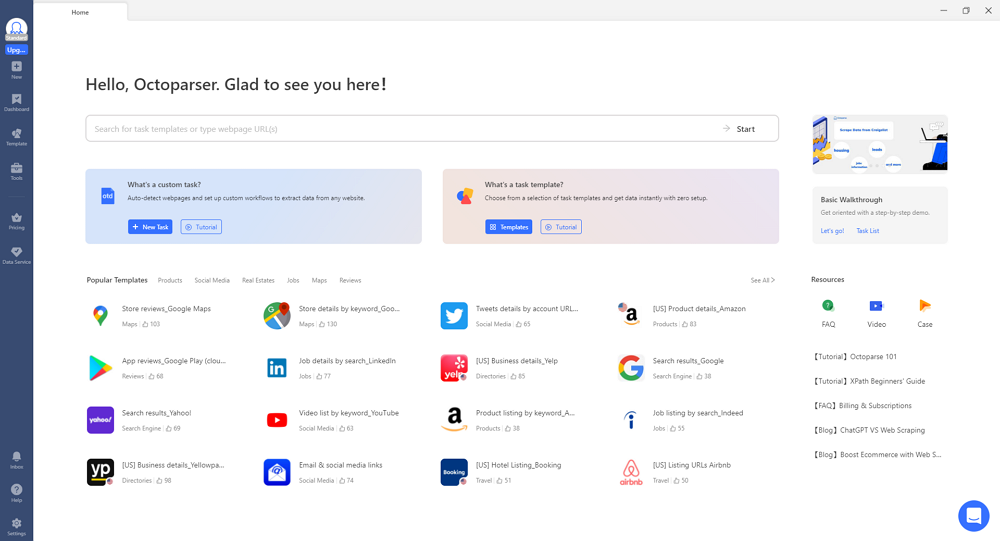
Step 1: Find the target website and create a new task
First you need to find websites with the healthcare data you need. Look for medical forums, health news sites, hospital websites, databases, etc. that contain information relevant to your goals.
Copy the URL of the webpage, and paste it into the search bar on Octoparse. Click on “New Task” to create a new scraping task.
Step 2: Select the data you want to scrape
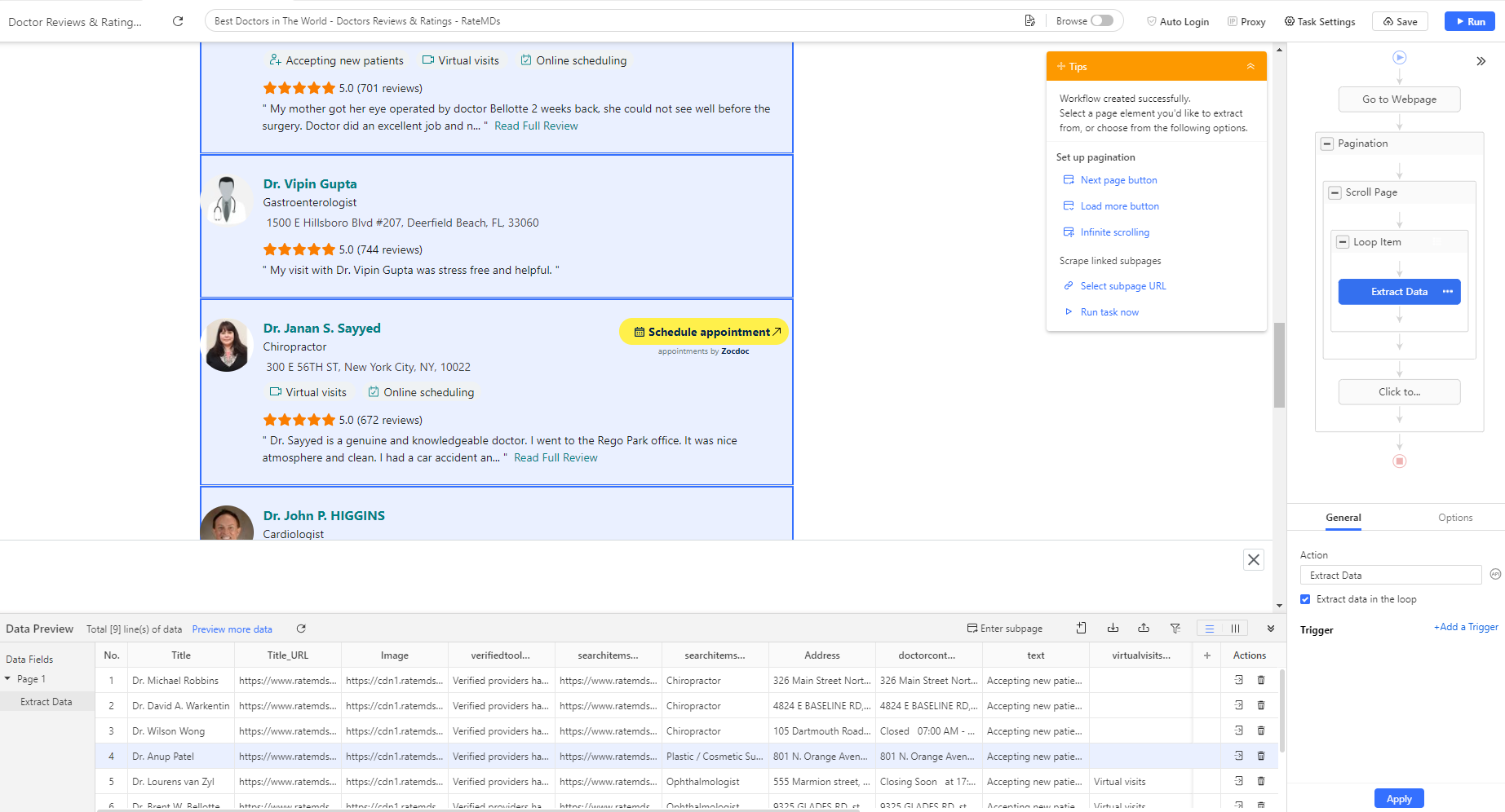
Once the website has loaded in the Octoparse’s built-in browser, click on “Auto-detect webpage data” in the Tips panel.
(Here I used Octoparse to auto detecting data to scrape on DoctorReviews)
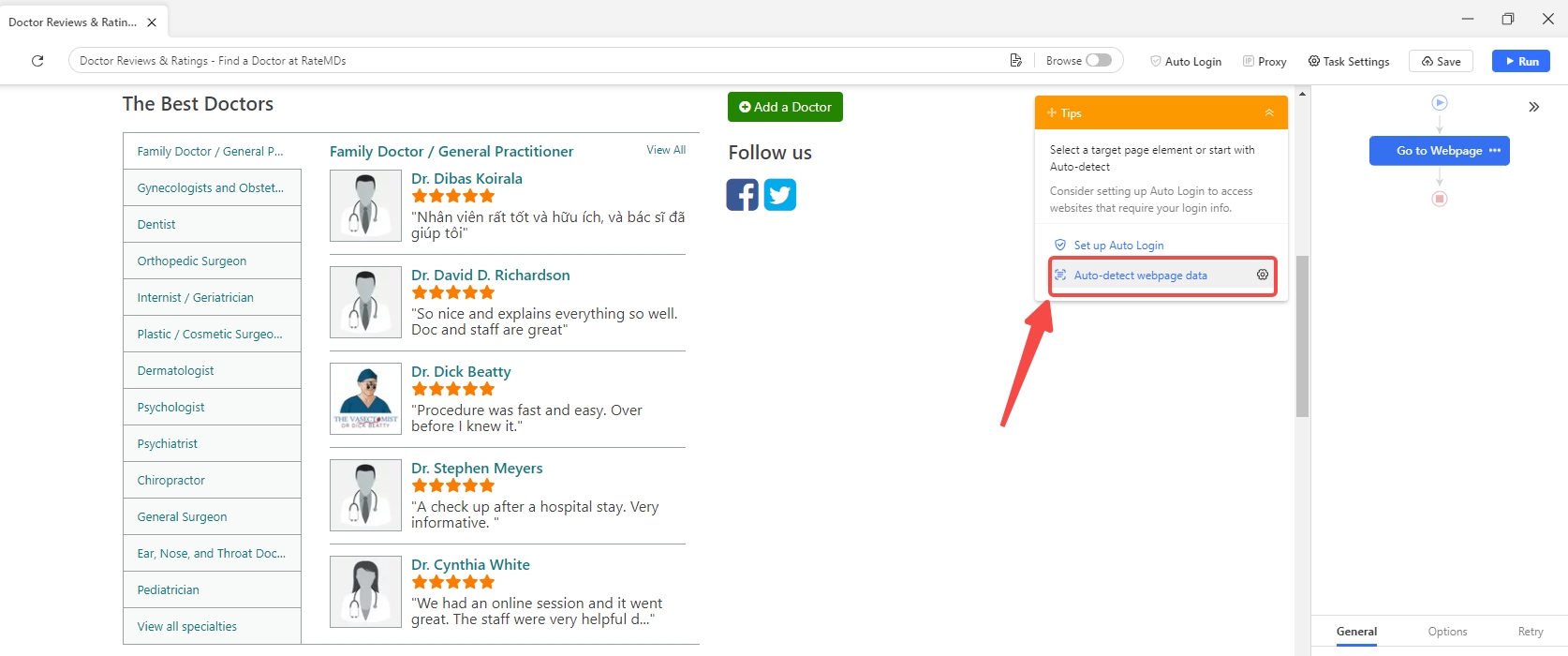
Then Octoparse will then scan the website and highlight any extractable data for you. You can check all the selected data fields in the Data Preview Panel at the bottom, and remove and rename the fields there as you need.
Step 3: Create the scraper
Click “Create workflow” to generate a flowchart of your medical data scraper.
It shows every step of data extraction. You can preview each step by clicking on it to ensure the workflow matches your objectives.
If you run into any issues such as CAPTCHA, IP bans, or even looking for tutorials, feel free to contact our support team for immediate answers.
Step 4: Run the task and export scraped data
Click “Run” to launch the scraper after you’ve double-checked all the details. Now you can choose to run the task on your personal computer or handle it on Octoparse’s cloud servers. After the task is complete, export the scraped data as an Excel/CSV file, JSON, or to a database like Google Sheets.
Octoparse makes it faster and easier to gather this valuable health information from all kinds of websites like youtube, reddit, and social media.
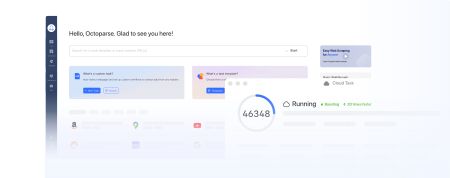
Turn website data into structured Excel, CSV, Google Sheets, and your database directly.
Scrape data easily with auto-detecting functions, no coding skills are required.
Preset scraping templates for hot websites to get data in clicks.
Never get blocked with IP proxies and advanced API.
Cloud service to schedule data scraping at any time you want.
Wrapping Up
Healthcare isn’t short on data; it’s short on the right data, collected from the right places. When done responsibly, web scraping fills that gap. It helps hospitals and researchers hear what patients actually experience, track which treatments work outside the lab, and spot early warning signs from public health discussions long before reports catch up.
The key is doing it ethically — protecting privacy, complying with HIPAA, and using only public, non-sensitive data. Incidents like the Change Healthcare cybersecurity breach are reminders of what’s at stake: medical data must empower, not expose.
With tools like Octoparse, healthcare teams and researchers can gather structured insights safely and efficiently — turning scattered online information into meaningful evidence for better decisions and patient outcomes.